Tragedy does not improve us

America is a series of stories we tell ourselves. Some are true, some were once true, some are ideals which we’ve never particularly honored. The truth of the story has little to do with how important it is to us.

One such story is that we come together during national tragedy, and this refines and improves us as a people. This is seen as our sacrosanct inherent nature. But it’s not true, and it never was.

9/11, of course, is the primary recent example, and many people like to repeat stories from New York City about how people came together after the attack. Less repeated, and less noticed, was how our national unity stemmed primarily from bloodlust and revenge, without much particular concern about whom was in the crosshairs. 63% of Americans thought at one time that Saddam was behind 9/11, but oddly, since he was decapitated by Shi’ite fundamentalists whom we recast as democratic idealists, these people haven’t felt any safer.

Now we’re supposedly bound together in mourning post-Arizona, as if this will be a great national defining moment when we regain our sanity. Today’s twitter stream is replete with newscasters asking, “Have you altered your language? Are you discussing it at your dinner table? How has this changed you?”

Changed us? Psychotic madmen with powerful weapons go on a killing spree on a regular basis here; it’s the automatic result of a country with 320 million people with easy access to guns. You don’t need a Ph.D. in probability to understand that. Six dead would be national headlines regardless; six dead and a brain-damaged Congresswoman makes for lingering headlines. But to say that the national character is changed in January 2011 should be easily disproven no later than July when the Republican attack ads begin to air for 2012.

The engines that refine political division into outright hatred are fed by money and power. There’s too much money in right-wing commentary for anything as minor as a murdered child to slow it down. There’s too much power in right-wing demagoguery for anything as trivial as a disabled Democratic elected official to ablate it. The sole thing that will stop these engines is starving it of fuel, and to do that, we need to shame the supporters and consumers which feed them.

Tragedy does not improve us. It brings out short-term benevolence and largely empty goodwill—I’ve lost count of the number of times I’ve been told to pray for Arizona—at the price of long-term fear and a backlash of savagery. I’m sure that today in many quarters it is being whispered that Giffords brought this on herself by being a traitor to America—and that before long, such sentiment will be spoken aloud by people who couch it in codewords to make it palatable. Already you hear the standard platitudes—that the actions of a deranged individual says nothing about the millions of decent, hardworking Americans who believe that assassinating treasonous liberals would be good for America, if only such things were possible in our society. Surely there can be no connection between the two.

Change is possible in America, but it does not come from tragic events. 9/11’s creation of a Kumbayah Moment did not last, if it ever really existed. Vietnam caused a rejection of the military, followed by a rebound cultural requirement to love our soldiers regardless of their actions or orders. Kent State is forgotten. Pearl Harbor did not cause a near-universal rejection of fascism; the Nazis themselves did that after their actions came to light. The Civil War led to the abolition of slavery—only after over a century of anti-slavery movements, and leading to another century of the repression of people who were once enslaved.

The actions which did lead to lasting social change—abolition, universal suffrage and women’s equality, civil rights, rejection of anti-Semitism, and today’s struggle for gay rights—came from decades of work on the ground by hardworking activists. Community organizers, if you will.

We can become a more peaceful nation. We can return to communal discussion between those who disagree. But we won’t do so without a great deal of work—and not before we recognize the cancers causing our national illness for what they are.

Note: I wrote this a few days ago, before Obama’s speech. I haven’t seen it yet, but already I’ve heard that his key pull-quote is in contradiction to my title. Once I have the chance to watch the speech, I’ll post followup comments if I have any.

Obscure nobodies with guns

Another shooting, and the media are gearing up again to make the shooter the Most Important Man in America. Who is he? What were his political motivations? Is he just a kook?

As always, it doesn’t matter. He was an obscure nobody this morning, and now he’s an obscure nobody who will spend the rest of his life in prison. The celebrity he’s going to briefly enjoy from the profit-driven machines of the mass media is probably one reason why obscure nobodies pick up lethal weaponry and use humans for target practice; it’s a chance for the world to finally reflect what the voices is their heads have been telling them all along.

But that’s not the reason he did this. If he’s mentally unstable, then there is no reason why he did this; it’s beyond reason. If he’s moderately sane—and some sane people are capable of killing people—then we should care about his beliefs only in the aggregate, to prevent future attacks with sociology. He’s lost the opportunity to be treated as an equal in human society, so let’s not encourage the ghouls who seek to understand him on camera. No one seeks to understand the dead who just wanted to go grocery shopping, because in death they drive less viewership.

However, an interesting wrinkle has already shown up on the Internet, so it’s clear how this is going to go for a while. On the one hand, Giffords is a moderate Democrat who was put in the rifle crosshairs of Palin’s infamous target map, and Arizona borders on a state where the losing Senate candidate called for Second Amendment solutions to problems with government. On the other, a Telegraph article was cherry-picked to update Wikipedia with the information that the gunman is a radical liberal.

The same article also says that he’s obsessed with the armageddon of 2012, and his favorite books are Mein Kampf and The Communist Manifesto. That, to me, isn’t a liberal; that’s a man who is neurochemically unhinged and will adhere to whichever political doctrine justifies extremist thinking. The sole source who called him liberal said she knew him in high school four years ago; perhaps then he was reading about the Sixties, and now he prefers the Tea Party. If Marx and Hitler are both on your preferred reading list, your political sensitivities can be expected to swing wildly.

That said: it doesn’t matter. He doesn’t matter. This morning, he did matter as much as any American opinion does, but no longer. But as I expect to hear Glenn Beck et al. talking about his extremist liberal views and love of communism within the next six hours, it’s worth documenting now.

Which leads to another Beck, one Patrick Beck quoted in a Washington Post blog about whether Tea Party activism led to the shooting:

“You have to be very careful what you say. We live in a very polarized environment here in the United States, and while I do believe in the Second Amendment, no one should be referring to Second Aamendment solutions,” said Patrick Beck, president of the Mohave County tea party group in the northern part of the state.

It’s a shame Beck doesn’t believe in the First Amendment like he does in the Second. This is America, dammit. No one has to be careful about what they say. It was wrong when Ari Fleischer said it, it’s wrong now, and it will always be wrong.

However, as Americans, we should also be goddamn responsible for what we say. This is the crucial missing component, when political candidates and other leaders can get away with spewing out the worst kinds of bile, without being called on the carpet for their rhetoric.

I can forgive Palin’s use of the rifle targeting metaphor in her campaign ad, although personally I doubt she’s capable of spelling the word “metaphor” correctly without help. There is nothing metaphorical about “Second Amendment solutions;” that’s a specific call-out to American history, and the only vagueness is exactly what Angle had in mind as its exercise. Writing from Nevada today, I would like to think her supporters are somewhat ashamed of themselves, but I doubt it; if there is any rending of clothing going on, I haven’t observed it.

Macworld: Army gives Jeff a reason to enlist

Army tests iPhone, Android deployment to every soldier

U.S. soldiers may be issued an iPhone alongside their MREs as part of their standard pack in the near future. A program spearheaded by the Army Capabilities Integration Center aims to improve fighting capability, as well as general efficiency, by making smartphones standard issue among both deployed troops and soldiers garrisoned on home bases.

Editorializing: this program impresses me in a number of ways. First, I’m glad to hear that they’re using off-the-shelf tech instead of spending $100 million on private contractors to replicate the wheel. Second, I can only imagine how useful things like virtual overlays and geolocation would be in a combat environment, considering how useful they are to civilians. And third, this strikes me as a genuine way of signaling younger folks that the Army might be their kind of gig.

Macworld: Will 2011 signal a Mac virus onslaught? Not so fast

I’m very chuffed that this article has already been retweeted over 100 times in the last few hours. It’d be nice if it made some headway against the Common Wisdom that I see quoted so often.

Is it really true that it’s only a matter of time before Macintosh users are under siege by a flood of viruses and malware? McAfee announced recently that 2011 would be a bad year for people using Apple computers, as hackers will be increasingly attracted by growing Mac market share. It’s not at all hard to find experts who agree.

The thing is, they also agreed back on July 18, 2010, June 17, 2010, April 9, 2008, and October 20, 2006, among many other dates in the past which I didn’t bother excavating from Google. Remember that horrible Christmas of 2006, when all of your Macs broke simultaneously?

Me neither.

I need more ears

Macworld: Jays to release stylish, midrange earbuds in U.S.

I like the way these things look, but damned if I can figure out why some rubber earbud headphones vary so much in price, when the sound quality is so highly subjective. I’m currently using a $40 pair of Scosche earbuds I picked up at the Apple Store—annoyed that they needed a repair very quickly, but sound and mic quality both seem to be pretty good.

Taking cheap shots at Samsung

Macworld: Samsung unveils new, small color printers

I enjoyed writing these turns of phrase:

Polymerized Chemical Toner may sound like the next head-to-head battle in Congress over environmental pollution, but it’s actually the technology in Samsung’s upcoming line of laser printers…. [$199] might be a good price for polymerized chemicals, but it’s hard to tell, as that phrase is about as specific as marketing your white bread as produced using Endothermic Infrared Radiation Transfer.

Scenes from a nascent police state

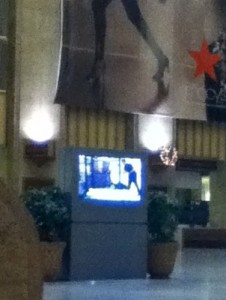
Blogging from 30th Street Station in Philadelphia on Christmas night, where I had, until recently, a fine view of the 24-7 video on infinite loop extolling the virtues of a police state.

The video isn’t all bad: parts of it include very valuable instruction on what to do in case of emergency. This kind of priming — giving real information to people about how to handle a crisis — is a crucial part of civilian training. But the rest of it, in which viewers are encouraged to report “suspicious behavior” while leaving it open exactly what this means, and telling everyone to put Amtrak police phone numbers in their cell phones (really? they want that many calls?), overall does more to heighten anxiety and blunt the valuable messaging that worked its way in there.

So I’m sitting by the power outlet, watching the video and composing this post in my head, when an Amtrak policeman stopped by and questioned me. What train was I waiting for? Okay. I have to pack up my things and move away from the wall; I’m not allowed to sit next to the only power outlets in the station. Then he moved on to the next guy, who was doing exactly the same thing.

Really, that’s all I need to say about the state of our security. On the one hand, smiling happy videos telling us about how the exquisitely trained police are acting solely to protect us. On the other, the actual police officer enforcing a rule which doesn’t seem to make much sense, when maybe a dozen people are using a space designed to hold a thousand.

Or perhaps charging a laptop is a suspicious activity? Lord knows, I wouldn’t want to cause trouble. Yes sir, Mister Officer. I’ll move along quietly. Maybe I’ll move to a seat where I can watch that video until I feel better.

TSA deems thermos as a weapon

God help us when they figure out that urine is an ingredient of gunpowder.

During the busiest travel season of the year, travelers carrying thermoses or beverage cups – which could be used to conceal explosive materials – may be subject to extra scrutiny.—Christian Science Monitor

Plus, they’re unbreakable. They must be dangerous.

Dear TSA: liquid explosives have been debunked. Plastic explosives can be carried in many containers, including stomachs and recta. Dayenu already.

JeffMedia: Mastering Gamification

I truly enjoyed this talk on applying game design principles to real-world project management:

I’m planning on checking out Gabe Zichermann’s blog, and noting that his Summit conference is conveniently nearby the spacetime coordinates of Macworld, I might pop by as well. My question: what other aspects of life management can benefit from these principles? I’m reminded of the Epic Win iOS app here—a very cool idea which I haven’t played with yet, mainly because it would be a major pain in the ass migrating my current project management system out of the convoluted, dedicated software I’m using to track it. But the two concepts in conjunction raise some interesting thoughts.