A better health care strategy for 2011

For once, can we please fast-forward through the next two years of kabuki theater and actually get some work done?

Now that universal subscription to the health care plan has been thrown out, the next two years are already scripted:

1. Obama will appeal the ruling to the Supreme Court.

2. The Supreme Court will uphold the Virginia ruling.

3. The health care plan will be thrown back into the 2012 election cycle, with both sides licking their chops over how they can turn this to their advantage.

4. Depending upon the results in 2012, one of three things happen:

4a. victorious Republicans repeal it down to smoldering embers.

4b. a mixed Congress and Obama fight it out for another four years, resulting in a further watered-down program.

4c. victorious Democrats inexplicably come up with very similar results to 4b, because that’s what they seem to do.

5. While all this is going on, people will suffer and die needlessly. It’s a high cost to pay for theatrical entertainment.

The problem here is twofold. First, 2014 was already a rather attenuated start date for serious provisions of the bill. The above battle pushes it out to 2020 or so, no matter which side is victorious, because the other side will be able to tie it up endlessly.

Second, the whole premise of the bill is that there are certain economic issues which need to be considered in order for the plan to be good policy. If you want universal health care access, lower overall costs, and minimal additional costs for those who can afford their own insurance, then you must have universal subscription. It’s a simple matter of how insurance works—Benjamin Franklin had this figured out in the 18th century.

The way most countries deal with this problem is to make it governmental. Everyone gets health coverage, and pays for health coverage in the form of “taxes,” not in the form of commercial payments to private for-profit companies. It was the added for-profit loophole that shifted the health care plan smack dab into conflict with the commerce clause—and even I’ll say that yes, there are certainly Constitutional issues if the government has the right to tell you that you must have a commercial interaction with a particular industry.

We all know how this ends: a watered-down compromise which meets the requirements of whichever faction has political momentum. And we all should know that these compromises result in bad policy. Compromise can work when the thing on the table isn’t the apolitical factor that makes the policy worthwhile. This isn’t a question of compromising on core principles; it’s a question of compromising on incorporating reality into your policies. The watering-down of the stimulus bill, by reducing its size and making 1/3rd of its cost non-stimulative, allowed us to endlessly debate Keynesianism and the core question of whether stimulus is good policy. We still don’t have strong data on whether a true Keynesian stimulus, of the size Keynes would have dictated, would have worked.

Ignoring reality is bad. Creating laws which don’t provide good data on whether your core principles are accurate encourages ignoring reality.

There’s an obvious way to avoid all of the above: if the health care debate is going to reopened—and make no mistake, it already has been—then it’s time to revoke the initial concessions made by Obama and the Democratic leadership. We need a loud and influential minority to back single-payer health care, and to start that debate with facts and figures from the decades of real experience and evidence from the countries that have tried it. Such as the US, in the form of Medicare and the VA. The “public option” was a compromise from this starting point. Let’s stop forgetting how many concessions have already been made to create the bad policy we have.

Obama is fighting hard to sell his philosophy of incrementalism. Right now, he’s not doing well. I agree with him that he’s not getting credit for how much he’s accomplished in the last two years—the problem is that it’s not a philosophical question how he accomplished it. If he wants to sell his base on compromise and pragmatism, fine. But when the compromise results in bad policy and ineffectual government—which provides ammunition to an opposition dedicated to creating ineffectual government—then it’s the role of his supporters to say, “No sir. Not this time.”

My biggest disappointment with Obama is that I expected him to know this already. But it appears that he needs a course correction. He wants to chart a path of moderation and compromise. That means that it’s our job on the left—a job we have been spectacularly failing at—to make our case without compromise, because only once we have defined our side of the issue can there be a halfway point from there.

Dennis Kucinich has a proposal which makes this easy: universal access to Medicare. It’s a simple law, easy to state and easy to sell. We need to put this on the agenda, politically and culturally. We are unlikely to win—but our goal isn’t to win. Our goal is to move the middle back into the realm of good policy. That’s not where it is now.


iPhoning part 3/JeffTech review: Clear 4G+ mifi

After all of my recent bitching and moaning about telecommunications services and the gizmos they sell, I’m extremely pleased to turn to the Clear 4G+ mifi review. This is, quite simply, the best-designed gizmo I’ve used in a long time. And I say this in a year when I bought a Retina display iPod touch.

Clear is deploying WiMax service for their 4G coverage, which makes them the odd man out in the 4G footrace. AT&T and T-Mobile are both using LTE (which, confusingly, will be deployed on their existing GSM and CDMA networks, so they will not be compatible), while T-Mobile is ramping up HSPA+ on its GSM network. In other words: it’s a highly fragmented market, and when you buy a device, you’re also committing to that carrier.

The Clear service is available under substantially similar terms from Comcast and Sprint, both investors in Clear—but I’ve been a customer of both, and suffice to say, that was good enough reason to buy from Clear. You’ll get different equipment from each provider, even though they all use the same network. Based on my experience, the equipment is another damn good reason to be a Clear customer.

A mifi device picks up a cellular signal and connects it to a wireless router, all in one box. Essentially, when I throw my mifi in my backpack, I become my own hotspot. Most carriers now offer one, nearly all of them on contract—Virgin Mobile being an exception—and almostall of them with stringent restrictions on how much data you can use each month. WiMax is an exception.

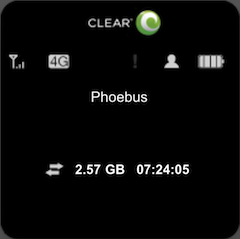
Mifi display showing 2.57 gigs downloaded in 7.5 hours.This screenshot indicates why a data cap doesn’t work for me. This is my usage in one evening; total data usage since I received the device five days ago is a hair shy of nine gigabytes. So I’m approximately using in one day what AT&T will sell me for a month’s usage. Notably, WiMax is fast enough that I’m using it as a replacement for both home Internet service and roaming hotspots—which isn’t possible on any other service at the moment.
The “+” in the “4G+” refers to roaming on Sprint’s 3G network when you’re outside of Clear’s 4G coverage. It also can kick in when you wander into a nook or cranny of a building where one signal is available but not the other; admin settings let you turn off either 4G or 3G, or set 4G to preferred. Clear’s plan includes 5 gigs a month of 3G data, which means that I’ll be cutting back on podcast downloads and streaming media when I’m outside 4G range—a good idea anyway, as 3G ain’t the fastest pipe.

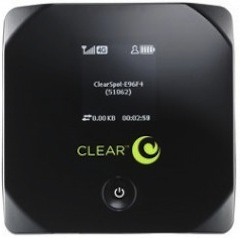
Front face of the Clear mifi, with LCD display.The mifi has an LCD screen showing crucial connection data; you may note that the screenshot above looks very similar. That’s because it includes a web server which displays the LCD information live in a browser, which works perfectly on an iPod touch. With the mifi in my backpack, I can check to make sure I’m on 4G before catching up on the next Netflix episode of Doctor Who.

Battery life is an issue; I get about 3 hours off of a charge. But in a winning move, the included charger is also a USB cable, so I can power it off of wall sockets, my laptop, or any portable gizmo which can provide USB power. In a second winning move, the mifi uses a standard battery size, so purchasing a few third-party extras and tossing them in my bag is easy (online; these aren’t stocked at CVS). Plug the mifi into laptop USB power, and a disk will mount in case you want to install Mac or Windows USB drivers, after which you can power down the wifi antenna if you want to lock up for security’s sake. The thing even includes a microSD slot—for reasons I can’t quite fathom.

4G speeds have been phenomenal by cellular standards, and decently fast by home wireless standards. It regularly kicks the ass of Starbucks wifi by 3:1, and by far more when it’s crowded. Spot check from my iPod: 1.56 Mbps down, 0.84 Mbps up, 363ms ping latency. (Which was happening while my MacBook was sharing the connection and downloading podcasts.)

Pricing: extremely decent. $55 a month for unlimited 4G and capped 3G service; $9 a month for modem lease. I’m on a contract, but the cancellation fee is only $40—compare that to the $350 outright purchase price of the mifi, and it’s quite a deal. Beyond that, though, this is the first mobile gizmo I’ve used in years that I can see myself using for two years straight.

Clear 4G+ mifi
5 out of 5

I have minor quibbles, but I didn’t think ahead to creating a 4.75 ‘bucks graphic. I wish there were a more obvious alarm when 3G kicks in, especially when using lots of bandwidth. Clear doesn’t shut off the 3G when you exceed 5 gigs, it just sends you a honking large bill. If and when I get close to my monthly allotment (which isn’t directly measurable, unfortunately, but the mifi does have a lifetime counter), I’ll shut off the 3G entirely just in case. But this could be a bit more elegant.

Clear 4G service (to date)
4 out of 5

I’ve yet to kick the tires on 3G roaming, but will probably do so next week. Very happy with their 4G coverage; I’ll be in at least five cities in the next two months, and 4G is in four of them. (Notable exception: New York City.) $55 ain’t schlect, but it’s very competitive with home Internet costs, and highly competitive when used to replace home and mobile Internet costs. Worst offenses: no online meter of 3G usage, and no way to tell them, AFAIK, to turn off the service when I hit my cap. Makes me nervous… but I’ve used all of 20 megs so far when out of 4G range in DC, so I’m not too concerned.

iPhoning Interlude: Breaking Up Is Hard to Do

I’ve been fascinated for years about human-computer interaction; specifically, how we tend to anthropomorphize our most-used (perhaps most-loved?) technologies. I’m sure I’m not the only person who feels something akin to physical illness when my primary computer is in mid-crash, or the only person who has recurring nightmares about accidentally leaving my MacBook in a taxi or on a bus and watching it pull away.

I make no bones about my affection for my computer. I’ve been living an aggressively digital life since the late 1980s, and a large portion of what I do in real life has always been funneled through my computer—as I’ve said before, it’s where most of my friends live. But it’s weird what happens when I buy a new laptop; my emotional attachment gets transferred from old to new along with the data on the hard drive. Until then, the new computer is just a shiny new toy; afterwards, the old computer—the one I’ve been having nightmares about—is just another appliance.

But I don’t feel the same way about my backup drive, which holds the same information. It’s not just the collection of 128,849,018,880 bytes of data itself—it’s making them all actionable that creates the sense of genuine affection.

All of this is said by way of introduction to a strange experience I had yesterday.

Virgin Mobile is a rather quirky company, or at least, one that puts a lot of effort into appearing quirky. One of these quirks is the splash screen that appears when you start up any of their phones:

"Hello"

It’s not the most friendly font (which I’m approximating here because I can’t find a picture of it online), but there’s definitely a “Welcome to Macintosh” kind of vibe going on. It might be noted in passing that I almost never turn my cell phone off, preferring instead to just run it into the ground until the battery dies and the cell phone goes t’poof.

So yesterday I was packing up the Virgin Kyocera Loft to return it to the store, due to a laundry list of issues which led me to savage the phone earlier. Standard procedure: fricassee its brain with a systemwide reset to wipe out my personal data. Put it back together in the original packaging so the store doesn’t argue about the return. I was just closing up the box when I realized I had neglected to power the phone down. So I did.

And it said:

Bye

I’m sure I’ve seen that before; I just never really noticed it. But this time, it struck me. That’s not a font that you would normally associate with a broken-hearted, plaintive tone of voice, but that’s how I heard it in my head. I actually hesitated before closing the box.

That message… it made me feel sad. Writing this now, I feel sad again. That’s silly. Ridiculous. I owned that phone for all of three weeks. I rarely used it. I disliked nearly everything about it.

And somewhere in the limbic portions of my brain, that parting message gave me the impression that it was apologetic and remorseful for letting me down the way it had.

Like I said, it was a strange experience. I’d love to know what it is about that phone that gave it more personality than a toaster, because I sure wasn’t feeling it while I was working with it.

And, Loft, if it makes you feel any better—my next relationship with the Pantech Link? Even worse. After a one-night stand, I’m already regretting it.

A few thoughts on WikiLeaks

There are a lot of silly things being said about WikiLeaks in the media, primarily parroting the official US government line. Some quick rebuttals:

  1. WikiLeaks is revealing dangerous secrets. Like Daniel Ellsberg said 35 years ago, it’s not a secret in Cambodia that we were bombing them, it was only a secret in America. WikiLeaks does not have a vast espionage network; it provides a central dropbox for whistleblowers. Vast espionage networks, presumably, have access to any data which is circulated widely enough to reach the whistleblowers; it’s not like Hillary Clinton is the source for these documents.
  2. WikiLeaks is endangering Americans. Best refuted by the same Daniel Ellsberg on Democracy Now!. If there’s a specific danger, it hasn’t risen to the point where the military has warned any servicepeople about it. If there’s a generalized danger, it’s entirely unclear what this is. Mike Mullen is claiming all sorts of generalized danger from data-mining the archive—which is a) exceedingly vague, b) omits the point that large stacks of hay make it harder, not easier, to find needles, and c) ignores the fact that WikiLeaks is not dumping everything it has in one fell swoop to the public—which it certainly could do.
  3. Our government should control what remains secret. In general, yes—no one, including Julian Assange, disagrees with the right to privacy for personal issues. Governmental secrecy, however, is another matter, and there is no separation of powers between those deciding what is secret, and those who are protected from legitimate public reaction by it. There is also a strong public interest in knowing that our Two Wars model in Iraq and Afghanistan is a misnomer; the proper number is four, including Pakistan and—thanks to WikiLeaks—Yemen. I think there’s a clear public good in knowing which countries we’re committing acts of war against; this is the principle behind the First Amendment.

This is not to say that WikiLeaks is a perfect organization—far from it—or that I am 100% in agreement with Julian Assange. I’m particularly concerned about the rape charges leveled against him in Sweden, and I’m hoping to hear that they were trumped up for political reasons. I know nothing about the case beyond what I read in the mass media; I merely note that a sex crime charge is the perfect way to discredit him among the kind of people who would otherwise support his efforts. If he is found guilty, I’d prefer to not see the message tarred by ad hominem attacks on the messenger; far easier for the cause if he is not a sex criminal.

Whether he’s a criminal on the basis of his WikiLeaks work, though, remains up for debate. But we should note the double standard: Western nations are strongly in favor of transparency of government for all other nations as a guiding principle. The leaked documents show that our own government, and many of our allies, are not living up to this ideal. I would be quicker to defend the right of the government to stamp Top Secret on a document if there weren’t such a long string of examples showing that they do this to facilitate actions ranging from avoiding embarrassment to breaking their own laws when it’s convenient.

A few resources:

Steve Aftergood at the Federation of American Scientists has been tracking governmental secrecy issues for decades—and no, we do not agree on all points. Start with his blog, then jump into the archive.

When details come out to the public about how these documents were made available to the whistleblowers, and how they were moved to WikiLeaks, the first guy to read will be Bruce Schneier.

Finally—it should be a citizenship requirement that every American must watch the 2009 documentary, The Most Dangerous Man in America, about Ellsberg and the Pentagon Papers. I thought I knew this story—I was wrong. It was far worse than I learned in grad school.

iPhoning the iPod touch, part 2: Replacing the Backup

I haven’t been an AT&T customer for nearly ten years, so having purchased one of their prepaid phones, I have to say, I am utterly stunned by their phenomenal efficiency.

It took AT&T less than three minutes to infuriate me and make me wish I never got suckered by them. Maybe that’s too strong—I’ll know more after I actually start using the service. But my initial impression is: run away, run far far away!

Recapping part 1: I am setting up my iPod touch with a mifi device to use it as a primary cell phone and infotainment device. It seems prudent, since that solution relies on no less than four or five different hardware and software services (details to come later), to have a secondary cell phone in place for plain old phone calls. And GPS. And maybe Google Maps. Perhaps some light web browsing. You know, the basics.

I chose AT&T for the following reasons:

1) Primarily, it’s because the Clear mifi uses WiMax in its 4G coverage area, and roams on the Sprint network everywhere else. That’s CDMA, so I should also get coverage on Verizon networks where Sprint has network sharing in place. AT&T uses GSM, so that gives me access to AT&T and T-Mobile towers. Toss in wifi, and I’m pretty much set up to use any current wireless telecom standard on Earth.

2) AT&T offers a $2-per-day unlimited text-and-voice plan, only on days that you use it. I can go a week without using my cell phone on general principles, and that was when it was my primary phone. So that made sense to me over T-Mobile’s $30-a-month (and up) plans.

(Add to this that while T-Mobile still offers the “Even More Plus” plans, they’ve decided to take it off their website and replace them with a completely different set of parallel prepaid plans. So if you want to become a T-Mobile customer, you have to know the secret handshake, rather than just research online what they’re willing to sell you. Annoying.)

3) AT&T is currently offering a refurbed Pantech Link phone, knocking the no-contract price down from $160 to $30. Thirty bucks? No-brainer. (Although most of their other refurbs are only $20 off the original price, so one wonders how many Links are in their refurb supply chain, and just how they all got there.)

Sounds great, right? Except that it turns out to suck.

T’Poof

Both Ts in AT&T stand for t’poof—the T is silent. T’poof is a Vulcan expletive which loosely translates as “bend over and grab your ankles,” but its common usage is remarkably similar to its English homonym.

AT&T data plans: 1 meg per month for $5, 100 megs per month for $20.

I started with the data plan because it’s the A-number-one way that the phone can be useful even when I’m in a WiMax or Sprint coverage area. The Link has GPS; the iPod touch doesn’t. GPS won’t do diddly without a data plan to download the maps. I’ve generally been pretty happy with wifi-based geolocation, but c’mon—one technology talks to frickin’ satellites and requires relativistic calculations to work at all, and the other one merely relies on a fantastically complex map of all wifi hotspots in the world. I mean, both are amazingly cool… but satellites and relativity? Sheesh. No question which one is more Star Trek.

But look closely at the data plans that AT&T offers. Five bucks gets you… a megabyte. A frickin’ megabyte. And if you don’t use it in 30 days, you lose it. T’poof. Gone.

Twenty bucks gets you 100 megabytes, which sounds much more reasonable—which is to say, it’s still a buttload of money for that teaspoon of data, but 100 megs sounds like enough data to be husbanded for a month. The problem: it also expires in 30 days.

Keep in mind that two days ago I had a Virgin plan for $25 a month with unlimited 3G data, text, and 300 minutes. I dumped it to avoid paying any regular monthly fee. But with these “offers” from AT&T, I’m looking at probably shelling out about the same amount of money, on a monthly basis, for far less service. I had figured I’d toss 100 megs on the phone and just use it as needed. Nope. My data goes t’poof too quickly.

Which leads us to the second way that AT&T sucks. The standard way these prepaid phones work, you toss some money into the account, and then you use that money as a debit account from which you purchase services or pay-as-you-go options. I.e., with no plan in place, it’s 10¢ a minute for calls, and 1¢ per kilobyte of data. Let me repeat that: 1¢ per kilobyte. Phrased in 21st century terminology—since I haven’t thought in kilobytes since 1988—that’s $10,485.76 for one gigabyte of data.

You can buy cards at any CVS or 7-11 to add funds to your account, or you can go online and use plastic. Here are the terms for that:

AT&T cash refills: $100, $75, $60, $50, $25, and $15. $15 expires in 30 days; everything below $100 expires in 90 days.

See that third column? Your money expires. Put funds in the account without using them—say, for instance, you’re using a $2-a-day plan and you don’t want to think about it—and your frickin’ money expires. There’s an unwritten rule: folks who sell debit cards—be it a prepaid phone, a Starbucks card, or gifted plastic—can screw you up the posterior with fees or what have you, but money doesn’t expire. Money is money. Services expire. Folks who sell debit cards make their profit from having your money between when you buy the card, and when you spend the funds.

Except on AT&T, where money goes t’poof. But it also goes t’fizzle. I put $25 into the account to buy the $20 data plan—more on this in a bit—since I figured I’d probably burn a bunch of data setting up the phone. Then I popped into the web interface on my MacBook to buy the plan… and the only option was to pay an additional $20 for the feature.

Turns out, if you want to buy a data plan with money you’ve already given to AT&T, you need to call their 800 number, talk to Julie the Robot, and she’ll happily debit your account from the money you’ve already given them. But online? Where, say, you can “manage” your account? There, your option is “please hand over your credit card, thanks. That $25 credit you’re seeing, right there onscreen? Pay that no mind.”

Far as I can tell, AT&T just tried to trick me into paying them more money. And really, that’s kind of slimy.

Odd Man Out

Take another look at the payment chart:

AT&T cash refills: $100, $75, $60, $50, $25, and $15. $15 expires in 30 days; everything below $100 expires in 90 days.

Two thoughts come to mind:

1) The services I’m using so far are $20 a month, or $2 a day. $25 isn’t evenly divisible by 2.

2) $15 goes t’poof in 30 days. 15 is less than 20.

So even before we consider the quantum value of money where AT&T is concerned, we have the additional issue that it’s necessary to hand AT&T chunks of money in amounts which are poorly suited for the services they’re offering. It’s sort of like selling a bunch of brightly colored spheres, then requiring you to buy an irregular heptagonal case to carry them in.

Conclusion: AT&T—We Suck Harder!

Let’s return to the original philosophy of this exercise. I’m jumping through hoops because 1) while the iPhone is pretty damn nifty, 2) it’s saddled with AT&T service, and 3) AT&T doesn’t sell unlimited data plans and sticks with 3G (also Apple’s fault, to date), so 4) I’m-a-lookin’ for something more useful.

Sidebar: Yes, I’m aware that Verizon is rumored to get the iPhone in January. Which was made more interesting by the announcement that they’re launching 4G LTE service in December, so one wonders if that theoretical CDMA iPhone also gets LTE. (Addendum 12/2: No.) However, there are several things to keep in mind:

1. I’ve heard this every year since 2005. I’ll believe it when I see Jobs coming down from the mountaintop with his new stone tablets.

2. All of the crappy things that AT&T is doing to the iPhone are practices which were pioneered by Verizon. They’re the worst offenders in the US for crippling their phones—which is precisely why I have happily refused to be their customer since I cut my Bell Atlantic landline in 1996. I expect the fabled Verizon iPhone to be far more larded up with limitations than AT&T’s version.

3. That Verizon iPhone? Two-year contract. Whole point of staying off-contract: so I can switch phones whenever something better comes along. Which is guaranteed to happen when Apple upgrades the iPhone and iPod touch in 2011, if another company doesn’t beat them to it.

What truly sticks in my craw about AT&T’s iPhone plan is that they charge you $20 a month to connect your iPhone’s data to your laptop. There’s no additional data included with that $20 a month; it’s just what you pay for the privilege of doing something which I’ve been doing for free on AT&T, Sprint, and T-Mobile since 1997. Sprint charged $40 for the Phone-As-Modem plan, but that included unlimited data. I don’t mind paying $40 a month; I mind being forced to pay $20 for nothing at all. It’s philosophical.

Then AT&T comes along and offers me a different phone that—what a concept!—gets me interested based on the quality of their offering. Two bucks a day, moderate data—and fuck me gently for not reading the fine print closely enough before buying the phone. I should have known better, simply based on the Death Star logo on the box, that my odds of being satisfied with this were measurable only with electron microscopy.

More shortly when I review the Pantech Link. But my initial impression based on the last few hours: this was a perfectly good phone until it was ass-raped by AT&T. It may take away the crown of Worst Gadget Ever from the Virgin Kyocera Loft. And I strongly suspect that in 30 days or less, my relationship with AT&T is going to go t’poof.

iPhoning the iPod touch, part 1: Philosophy

About 90 seconds after purchasing my iPod touch, I started thinking, “Man, this gizmo just wants to be online 24/7.” So I started making plans to do that.

The normal person reads that paragraph and thinks, “Damn, Jeff, that’s called an iPhone.” But I am not a normal person—and in my opinion AT&T has crippled the iPhone so badly that it’s just not a viable option.

The Criteria

I have a basic philosophy which is currently at odds with the American telecommunications industry: I want to pay for a single, fast, mobile Internet connection, over which I can do anything I damn well please, and to which I can connect any device I like.

This has been available for nearly a decade by knowing your way around various cell phone hacks, most of which were officially unsupported by your cellular provider. “Unsupported” could mean anything from “we don’t mind if you do this” to “we’re going to actively shut you down if we find out.” This is starting to change as more cell phones—notably Android cell phones—ship with built-in cellular-to-Wifi hotspot applications. But it’s still up to the carrier whether they will delete them, support them, or charge extra for their use.

AT&T is notably lagging behind in this regard. You can now (finally) tether your iPhone to a laptop over Bluetooth, but AT&T will charge you $20 for the privilege, without providing you with any extra data over the standard two-gigabyte monthly allotment. This, to my way of thinking, is batshit crazy. (And more crazy is that if you have an iPhone and an iPad, then you need two different AT&T payments.)

These days, if you want “fast,” that’s defined as 4G, and that’s available from Sprint and T-Mobile. Both sell phones with wifi hotspots built-in; I’m especially tempted by the Android MyTouch 4G—$450 without a contract.

Which leads to the second criteria: sell me a service which I want to stick with. Don’t lock me into a two-year contract for your service. Two years? This is Internet time we’re talking about. Two years is a decade.

The Solution

After much evaluation and gnashing of teeth, I settled on a Clear 4G+ mobile mifi hotspot, which uses WiMax service in its 4G coverage area, and shifts back to 3G outside of those zones. I ‘m writing this now from a Barnes and Noble, where my podcasts are merrily downloading at 580 kilobytes per second, despite the 178 Kb/sec cap I’d have if I were using the local wifi (and the fact that on a Saturday night, their wifi is saturated and slow as molasses).

Said mifi happily rides around in a backpack pocket while I’m ambulatory, keeping my iPod touch online at pretty much all times. (Known dead zones: some Metro stations, all Metro tunnels, and the Borders cafe at 18th & L.)

But there were still a bunch of steps necessary to make the setup usable, with iPod apps and some tweaks to both my hardware and telecom plans—so this will be a multipart post.

JeffMedia Review: Banlieue 13 (District B13)

4 out of 5I recently rewatched this 2004 film in preparation for the sequel, which is my current Netflix DVD. Not that you need to watch one to get the other, as these are simple action films where the plot is secondary to the balletic violence.

But damn, this is the best balletic violence I’ve ever seen. Stars David Belle and Cyril Raffaelli are experts in parkour—for those of you unfamiliar, it’s what you saw during the opening chase scene in Quantum of Solace—and they do things in this film which makes you wonder what low-gravity planet they filmed it on.

Beyond that, this is an over-the-top, ridiculous film and it is completely self-aware of this fact. A very enjoyable watch after a long day, no brainpower necessary.

JeffTech Review: Virgin Mobile Kyocera Loft

Virgin Mobile released a decently aggressive plan a few months ago called Beyond Talk: $25 a month for unlimited Internet data and text messaging, 300 voice minutes, and no contract. As most of my calls are going through VOIP these days, this sort of thing is up my alley, so I stopped by a store today to pick up the cheapest of the five phones that are eligible for this deal.

Virgin Mobile advertises the Kyocera Loft as being “Simply Loaded”. After a few hours playing with it, I agree—in much the same way that an infant’s diaper can be described the same way.

Let’s start with the Virgin signup experience. I paid for the first month of service at the point of sale, so I had the Loft’s serial number and a code to add $25 to my Virgin debit account. Tapped the in-phone Activate button to go through the process, but as soon as I asked for a new phone number, the phone told me to go to the website. Which you can’t do from an unactivated phone. So off to the iPod touch and a wireless hotspot.

Signing up on the website was reasonably simple, if I hadn’t been standing outside in front of a Starbucks on a cold night to do it. Chose the plan, declined the insurance, entered the codes, good to go. Until I tried to place a call. Unfortunately, I had only $25 in my account, the recording said, and I had chosen a $25 plan, so I’d have to add an additional zero dollars to my account before I could use the phone. And I was warned that I didn’t have enough money for the insurance I had declined.

Thirty minutes later after a long talk with a nice man with a difficult South Asian accent, I was told to wait four hours and everything would be working. Everything seemed to be working in under five minutes.

Except, of course, the phone.

Picture of the Kyocera LoftThe Kyocera Loft looks like a Blackberry knockoff—it feels cheap and lightweight, which is fine because it is cheap and lightweight. But the keys are scrunched and easy to miss—I’ve owned my iPod touch for all of ten days, and I’m already much faster at the soft keyboard than I am with this phone. You’ll note from the picture that the phone number keys are normal-sized, so dialing out ain’t easy. And since there’s no way to sync your contacts except to pay for it as a subscription service, you’ll be entering a bunch of numbers.

The real problems start when you try to use the phone’s menu, pictured above. That US silhouette might make you think you’re going to the built-in Google Maps. Instead, it takes you to an advertisement for the $5/month Virgin Mobile navigator service. If you want Google Maps, click on the suitcase, then select Apps, then scroll down to Google Maps.

Which is a shame, because GMaps plus the phone’s GPS is the sole winning feature of this device. But while you’re using it, you can’t really call it a “phone”, as your incoming calls won’t ring the phone while you’re using GMaps. You can receive a call while using the Email app—also written in Java and using the data connection—so I have no idea why GMaps bounces calls.

The Loft also comes with the excellent Opera Mini browser, but that’s not what you get if you click on the globe icon. Instead, you get the insanely craptacular Loft browser. To launch Opera, burrow through the same menus—but unlike GMaps, you can’t go into the settings and assign Opera to its own hardware key for convenience. Mah nishtanah ha-Java hazeh? I have no idea.

In fact, most of the main menu, and a fair portion of the submenus, is just ads for other Virgin services. Click on Wallpapers and you can choose one of several backgrounds for the phone (or buy new graphics, which appears to be the only way to load them), but click on Ringtones and all you get is a sales website. This kind of thing is annoying enough when you can avoid it—it’s infuriating when it’s scattered throughout the phone including the top-level choices.

So this puppy is definitely getting returned within the 30-day refund window. There’s no way to get a refund on the $25 service, so as soon as I burn up the 300 minutes, away it goes. The only remaining question is whether the next JeffTech phone review will be a more powerful phone in the Virgin line, or whether I’m going to start nosing through T-Mobile’s options.

Kyocera Loft
1.5 out of 5I can’t imagine who would be happy with this phone. Geek users will rapidly be annoyed with what it can’t do, while novice users will be confounded by 12,000 bits of crapware they don’t need. The half-star over truly execrable comes from Google Maps alone; if you don’t care about incoming calls, this was the only part of the experience I truly enjoyed and found useful.

Virgin Mobile
3.5 out of 5Props to Virgin for aggressive pricing, no contract, and no bullshit. The Loft is a 2G EDGE phone, but email and GMaps with GPS were reasonably quick. (For pedestrian purposes—might be different if you’re driving.) I’m willing to give them another try with a different phone.

Jeff Porten, moblogger?

Toying around with options to try to blog from my iPod touch. For example: following is proof that DC is filled with Very Busy Important People who will gladly wait in line for a free Slurpee.

I will say, though, that the free t-shirt is kinda neat.

(Or, um, not following, as I’ve gotta figure out photo uploads to WordPress first. Anyone with ideas?)