Microsoft’s Dystopian Hellscape, part 2

In the previous installment of this post, I discussed a number of raging errors in Microsoft’s demo of the future, possible only if the designers hold a deep contempt for both their audience and the details included in their HD broadcast. If we take the video at face value, nearly everyone depicted is living a largely joyless, obsessive-compulsive existence. To not take this video at face value, one wonders what kind of management by committee would be necessary to make these kinds of howling mistakes.

For example, a phone call originates at 7:30 AM on April 12th in Johannesburg, and is received on February 19th in Hong Kong. So not only will our future Microsoft Zune iPads have holographic technology, they’ll also be remanufactured out of discarded TARDISes.

In any case, we’re now back to more insane user interfaces, and having already written a few thousand words, I’m caught up to a whole forty seconds into the video.

The Devices, Continued
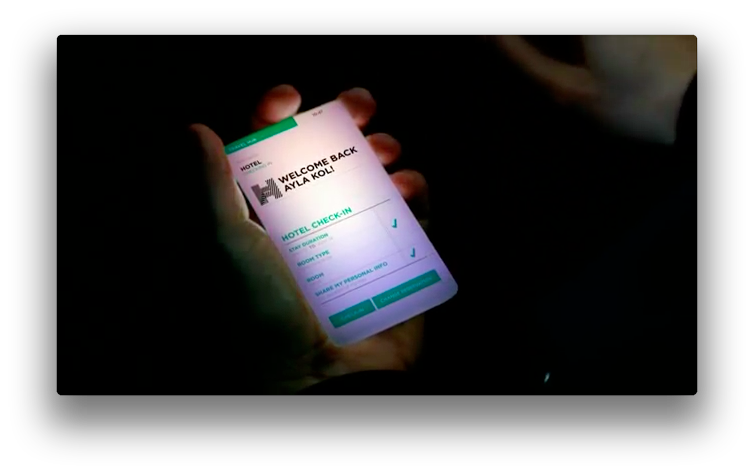
Without referring to the video, what do you suppose the above picture indicates? The text states “Stay Duration”, no check; “Room Type”, check; “Room”, no check; “Share My Personal Info”, check. The Share Info check is blank at first but then appears, presumably in response to a voice command. This immediately precedes Impeccably Tailored Bellhop Assistant looking at his impossible business card display.

The problem here is that it’s mixing multiple modes with the same UI. Presumably, the first three items are Ayla’s room preferences. The checks must mean hotel confirmation that she’s received her preference prior to checkin. Or it’s some kind of bizarre personal checklist to confirm that the hotel has kissed her ass appropriately. Or, most likely, it means absolutely nothing at all, because it’s hard to understand how she has her room type confirmed without a room number.

Meanwhile, the last entry is a user control that she can toggle, and it appears with an identical interface in a list of items of a completely different type. This is meant to show us how useful and intuitive Microsoft interfaces will be in 2021.

(You may interrupt at this point to say that I’m being too nitpicky. I’ll remind you that this kind of demonstration is the whole fricking point of the video.)

Cut to our buddy Qin, who had to sacrifice his Sunday afternoon, but at least he didn’t have to stay up all night like that poor bastard Jeff Zheng. Or is that Zeng? Qin’s phone can’t quite decide which it is.
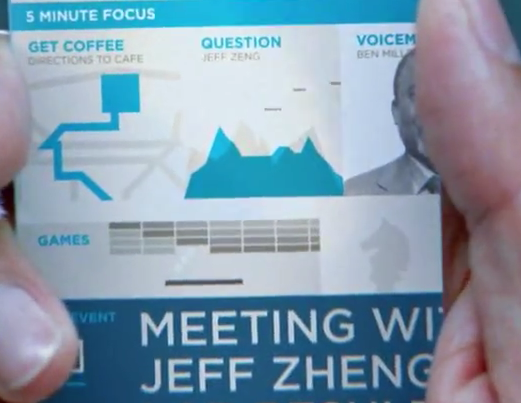
We arrive at this screen as follows: first we see the home screen for this Hong Kong resident standing in a Hong Kong subway station. The top headline of the day: the Senate has passed a new environmental regulation. Either Bing News is having a bad day, or the Chinese government will go through some changes in the next 10 years.

Qin taps on a picture captioned “Social,” which scrolls him to a lower page (not the second page, as the home page is shown to extend in all directions) instead of doing anything social or resembling a button press. Here we find that he has a portal called “five minute focus,” presumably with the things he needs to do in the next five minutes. Again, Microsoft believes this should be on a subpage, not in the primary display.

In the next five minutes, Qin is instructed how to get coffee, presented with an email message with attachments and an IM history, and has an incoming voicemail. Meanwhile, it’s 10:34 AM and his meeting is at 11 AM, so let’s hope that the subway is quick. Of course, nothing about this futuristic interface says anything about travel time or subway arrivals. I guess in the future, everyone in Hong Kong is Jewish and no one cares if you’re late.

The email from Jeff Z(h)eng pops up onscreen without a user request; unlike similar interactions in Ayla’s cab, it’s hard to believe that this is supposed to be a voice command because a) he’s on a crowded subway platform, and b) there’s a goddamn benefit concert going on over his left shoulder. So Microsoft devices apparently decide for you which email you need to read right now. And tell you about someone’s birthday—again in a pop-up with no user input.

This is still labeled “five-minute focus.” Considering how many fucking things we’re expected to get done in five minutes in Microsoft’s future, it really sucks that we’re working 160 hours a week.

Fortunately, Qin is also waiting on some lab results, so with any luck he’s picked up a drug-resistant Asian flu and will get to be bedridden for a long while.

We then get what could be the most bugfuck insane prediction of the video. A voicemail message is transcribed, “Can you approve the order?” A message appears saying “Creating reply interface…,” and Microsoft Bugfuck for Windows Phone with No Windows displays a numeric scroller which Qin uses to change “35” to “40.”
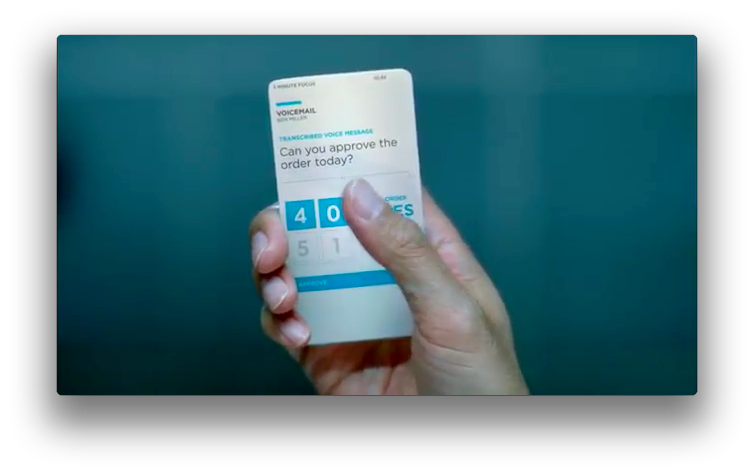
That’s the only interface for a transcribed voice message. Qin can hit an “Approve” or “Place Order” button. He can’t, for example, reply to the message. Or call Ben back. Or take a look at some document indicating whether he’s purchasing 40 liters of potassium nitrate or plutonium. Or cancel the order. About the only thing this advanced user interface allows him to do is to order 80 or 90 liters by mistake when some commuter jostles his arm.

The Environment

Microsoft depicts a future where pretty much any flat object is a display and control surface, and they all instantaneously integrate with the gadgets you’re carrying. In Ayla’s taxi, the window provides a heads-up display showing remarkably worthless information about her trip; in her hotel room, a wallscreen and a tablet apparently included with the hotel room immediately context-switches to whatever she’s doing.

Here she’s picked up the tablet while her back is to the wall; the wall switches from a “good morning Johannesburg” hotel info display to provide her instead with something relating to the work that’s on the tablet.

Of course, the first question is why she needs the tablet at all. The entire fricking table it’s on has the same controls, and presumably they’re all brimming with holograms. The purpose of the tablet appears to be so she can sit on the edge of the bed and use a touch interface, instead of the holograms in the much better wall display, or the much larger table by the window. This places her focus in her lap, which means that anything supplementary that appears on the wall (and presumably her iPod touch) is either intended as a distraction, or is important information that isn’t in her peripheral vision.

Later, a phone call arrives from her daughter, miraculously during the 18.8 seconds of downtime she has available this morning. Ayla, of course, takes the time to pick out a recipe for her, while the wallscreen merrily follows along with supplementary information. At this point, I was expecting her to pull a piece of pie out of the hologram so she could see how the recipes tasted.

Back home in Sydney, a large whiteboard receives the messages Ayla sent to her daughter, as opposed to having them go to Sydney’s dedicated tablet. (The daughter and the city are both named Sydney. Or her name is Shannon. It changes. No, really.) Unnamed Ayla husband is reminded by the AI in his car to schedule a tune-up, which he drags with a smile to his busy schedule. Offscreen, an unnamed mechanic receives a message telling him to reconfigure his entire schedule for His Eminence, because there’s no indication that this scheduling had anything to do with the mechanic’s workload.

Credit where credit is due: the idea that all sorts of display surfaces will configure themselves to your liking is a premise that’s both possible and useful. I’m less sanguine about whether a hotel in 2021 would provide a flatscreen and tablet computer that automatically hosts these services instead of, say, advertising $99 for one day’s Internet connection and a reminder of all of the movies I haven’t seen on pay-per-view. Indeed, the dystopian insanity of having my entire world reconfigured to show me advertisements is the main reason why I think I’d prefer to drop dead before existing in Microsoft’s world.

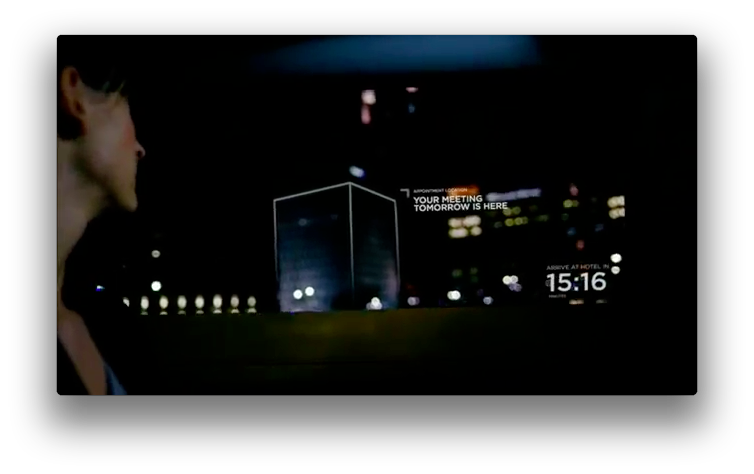
For example, here is the clean, uncluttered view out of a cab window in 2021, according to Microsoft:
And here is the clean, uncluttered view of a Bing search in 2011, according to Microsoft. The highlight indicates the search result.
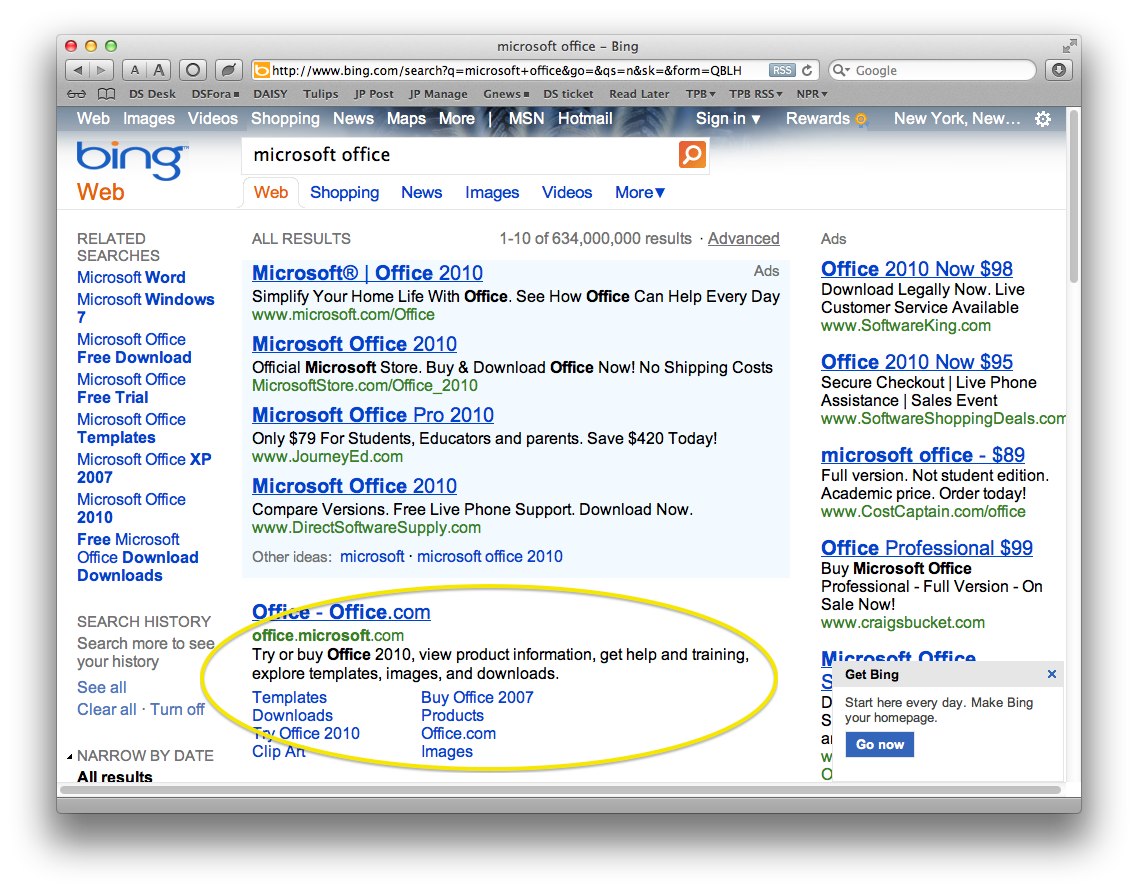
In other words: in the future, the killer app will be a Flash blocker for real life.

Coming next: how a competent designer or futurist would have presented a completely different view of technologies that are not bugfuck insane.

Microsoft’s Dystopian Hellscape, part 1

There’s a meme going around to critique the latest concept video out of Microsoft telling us all how we’re going to live in the future. Gruber points out that, like the 1987 Apple Knowledge Navigator video, this is a corporate exercise in vaporware that says nothing about what the company is developing or any real products. Other critiques mention that the haptic interfaces of the future are clearly fictional, and on top of that, your wife is probably sleeping around.

I’ll point out one other major difference between the Apple Navigator demo and the Microsoft 2011 version: Apple showed me a future that I wanted to live in. (With many flaws, which I’ll come back to in another post.) I was so confused by what this video was depicting that I downloaded the HD version to try to figure out what kind of world Microsoft wants us to live in. We’re supposed to believe that this is a cool vision of the future where computers make our lives easier. It’s not. It’s a dystopian hellscape of despair.

The Culture: Work Schedule

Let’s start with the work culture we’ll be experiencing in the Brave New World of 2021. Ayla, our hero, has just arrived in Johannesburg from Sydney on a Sunday afternoon. She’s arriving at night and we learn later that she only had a 9-hour incoming flight; check Kayak and, hey, turns out she sacrificed her entire weekend for this trip. It’s at least a 24-hour flight, and she had to leave as early as Saturday morning or Friday night. (The only alternative: Qantas flies airplanes that are 44% faster in ten years, and completely changes its arrivals schedule.)

Despite this hellacious trip, Ayla immediately gets down to work in the cab. She’s got “new” messages that arrived in the last few hours, so despite the holographic speeds her Australian data plan achieves while roaming in Africa, her plane didn’t have an Internet connection. Meanwhile, her daughter was awake at 5 AM in Sydney to wish her a safe flight.

It’s 10:34 PM in Jo’burg and Ayla has already reviewed five tasks in the cab. Her colleagues in Hong Kong also work weekends. One sent her an email while she was in the air this afternoon, the other emailed her at 3:30 AM his time. Ayla lets the first guy know that she’ll get to his work first thing, and sets a reminder… which will take place 3 hours after the meeting he needs it for. Apparently futuristic Microsoft devices have trouble with time zones. This might also be why the email was dated Sunday 4/21/2021, which can’t happen.

Something odd happens in the cab; she’s only 15 minutes away from the hotel when her meeting is pointed out, but 15 minutes later the cab says she’s at the hotel when clearly she’s not much further down the same road. The bellhop’s watch says it’s noon in Australia, making it around 4 AM before she gets to her room.

We get to see how technology organizes the work of the bellhop assistant. According to his schedule, he has 15 minutes to stand around looking impeccably tailored, after which eight people (one of whom is handicapped) will need his services in the space of six minutes. That’s some fine AI agenting he’s got there.

Unfortunately, Ayla has set a 7:30 alarm in order to blow that Hong Kong deadline by only three hours, so it’s a good thing she’s a high-powered executive who can fly for 24 hours and then get only 2 hours of sleep. Indeed, by 7:36 AM she’s fully dressed and the bed has not been slept in. Her meeting is scheduled in 84 minutes and is apparently either a 15-minute or a 6-hour drive across town. Oddly, none of her information appliances mention travel time or say anything about it on her schedule. So she has plenty of time to jump into a meeting with colleagues in Hong Kong and the US (local time: 9 PM – 12 AM Sunday night) and to pick out a bake sale goodie for her daughter.

So in the grand Microsoft future, all of us work 24/7 and pretty much conduct our social lives through our devices. Good thing Ayla is able to mother her child over the live video link. It’s less clear how Microsoft expects us to handle the constant sleep deprivation.

The Culture: Health and Well-Being

When Ayla arrives at the airport curbside, there’s almost no one else there, which pretty much never happens at an international airport. Her flights are on Qantas, so we know that she doesn’t have a private jet. Ergo, we must assume that her flight was nearly empty, maybe a result of the still-ongoing global depression. Or perhaps we can take the hint that her daughter wrote her at 5 AM to wish her a safe flight on what is currently one of the safest airlines on Earth. Is terrorism that much of a concern in the Microsoft future, to keep a child awake all night? Perhaps this also explains why there was no Internet connection on the plane; lingering radioactive fallout may play havoc with the signal, or perhaps even a major airline can’t afford the amenity when the plane is flying nearly empty.

Ayla is clearly a top executive, as indicated by her executive suite. But at the other end of the economic scale, we see that plenty of jobs have been made available at the entry level, where the only black man who is featured in the video has the grand title of Bellhop Assistant. The only black man in a video set in Johannesburg. Shine on, you crazy Microsoft diamond.

But Ayla has concerns: at the end of the day, there’s a large “1600” displayed on the health meter on her phone, next to her yoga log. Was that her caloric intake today? Her caloric target? Either starvation is common enough that wealthy women don’t get that much more to eat, or this already thin woman with a very active schedule is on a diet.

On the bright side, the husband of this important executive appears to be 10-15 years older than she is, and is at home raiding the fridge on a Monday afternoon while a tablet parents his kid, so it’s nice to know that the future will continue to benefit me with a gender gap in my favor.

The Devices

The whole point of this video is supposed to be its depiction of the future. Meaning that these devices should have a basis in a reality that somewhat intersects our own. Instead, what we’re shown is frequently so batshit crazy that it ranges from the merely poorly-designed to the physically impossible.

All of the flatscreens have what appear to be a window view on a 2-dimensional infinite plane that scrolls in any direction. Scrolling is somewhat constrained on the handheld professional devices, but have 360-degree zooming and scrolling on the tablets, as depicted by the above workspace that is deemed appropriate for a 11-year-old child.

These flatscreens have holographic output that extend past the boundaries of the display in what appears to be at least a hemispherical radius of several inches. Holographic input is also accepted at any angle to the device and at an equal radius. Devices are able to track eyelines of people glancing in the direction of the device in order to dynamically change information displays (the bellhop’s card) or determine when one surface is subjectively “behind” another (moving items from the tablet to the large desktop display). Despite three-dimensional input and output, navigation is always two-dimensional, as is data input.

So in other words: we’re discussing devices that constantly track all humans in the area and monitor all movement, sounds, and gestures in order to determine when these actions may be a command. These devices instantly network to each other and to any new devices in the area when they are detected. This is somehow deemed to be a good thing, in a world where we were forced to invent a word for butt-dialing.

Consider what needs to happen for this clip where the bellhop assistant takes a card out of his pocket, uses the dual touchscreen, then uses the dual transparent display. The card needs eye tracking to determine when it is being used, and when it’s merely being removed from his pocket. The card is transparent but there is not even a shadow of the reverse image when the card is flipped over, which means that it is redrawing when it detects it is exactly parallel to his eyes.

If that’s not impossible enough for you, consider the close-up of the handheld display. That grid could be a background element on screen, but I doubt it’s coincidental that it mimics a close-up of an iPod retina display. On an iPod, each of those squares is a pixel, and that square is 0.00307 inches on a side. The text in the upper-left and the image to the left appear to mimic sub-pixel rendering on a current display, but for the rest of that text, clearly the designers just said “fuck it.” You want a curve like that “O” on a Retina display? I’m guessing that’s at least 10 more pixels within each 0.00307 of an inch, or 100 pixels per square, for a total of 1.06 billion pixels per square inch implied on this screen.

There is still more mock-up bullshit to come, to be continued in the next post.

Social networks: Shit work vs. invasive heuristics

A post from Zach Holman by way of John Gruber, on the topic of dividing our friends into separate groups and applying these to social networking:

The problem is that, anecdotally, no one seems to use Lists. Twitter is filled with users who have carefully made a few lists, and then promptly forgot about them after they realized their clients don’t make it as easy to read List tweets as it is to read tweets from people you follow.

This is why I was never fascinated by Google+ and its concept of Circles.

Holman goes on to say that Facebook has the better idea, in that it can automatically intuit which groups are preferred by the user by using it’s existing networking data.

I call bullshit on this. Take the examples given in Holman’s screen shot: “close friends” (presumably a list), the city he lives in, the university he went to. I don’t know about you, but I have plenty of friends and followers in my city of residence whom aren’t exactly close friends, and I’m hard-pressed to think of hyperlocal content that I’d be interested in posting that would use a city limit as an interesting boundary.

On the other hand, Google+ does one thing that crucially escapes the shit work designation: you don’t organize your friends into circles, you are forced to add them to circles from the get-go. Create a new Google+ acquaintance and you can’t just add them to the master list; you’re forced at the point of sale to make a purchasing decision and categorize them into a circle. This mediates the work of organizing through UI design.

The downside is that this is still a pain in the ass and not particularly useful. Everyone who is in my college fraternity circle has to also get added to a friends or acquaintance circle; everyone who is in my scientific advocacy organization is subject to a brain fart that’s been going on since college where I might accidentally put them into my fraternity.

On the other hand, consider some heuristics that could automate this process. For example, how would you easily define “close friends” in a way that an algorithm could recognize?

  1. How many emails have I sent this person? Over how long of a period of time? What was their length? How often is this person the sole recipient?
  2. Did this person have an association with me in the past (i.e., college or fraternity), and have we kept reliably in touch since then?
  3. What was the size of that associative group? My university had a population of 30,000 students. My fraternity had a population of 20-30. Ergo, if you were in my fraternity, you’re much more likely to be a closer friend than if we wear red and blue colors on the same anniversaries.

Who has all of this data? Google. Who could use data-mining to come up with these suggestions automatically? Google. Who has access, additionally, to my phone records and calendars? You get the point. There’s some additional work to be done here where everyone needs to be incentivized to provide a more thorough curriculum vitae listing all of their associative groups to provide the seed data, but I expect that ice has already been broken by Facebook.

This references an old issue that arose as far back as the 80s, which few people get concerned about: different relationships leave different data trails. You probably consider information about whom you sleep with to be intensely personal, but it’s revealed in your data trail. People who sleep together have different data patterns than people who meet casually for dinner every so often.

This would be a stunning invasion of privacy, but depending upon the implementation, could also be a stunningly useful stunning invasion of privacy. To date, the only heuristic that’s been released into the wild, as best as I can tell, is Gmail’s guess at which email messages are deemed important. It seems to me that it’s only a matter of time before these heuristics become a standard feature of social networking, limited only by the data you’ve shared by the company, and by the social conventions that would lead users to riot in the streets if they’re released indelicately.

Rock on, Fallows

We have gone so far in recent years toward routinizing the once-rare requirement for a 60-vote Senate “supermajority” into an obstacle for every nomination and every bill that our leading newspaper can say that a measure “fails” when it gets more Yes than No votes.

So how about a headline that says plainly what happened:

“Obama’s Job Bill
Blocked by GOP in
Procedural Move”

http://www.theatlantic.com/politics/archive/2011/10/a-modest-proposal-call-obstruction-what-it-is/246528/

Rock on, Penn

As faculty members at the University of Pennsylvania, we wish to express our solidarity with the Occupy Wall Street movement now underway in our city and elsewhere.

This movement expresses widespread anger with the economic and political disenfranchisement of the great majority of the American people. Occupy Wall Street is protesting a system that provides increasingly few opportunities for the majority — the 99 percent — while generating vast profits for a tiny minority. Along with the demonstrators, we are demanding an end to the extreme inequalities that structure our society.

http://thedp.com/index.php/article/2011/10/ your_voice_occupy_wall_street_solidarity_statement/

Steve

In the category of “horribly ironic,” I was watching the iPhone 4S event last night, comparing new CEO Tim Cook to Steve. Cook reminds me of a beloved professor I had back at Penn—even when he talked about things I found absolutely fascinating, his presentation made me feel like I was watching an Iowa farm report.

Simply put, I missed the Reality Distortion Field, and I gave some idle thought to what Jobs would do in retirement.

Reality came along and smacked me in the head a half-hour later.

Suffice to say that I’m not particularly concerned about Apple from a business or technology design perspective. Jobs was one hell of a leader, his protégé class has plenty of his skills, and all of them were working with a talented crew that remains in place. I fully expect an idiotic business/tech/analyst community to come up with a new meme to replace “beleaguered Apple” within three to six months, saying how badly Apple has lost its way since Steve died. Really, it’s just a matter of time, one of those stories that writes itself regardless of whether it’s true.

As for my feelings… anyone remember when Charles Schultz died the same day the last Peanuts cartoon was published? Yeah. That.

This was from Tuesday’s presentation, the first without Steve at the helm, and a day before he died. I don’t know if the reserved seat was for him, but a day later, the black drape with the “Reserved” moniker seems… appropriate. This seems to me to perfectly encapsulate where Apple stands.

A room full of people applauding Apple’s latest release.

Rows of Apple employees basking in the moment.

An empty chair for the man who won’t get to see next year’s model.

A whirlwind romance

Someone at OKCupid has a sense of humor.

Last Online: Online now!
Ethnicity: Other
Height: —
Body Type: Curvy
Diet: Mostly anything
Smokes: No
Drinks: Socially
Drugs: Never
Religion: —
Sign: Virgo but it doesn’t matter
Education: Dropped out of space camp
Job: Hospitality / Travel
Income: —
Children: Dislikes children
Pets: Likes cats
Speaks: English (Poorly)

My self-summary
I am a large tropical storm system characterized by high winds and numerous thunderstorms.

ESFJ

What I’m doing with my life
Just kind of blowing my way up the eastern seaboard; it’s like I go to Wellesley.

I’m really good at
Inspiring contagious idiocy: Hurricanepocalypse 2011, #GhettoHurricaneNames, etc.

The first things people usually notice about me
100 mph winds.

Favorite books, movies, shows, music, and food
Books
The Perfect Storm

Movies
Armageddon, Twister, The Day After Tomorrow

Music
Sounds of Nature: Tranquility, Vol. 2

Shows
The Wire

The six things I could never do without
A maritime tropical air mass
Evaporation
Condensation
The Tropopause
A large low-pressure center
Densely populated urban zones

I spend a lot of time thinking about
Finding the right guy to settle down to start a family. Just kidding: death, flooding, mayhem, panic, property loss, and is it possible for me to pick up a shark from the ocean and hurl it at Michele Bachmann?

On a typical Friday night I am
Partyin’, partyin’ (Yeah)

The most private thing I’m willing to admit
I play rough.

I’m looking for
Everybody
Ages 18-99
Near me
For new friends

Airline miles from buying money

It may sound like a scam, but it’s actually pretty legit. Clever “rewards travelers” have figured out a way to get airline miles by purchasing money, because the U.S. Mint sells $1 Presidential Coins, at cost and by the roll. Since the Mint also offers free shipping for orders over $500 (coins are heavy), some have even managed to get huge amounts of miles for what technically equals zero dollars spent.

http://lifehacker.com/5812114/get-extra-frequent-flyer-miles-by-using-a-credit-card-to-buy-1-coins-straight-from-the-us-mint

Thank you, nanny state

So. Cigarettes are bad for you. Who knew?

That appears to be thinking behind new cigarette packaging due out later this year, on which the federal government will attempt to gross me out with yucky pictures. Apparently, the boffins at Health and Human Services believe the following:

  1. I really don’t know that smoking is bad for me.
  2. Showing me pictures of cigarettes fucking up my insides will convince me.
  3. Hence, I’ll quit smoking and stop forking over approximately $5 a day in optional state and federal taxes.

Genius!

Let me clarify for HHS:

  1. I know that smoking is bad for me, probably with greater detail than most of the administrators at HHS who approved this campaign.
  2. In my family, the more you smoke, the longer you live. (N=3, p ≤ 1.0)
  3. I think it’s highly likely that I started smoking because it’s bad for you, and at the ripe old age of twenty, I disliked being such a goody two-shoes.
  4. Now that I’ve been smoking for twenty years, I am addicted. That means that the cells in my body really couldn’t give a flying fuck what you have to say about it.

I don’t think that my experience with smoking is that anomalous; smokers have known for centuries that it’s bad for us, and we do it anyway. Like most smokers, I’d prefer not to be addicted whether or not I choose to stop; like most smokers, I intend to quit someday before it’s forced on me by reasons of health or early death, just not right now.

Chances that sterner warnings or yucky pictures will affect this: zero. Chances of cigarette-holding flip case sales going up: high. Or I’ll just switch back to an Altoids box.

You want to improve the health outcomes of smokers? Try doing research to make genetically-modified safe cigarettes—or at the very least, let’s see some actual government regulation that reduces the amount of crap in an American cigarette. Because that would be useful. This? It’s a load of bullshit designed not to piss off the tobacco companies too much. As if we can’t tell.

Republican Health Care Plan

Land of the free, home of the brave.

A 59-year-old man has been jailed in Gastonia, N.C., on charges of larceny after allegedly robbing an RBC Bank for $1 so he could get health care in prison. Richard James Verone handed a female teller a note demanding the money and claiming that he had a gun, according to the police report.

http://abcnews.go.com/Health/Wellness/nc-man-allegedly-robs-bank-health-care-jail/story?id=13887040

CFP conference swag report

And here’s what I was given at CFP, to assuage those who believe I’ve become a media whore:

From CFP, a nifty shoulder bag that I’ve drafted as a laptop carryall, a few 2 gig USB sticks, and an extra-large T-shirt that oddly enough placed the conference logo at right hip level. Also a few yummy catered box lunches.

From AT&T, a notebook in which I can write all of the reasons why I’m glad I’m a Virgin Mobile customer.

The Center for Democracy and Technology and Public Citizen both sponsored evening happy hours, with free vittles and libations. I vittled heavily and libated lightly.

Computers, Freedom, and Privacy 2011 Day 1: Teens and Data Retention

After the debate over the Do Not Track header (see “Computers, Freedom, and Privacy 2011 Day 1: “Do Not Track” Debate,” 14 June 2011), I managed to sit in on two other talks at the Computers, Freedom, and Privacy 2011 conference. The first, about teen attitudes toward privacy, was refreshing in that it’s clear that teenagers aren’t just clueless; they have significant — if different — beliefs about maintaining a public/private split in their lives. The second, about data retention policies, is one of those CFP conference topics that can make the most rational of us start lining our hats with tinfoil.

http://tidbits.com/article/12250