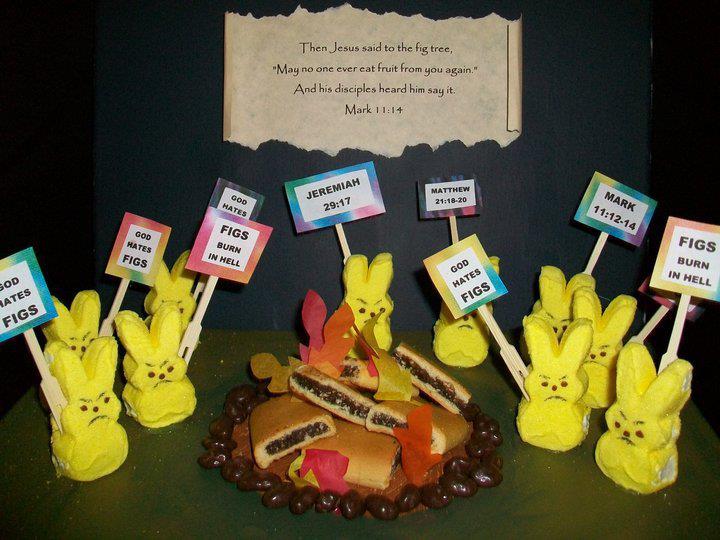
Only species happy with this forecast: the Haroldcampingites. Via George Takei.

|
Only species happy with this forecast: the Haroldcampingites. Via George Takei.
|
|
The glasses looks similar to Oakley’s MP3-playing Thump line — somewhat of a departure from the “normal-people” eyewear that had been initially described — and incorporates a front-facing camera and flash. The on-board hardware is said to be in line with a “generation-old” Android phone, and while it’s claimed that the glasses will operate as a smartphone, it’s unclear if a cellular radio is integrated or if pairing with an Android device will be required.
According to the tip, the glasses aren’t transparent… but if there’s an onboard camera, presumably the front view could be provided in real time so you don’t walk into things. I think it’s self-evident that this technology will be ubiquitous someday, and the only question is how soon. Sign me up for the beta as soon as one’s available.
Update: something similar to my proposed HUD display is already available for Android.
Picked up from Macworld:
Launched four years ago, the use of Wi-Fi on U.S. airlines has yet to catch on, with estimates that the wireless technology is still used by only 7 percent of the flying public.
There are a number of reasons: With Wi-Fi cropping up for free in many airports and public locations, passengers don’t want to fork over as much as $10 for a flight of a few hours. Passengers also may not know when Wi-Fi is available on a flight since the airlines provide the wireless service on only a small percentage of their planes.
Having just gotten off a flight where I was gaming the system to determine whether I’d want wifi, I have a few perspectives on this.
There’s no question that wifi would be a no-brainer for handheld devices at the right price point. Regardless of whether you view a flight as uninterrupted work time or uninterrupted leisure time, I doubt anyone except the “thank God I’m unreachable” crowd wouldn’t see value in connecting to Facebook, Twitter, and email from the air. I thought it was truly nifty to use Flightstats as an in-air GPS telling me where I was midflight, and being able to tap my flight number into Google for minute-to-minute updates on arrival time and gate was especially useful for planning my connections.
Still, the main issue for wifi uptake is the horrible ergonomics in coach. This is where you both have people who are trying to make maximum use of their 21 inches of space, and the people whose in-flight expenses probably aren’t paid for by their businesses. You will probably see this ameliorated somewhat–with a corresponding upswing in wifi usage–as more people use iPads as work machines and don’t need the full space a laptop requires. But until an airline figures out how to make flying more comfortable, then you’re less likely to see widespread uptake of in-flight Internet.
Beyond that, price sensitivity is the main issue. On my last flights, Gogo was $8 for a single flight and single device, or $13 for a day pass that I could use on any device, one at a time. It jumps to $40 for a monthly pass–which means, obviously, that if it’s the beginning of the month and you’re flying more than two roundtrips, it starts to get cheaper. I suspect that the 7% correlates to people who are on airplanes more than once a week. Gogo needs to start looking at the economics of App Store pricing if they want market penetration; drop your prices significantly, and the new users are likely to be low-bandwidth users compared to the early adopters… plus you’ll start locking in more casual flyers who will see in-flight wifi as a casual expense, similar to the need to buy a sandwich before boarding a flight.
Harrison Ford in talks to reprise Rick Deckard in a Blade Runner sequel. Please, God, let it suck less than Crystal Skull.
Lifehacker links to musicForProgramming(), a site that packages one-hour ambient mixes for white-collar work. Unfortunately, as I write this the site is down, either due to being slashdotted by Lifehacker, or because they didn’t mind their jots and tittles regarding copyright before they got major notice.
Web site musicForProgramming(); distributes a series of roughly hour-long ambient music mixes intended to “aid concentration and increase productivity” while you work.
I’ve long been a fan of Above and Beyond: Trance Around the World‘s iTunes podcast for the same reason. Two-hour blocks of techno/trance without much voiceover, it’s good for either a writing or cogitation session. And with 400+ episodes in the available archive, you’re not going to run out of music anytime soon.
Clearly, this is why I’ve been unsuccessful. There is no other rational explanation.
Interesting graph linked to by Krugman that claims to quantitatively measure presidents by how far they are to the left or right based on supported legislation. I’ve made a mental note to click through later and read the methodology, as well as the scoring mechanism, because there’s quite a lot here that doesn’t sit right with me.
Off the top of my head, I’m surprised to see that Ike gets ranked way below Nixon, as Nixon (despite being generally reprehensible) had lasting impact as the sitting president for the EPA, and most of Ike’s likability by the left stems from his farewell speech more than anything he did in office. Likewise, LBJ as the most moderate Democratic president (short of Obama) seems to underweight that whole civil rights legislation thing.
No argument with the numbers that demonstrate why Obama is a disappointment on the left, though, or with the scale that shows that Republican presidents are uniformly more to the right than Democrats are to the left. But if this graph is based on legislative support, then it wouldn’t count statements made in office that never made it to the Congressional floor, which seems like a big omission.
From Conscience of a Liberal:
This is what I mean when I say that the left and right aren’t symmetric. People of all persuasions lie; but the right has a whole institutional structure of lying that has no counterpart on the left.
News scoop from Good eReader, via The Stranger:
Amazon sources close to the situation have told us that the company is planning on rolling out a retail store in Seattle within the next few months. This project is a test to gauge the market and see if a chain of stores would be profitable. They intend on going with the small boutique route with the main emphasis on books from their growing line of Amazon Exclusives and selling their e-readers and tablets.
I disagree with The Stranger’s take that these stores need to be stocked like a book superstore. All the stores have to do is provide some in-store service that’s not available online. Drive to a store and they don’t have your book? “No problem, sir. Have you considered an e-reader? If not, then we’ll give you one-time Prime and have that book on your doorstep in two days.”
And of course, if Amazon includes a print-on-demand service, then all bets are off.
From The Bureau of Investigative Journalism:
But research by the Bureau has found that since Obama took office three years ago, between 282 and 535 civilians have been credibly reported as killed including more than 60 children. A three month investigation including eye witness reports has found evidence that at least 50 civilians were killed in follow-up strikes when they had gone to help victims. More than 20 civilians have also been attacked in deliberate strikes on funerals and mourners. The tactics have been condemned by leading legal experts.
I wish the article didn’t lead with the headline “Obama Terror Drones”. I agree with its implied premise that unmanned drones probably do more to incite terror in populations under its routes than just about anything that’s happened in the US in ten years, but the phrase as a whole isn’t a statement, it’s a political argument.
Also of interest: Glenn Greenwald documents that the NYT breaks its own anonymity policy when reporting on these strikes.
Professor Richardson believes the price for helium should rise by between 20- and 50-fold to make recycling more worthwhile. Nasa, for instance, makes no attempt to recycle the helium used to clean is rocket fuel tanks, one of the single biggest uses of the gas.
Professor Richardson also believes that party balloons filled with helium are too cheap, and they should really cost about $100 (£75) to reflect the precious nature of the gas they contain.
So the world is running out of helium, mainly due to U.S. privatization idiocracy, according to this article. Richardson asserts something I didn’t know, that we can’t make new helium; I figured there was some sort of lab method, but I’m guessing that doesn’t scale.
The next question: how many of our helium applications require helium, and how many use helium because it’s cheap? I can picture kids’ balloons being filled with hydrogen and a salting of other components that reduces flammability.
The Verge reports on new features coming in the $5/month Wolfram Alpha Pro service.
Speaking as a guy who is still waiting for the Ritalin to kick in today, if I can’t get into one of these clinical trials, I may just bang my head against a light socket until I get zapped. Electrical currents may induce flow state:
If your brain isn’t just naturally inclined toward the flow, though, there is the option of zapping it into line. This is called transcranial direct current stimulation—basically running a very small electric current through specific parts of the brain. In some studies, and for some tasks, it’s been shown to induce a feeling very much like a flow state, and possibly make it easier for people to get to a high level of skill faster.
Hearing so often about how casino billionaire Sheldon Adelson has been bankrolling Newt Gingrich, and will likely go on to throw money at Mitt Romney, I just realized I had no idea which casino Sheldon owns.
Bad news: it’s the Venetian. Sheldon’s the guy who took his money from running COMDEX and built the damn thing. I’m a fan of the Venetian, although I rarely spend time there except during CES when part of the show takes place there. But next time I’m deciding where to pay poker rake or play some video poker, I’ll be keeping Adelson in mind.
UK couple banned from US on suspicion of celebrity graverobbing:
Two British tourists were barred from entering America after joking on Twitter that they were going to ‘destroy America’ and ‘dig up Marilyn Monroe’.
Despite telling officials the term ‘destroy’ was British slang for ‘party’, they were held on suspicion of planning to ‘commit crimes’ and had their passports confiscated.
‘I almost burst out laughing when they asked me if I was going to be Leigh’s lookout while he dug up Marilyn Monroe. I couldn’t believe it because it was a quote from the comedy Family Guy which is an American show.
I get challenged all the time by people who think that examples like this are no big deal. Let’s leave aside for the moment my thinking that this is not the kind of America that we’re taught we live in, and that bouncing anyone out of the country is a big deal if we care about who we are.
The non-idealistic reason why this is a big deal: no problem if immigration wants to question someone. But for these people to be rejected entry to the US makes it clear that the questioning was completely beside the point: no matter what they said, they were going to be sent home, because the officials involved have invested their egos into presumed guilty before proven innocent, in combination with a complete lack of oversight. That’s not law enforcement, those are the actions of a police state.
Awwwww. Via Gruber, Stormtrooper happiness.
If there were any question about malware designers going corporate (and after serious money), Brian Kreb’s story on a malware trouble ticket system will lay that to rest:
Underground hacker forums are full of complaints from users angry that a developer of some popular banking Trojan or bot program has stopped supporting his product, stranding buyers with buggy botnets. Now, the proprietors of a new ZeuS Trojan variant are marketing their malware as a social network that lets customers file bug reports, suggest and vote on new features in upcoming versions, and track trouble tickets that can be worked on by the developers and fellow users alike.
Twitter @twitter:
The highest Tweets per second #SuperBowl peak came at the end of the game: 12,233. 2nd highest was during Madonna’s performance: 10,245.
What impresses me about this number is that we’ve blown way past measuring tweets in milliseconds, which is the measure I most associate with Internet communications. A decent ping latency is 100 ms or less; this pace of tweets means Twitter is processing them at a rate of 0.082 ms each.
Circulating on Facebook:
|