If you did not know that this subject line refers to the Hudson River, then you should download this Nerdist podcast [MP3, 44.2 megs] immediately and listen to Chris Hardwick interview The Muppets. Hysterical.
Maybe I should bring TWO snacks
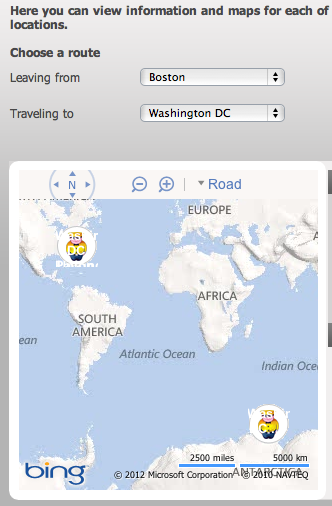
According to Bing, I’m about to have a bit longer of a redeye than I expected.
|
This will sell great in Philly
@chrismear via Jeff Carlson:

Probably just a matter of time
Why not? Not only do I have two hands, but I also have two eyes. Worth trying.
Morse wheels
The Gmail Tap release reminded me of another revolutionary input device.
ThinkGeek is brilliant
Once again, ThinkGeek comes out with April Fool’s Day products that I predict the masses will clamor for them to make real.
And does He go well with corned beef?
Spotted in a Metro parking lot: a Maryland vanity license plate reading “GODSLAW”.
Jeff reaction: “I wonder if that tastes like cole slaw?”
Sorry, Apple won’t let you burn money
Amusing blog post from a developer who created an app primed for rejection, which was subsequently rejected:
‘Buy Money’ allows you to spend from $1 to $1000 on credits. $1000 dollars buys you a million credits. Once you’ve got credits, you can burn them.
Pressing ‘Burn Money’ shows you a pile of dollar bills, and burns them with some quite nice fire and smoke effects courtesy of Particle Candy. The more credits you’ve got, the longer it burns for. Although not that much longer… fire’s like that.
HOWTO get metal through a TSA full-body scanner
Need to get some metal objects onto your next flight? Easy peasy, but only if you’re at a checkpoint with a pornographic millimeter scanner.
The method relies on the fact that the scanners show subjects’ bodies as light objects on a dark background, and also render metal as dark objects. If an object is off to the side of the subject — in a side pocket, say — it shows up as black-on-black and is thus invisible.
Microsoft “ceding the future”
Gruber on the decision to run normal Windows 8 on tablet/phone hardware:
Count me in as one who suggested they go Metro-only on ARM. I truly believe this is a grave error on Microsoft’s part, and they’re ceding the future of personal computing to Apple and the iPad by doing this.
CCTV, giving police something to do
Sometimes a story makes a snarky comment superfluous, as in this story from Boing Boing:
An undercover police officer in Sussex, England, shadowed a suspicious character through the streets a small market town for 20 minutes, following directions passed to him by a CCTV operator who guided him towards the suspect. After 20 minutes, the CCTV operator realized that the “suspicious character” was the police officer himself.
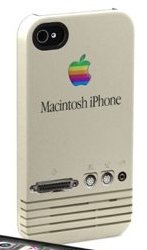
Retro iPhones
|
These cases are frickin’ brilliant. I especially love the ports. |
 |
Baby steps to Skynet
I’m surely not the only guy who gets chills reading this story about US-airspace drone flights:
The US Federal Aviation Administration will have until the end of 2015 to open national airspace to unmanned civil and commercial craft. The bill, which granted funding to the FAA, requires the agency to draft a plan for licensing remote-piloted drones to operate in areas that were previously reserved for manned planes. Currently, drones can be used in certain parts of military airspace and at low altitudes or isolated areas; this bill will let them occupy the same space as passenger planes and other traditional aircraft.
The ACLU is already preparing a lawsuit concerning how cheap drones open the door to wider surveillance by government and private companies, but honestly, my other concern is sticking these into already crowded airspace. My question: considering that the FAA still uses antiquated 1980s technology (the GPS in your phone is better than what the FAA uses, which is to say, none), is this really the priority Congress should be focusing on?
Update: apparently $11 billion of the $63.4 billion authorization passed by Congress is dedicated towards GPS upgrades for the FAA. So that’s good news. No link available, as I can see it in Google Reader but the original page isn’t coming up on The Verge.
Path iOS app uploads your entire address book to its servers
I installed Path a few months ago to figure out what it was all about, but hearing that it’s up to some data shenanigans, this was an easy choice for deletion.
Heat-based hard drives
Boffins at the University of York have come up with a hard drive read/write method that could increase speeds to terabytes per second, using much less energy than current magnetic methods. The hard drives still use a magnetic platter, but the bits are flipped using heat to harness some internal property of the magnetic media to get much more bang for the buck out of the energy and speed.
Considering that we appear to be at the beginning of a headlong rush to SSDs, and also that hard drive capacity will be a lot cheaper than SSD for the near future, I wonder if this will prolong the argument.
More power of positive thinking
From the HBR:
The good news, Harvard Business Review says, is we can train our brain to be more focused and productive—by improving our emotional balance.
Dr. Paul Hammerness and Margaret Moore write that negative emotions sabotage our brains’ ability to solve problems and ignore distractions, while positive emotions and thoughts actually improve the brain’s executive function.
More to the point, the takeaway lesson of pretty much all of the recent research I’ve read: even mild chronic depression can really fuck up your life, and it would be nifty if there was broader societal recognition that this is an illness.
Sign of the end times #4,238
Ladies and gentlemen: the bacon milkshake. I was in the vicinity of a Jack-in-the-Box last week, and let me tell you: I would have tried one, out of pure morbid curiosity.
The engineer who saved the most lives in aviation
Next time your airplane does not experience “controlled flight into terrain”, thank this guy.
Rick Santorum’s Tears
Every once in a while, Twitter provides a little bit of perfection.

|
God, we really need pundit ratings
Standing question: why don’t we care whether an expert is right about predictions he makes? According to Krugman, economists are just as bad at paying attention to such things.