Frontline: Rules of Engagement

Watching last year’s Frontline documentary “Rules of Engagement“, about the killing of 15 civilians in Haditha. A few random thoughts; glad to hear contradictory opinions in comments.

1. At one point, a military lawyer states that the rules of engagement allow for presumption of hostility of “men of military age” fleeing an explosion, such as the IED that killed a Marine and set off the Haditha incident. From the military’s perspective, I can see why this makes sense.

But speaking as a man of military age: if I’m standing near the site of a recent explosion, my instinct is to get the hell out of there in case it’s the first of several. It seems to me that the rule sets a standard whereby an Iraqi has to first check the area to see if there are any US military around; if not, he’s allowed to run like hell. If there are? Well, apparently that’s too damn bad — as the documentary makes clear, it doesn’t appear that there’s any way of remaining still and staying safe from either insurgent or military attack.

(Note: I’m not presuming that US troops would mistakenly fire on civilians, although the later Haditha conviction does indicate that it isn’t a matter of opinion whether it sometimes occurs. However, I assume that the average Iraqi “man of military age” may have drawn his own conclusions about whether it’s safe to stay put when facing US troops under attack, and it seems this particular rule puts him in a fatal catch-22.)

2. The unsworn testimony of two Marines struck me as extremely eloquent, more like submissions to Reader’s Digest than court testimony. On the presumption that most sergeants and corporals can’t write with that skill, I assume they had help drafting the statements. Nothing wrong with that, but it does make me wonder about a military court system that values such written contrition and makes resources available to provide it.

3. The conclusion of the documentary states that the new policy of automatic investigation of civilian casualties is causing troops in the field to hesitate out of fear of what the subsequent investigation will turn up. A lieutenant is quoted saying that this does increase battlefield risk — and notably adds that it’s worth it.

The possibility is raised that it’s not, but I think that contradicts military policy. If we want to reduce troop risk above all other considerations, we could replace ground troops with much more indiscriminate ranged and air weaponry. We don’t do this, because we don’t wage war that way (and neither does anyone else who is a signatory to war crimes treaties). So we already allow for increased risk to our troops in return for both military and moral goals. I have trouble understanding why a combat pause to assess the targets — which may indeed increase the risk of giving your enemy a chance to return fire — doesn’t fall into this category.

That said, I’ve never been in combat nor expect to be, so I’m interested in hearing why I’ve got this entirely wrong.

A little light mortgage math

goodnewsThis is a calculation I’ve been meaning to do for a while.

According to a Google search, there are 21 million mortgages in the US. Another search says that the average mortgage payment is $1660 per month. (I’m sure these are somewhat inaccurate, but let’s presume they’re good enough for a Fermi calculation.)

Reuters reported yesterday that 7% of these mortgages are past due by one month or more.

So, let’s say we lived in an alternate universe which propped up the banking sector, not by pouring in trillions of dollars at the top and expecting it to trickle down, but by shoring up the assets which turned toxic. How much would that cost?

(21,000,000) * ($1,660) * 0.07 = $2,440,200,000 per month.

That’s billion with a “b”. That’s what it would cost to provide a guarantee to pay off all mortgages for one month; presuming of course that it was an outright government grant. If it were simply a loan, it would cost much less.

Annualized, that’s under $30 billion a year. The TARP funding from September 2008 would have paid for this program for 23 years, 4 months — again assuming that not a single dime of it was ever repaid. I’ve honestly lost track of how many trillions have been committed in total to various bailouts, but if we combine Congressional bills, Treasury programs, and Fed guarantees, but it seems like what we’re spending amounts to a century or so of paying off mortgages.

I’m not proposing this as a solution; my understanding is that this might have worked last September, but once the house of cards was in mid-collapse this wouldn’t have helped. Perhaps not. But this is the first number I’ve come up with that puts the Fed/Treasury/Congressional/Obama plans in perspective — and the numbers being poured into the banks seem, well, awfully high.

Second question — it’s been eight months since September. Wondering why I’m blogging this, instead of pointing to a link that someone in the financial media actually researched and reported in all that time?

How people found me, 2008 edition

It’s been a while since I did one of these, so this is the 2008 edition of “How People Find Me”, a.k.a. a whirlwind trip through the minds and bizarre interests of people who use Google search phrases to get here.

When I say Google, I mean it. 27 different search engines sent traffic my way last year. 91.6% of that traffic came from Google. In second place: Yahoo, with 3.1%.

For at least the fourth year running, the most common search phrase that landed people here was… “Jeff Porten”. Okay, so maybe you’re not surprised by that. I am, just a little; it comprises people who had the interest to look me up by name, but who didn’t already know me well enough to just go straight to jeffporten.com.

In second place: “annual gun deaths”. Similar phrases come in 9th, 11th, and 14th places. The culprit appears to be something I wrote in 2007, but as it’s not in the top 500 Google results right now, I have no idea how it got so much traction.

In third, fifth, and seventh place, an object lesson to be very, very careful when naming your blog. “The Vast Jeff Wing Conspiracy” is supposed to be an obvious pun on “left wing conspiracy”, but I forgot that Google indexes actual words. So “conspiracy” and “powerball conspiracy” gets people here in 7th and 5th place respectively. It amuses me no end that my posts about PowerBall odds are much more popular than my writings about poker.

In third place, “jeff wing”, a search phrase for which I’m currently the feeling lucky result — thereby beating out a few dozen people who are actually named Jeff Wing. To all Jeff Wings out there: I’m really really sorry.

Leaving the top ten, I’ll cherry pick the rest of the list for things that amuse me:

A four-way tie in the top twenty between “jeffporten”, “porten”, “powerball rigged”, and “Hiromi Oshima“. Nice to see my name so closely related with gambling, cheating, and pornography.

Several people came here looking specifically for iraq site:jeffporten.com, which tickles me pink. Of course, most of those searches were probably my own….

I am inexplicably still in the top ten results for “jewish redheads” thanks to this post, which must come as a crushing disappointment to anyone who thought pictures of Hiromi Oshima were more indicative of what I do here.

I’m the feeling lucky result for “flaming laballa”, which makes it pretty damn clear that I’m the only guy in Kappa Alpha to ever blog about it. Jeez, I hope it’s not one of our secrets.

Laugh-out-loud query: “why do powerball numbers always get drawn in assending order?” Hint: they don’t. Hint #2: if you think they do, you should not be gambling.

Query I’ll be thinking about myself: “maximum mathematical edge in blackjack”. Presumably this would be a deck which had all deuces through sixes dealt out immediately, and a deep cut before reshuffle. This would give you a running count of +20 (let’s assume that we’re not doing ace side counts), and a true count of 20/(32/52), or 32.5. That’s about double the highest true count I ever remember seeing.

“World of warcraft tcp fiber”: an excellent snack to feed your Horde when they’re experiencing high latency constipation.

“Time delayed chemical fuse”: dude, I’m quite glad that you landed at my site for this one, as none of my advice is likely to blow you up.

“Porten washington crossing”: unfortunately, anyone named Porten who was crossing the Delaware with George wasn’t one of my ancestors. But most likely the guy was looking for Port Washington? Or perhaps this place, which still fills me with juvenile glee.

“P o r t e n   d i e t”: your guess is as good as mine, folks.

“Att roaming coverage in guatanamo bay”: Because when you’re visiting Gitmo, your iPhone damn well better be the least of your problems.

“What do you mean by a trillion teraflops”: Really. Frakking. Fast.

“Stolen ibook login password”: Um. Depends. Are you the thief?

“Porno sadish factions\”: I can’t begin to tell you how relieved I am that this search was used only once.

“What would happen if you shot superman in the head with a kryptonite bullet”: probably depends on which Superman you have in mind. Various amounts of kryptonite have been shown to be lethal to Superman since the rock was first introduced in the 1940s. These days, an amount about the size of a class ring will knock him down for a good long while. But a kryptonite bullet is unlikely to kill him immediately; it’s been shown to pierce his skin and cause internal injury, but the radiation effect probably isn’t fast enough to allow a headshot to do more than fracture his skull. That said, a shoulder wound will kill him if he doesn’t get the bullet out fast enough.

“What were the winning numbers for powerball when the jackpots were 200 million or higher for the last four years”: What a brilliant idea! Why didn’t I think of this?

“Clark superman shot with kryptonite”: Man, some people really want that man dead.

“Can you bring in a camera into the cryptologic museum?”: Sure. So long as it’s embedded in your molar.

“Making money on amazon selling for a penny”: Amused that the first Google response is: “it’s very easy to lose money selling books for a penny.” Really. I’d never have guessed. In any case, I got tired enough of people selling my book for a penny, so now I’m giving it away for free. That’ll show those bastards.

“Superman diet”: 1) Be born on a planet with extremely high density, circling a red sun. 2) Move to a planet with a yellow sun. 3) Eat whatever you damn well please. 4) Live forever until some yutz shoots you in the head with a kryptonite bullet.

“Sept 11 conspiracy powerball”: I have a new entry on my list of people I never ever wish to meet in person.

“What time does shopping open at charles de gaulle airport”: You’re in Paris and this is the best you can do? No wonder your family doesn’t get excited when you go home.

“Joe the plumber borgata poker”: Not when I was there. Paris Hilton, yes. Sam Wurzelbacher, no.

“Next fibonacci number”: Depends on which one you’re on now. It’s not a global thing.

“Daily dose of blasphemy”: I have a new entry on my list of possible new names for my blog.

“Can isp tell if you bit torrent”: Usually, the guys who are downloading 85 gigs a day have a way of standing out.

“Porten down conspiracy”: That’s Porton Down you’re looking for, if you want the top secret MI-5 site. Yes, the similarity in naming causes frequent confusion when I attend British lefty conferences. Unfortunately, it’s never rated me a day pass.

“Disinfectant used borgata smell”: Wait, are you looking for the disinfectant that’s used at the Borgata? Or a disinfectant that smells like a used Borgata?

“Crash 2004 no jews”: Note to self: write CGI landing script which parses for certain incoming search phrases, and upon a successful hit replaces the home page with the text “GO FUCK YOURSELF.”

“Blew his head off -jfk -game -clinton -shotgun -rpg”: I have another new entry on my list of people I never ever wish to meet in person.

“Porten family foundation”: Holy shit. This actually exists. Note to self….

“For better or for worse incest comic strip”: Eyes… burning….

“Conspiracy video jewish download”: The problem with a Jewish download is that it always cuts off at the last three percent.

“Safe to fly while on nitroglycerin”: For you, maybe.

“How to waste a half hour”: Um… Googling for the best way to waste a half hour is likely to do nicely.

“Why are penny in porten”: Self-treating a zinc deficiency. (I’m the #2 hit for this one….)

“Women make men stupid belgum”: Would love to know how many women this man had to meet before he forgot how to spell Belgium.

“Metrobus wagers”: Congratulations, you have thought of a way to gamble that has eluded even me.

And a sneak peek from the 2009 edition:

“boy 10 gets porn text on birthday phone”: It doesn’t bother me that five people hit my site looking for this. It concerns me somewhat that all five IP addresses traced back to .mil sites, or military contractors.


Announcing StillTwenty.com

Back in 1996, I wrote The Twentysomething Guide to Creative Self-Employment, which gave young (and the not-so-young) entrepreneurs all of the advice I had to offer from my own experience and my many, many mistakes. It received rave, if rather sporadic, reviews from those who managed to discover it—and then, like so many books, it disappeared from bookstore shelves and the public eye.

Until now. I’m publishing the complete book, in various formats, for anyone to download at http://www.stilltwenty.com.

Why? Because I think it’s a damn good book. Because in the recession of 2009, there are plenty of people who could benefit from learning how to start sideline ventures with as little risk as possible. And because—frankly—I haven’t seen a dime from this work in 13 years, and it would be peachy keen if anyone who thinks my book is worthwhile kicks something into the tip jar.

What’s on offer over there: free download of the entire book as a scanned PDF. A daily Creative Self-Employment tip in the form of an RSS feed. And the full text of the book, in a newly typeset and proofread version, sold as a Creative Commons work for any price you choose.

Let me know what you think, either here or there.

A nation of laws, not men

Really, those senators should have known better.

We all remember the arguments they made at the time: the government has no role in people’s bedrooms. Family bonds are too important for government meddling. Heads of households everywhere live in constant fear of meddling bureaucracies. As a result, Americans on both the right and the left found their reasons to support the new law; is it any wonder that the bill won 90-8 in the Senate, and with a 300 vote majority in the House?

So the Ramm-Bleech-Lyin bill passed in 1999, effectively decriminalizing incest between consenting adults—and more importantly, “near-adults”. Oh, sure, some sexual practices remained illegal and prosecutable: children under the age of 13 were right out, and most Northern states looked upon the practice unkindly if either party ended up worse than bruised. But by and large, the law seemed to be a boon for all, supported by pro-family groups and civil libertarians alike.

Reports of sex crimes and rape dropped precipitously in all states, which was clear evidence that actual crimes had dropped—what better data could we have had? And when Jamie, the pseudonymous 17-year-old, became a national media sensation with the publication of her memoir in 2005, all of us enjoyed the humorous debate which ensued. Can anyone forget the national argument we had to redefine “jailbait”? Only the most extreme feminists and fundamentalists had trouble with her story of trading oral favors with her stepfather for her shiny new car. She even made a brief career out of her notoriety.

Who could have guessed that, ten years later, a wave of revelations would hit the news, telling us—well, more like alleging, really—that so many of these sex acts with teenagers over the past several years were really not consensual? That, in fact, we had made changes to the law which were damaging to America’s children and families?

Most of us, of course, are quick to refute this allegation—who among us has not benefited, at least indirectly, from the new legal regime? Hence the national outpouring of sympathy for “John”, the unfortunate Connecticut man who has become the poster child for retroactive criminalization:

I know that many people think that I should have stayed away from my daughters. But after my wife left a few years ago, after she found me with Stephanie, what else was I supposed to do? I’m a man, for Christ’s sake. It’s only natural to be attracted to young people. So I can go out looking for it elsewhere, or I can get it at home. What would you do?

And, after all, can we blame John? What he did wasn’t illegal, and had immediate short-term benefits for all concerned… or at least, John can be excused for thinking so.

We all know we are a nation of laws, not men. That’s because, obviously, if the law doesn’t criminalize the behavior, we can expect no better of each other than to act like beasts.

This was inspired by this NPR debate, after which 60% of the audience of New Yorkers voted in favor of the premise that Washington is more to blame than Wall Street for the financial crisis, on the grounds that the regulations had been repealed, and therefore no one should expect anyone to have acted any differently.

More on the astounding lack of legislative transparency

Following up on my earlier post about legislative transparency. Had the occasion to track down a bill passed today in the House, and this was the process:

  1. Review various news articles about the bill, which also covered several competing versions of the bill. Amazingly, reputable political news sites–ABC, Washington Post, New York Times–neglected to actually say which of the bills had been passed, making it a search engine issue to figure out what was actually becoming law.
  2. Finally found a link on the New York Times article which led to a voting report on the bill, and that page deigned to tell me the bill number. But it didn’t link to the bill’s text.
  3. So I Google the bill number–and up comes a completely different bill, introduced in the last legislative session.
  4. Then I look up the bill in OpenCongress.org, which gives a great overview of the legislative action, but doesn’t (yet) link to full text.
  5. Finally, I find the bill in THOMAS. And am then absolutely flummoxed when some AJAX flummery prevents me from actually copying the text off the damn page.

This is ridiculous. We deserve better.

Jeff predicts TiVo

Doing some work with The Twentysomething Guide to Creative Self-Employment, a fine book which I wrote waaaaaay back in 1996. Just came across the following passage which shows that I was a few years ahead of my time.

But really, I’m sharing this because 1996 just seems so damned obsolete:

Let’s take a hypothetical example involving the worst possible activity, and try to turn it into a business. Our friend Joe has spent the last six months watching television. His apartment is unfurnished, with the exception of a twenty-seven-inch television set, a four-head VCR, and an eight-year-old futon that has seen better days. His job search went nowhere, partially because he spent too much time slacking off and partially because he didn’t hear about anything good.

Joe is reading the newspaper one day and comes across a blurb in the Style section about people hating their VCRs. One person interviewed says, “I’ve never been able to figure the thing out. I have it turned around to face the wall so I don’t have to stare at that blinking 12:00 all the time.” Someone else mentioned, “I can tape shows until the cows come home, but I never have time to watch them anyway, so what’s the point?” A third goes on, “Between cable and satellite and all of those high-tech features, I’m ready to just junk everything except my five-inch black-and-white set.”

Joe’s been thinking about trying to get some money to supplement the Kraft macaroni-and-cheese diet he’s been on, and his wheels start turning. If Joe’s not particularly bright, at this point he might think, “Hey, I can start a service where I set people’s VCR clocks for them, so they don’t flash 12:00!” Thanks to daylight saving time, Joe might get repeat business twice a year, but it’s questionable whether people would be willing to pay for this.

If Joe is a little bit smarter, he might think, “I can tape shows for people who can’t program their VCRs, so they don’t worry about missing their shows. I can even chop out the commercials for them, so they don’t have to fast-forward all the time.” Now Joe may or may not be on to something—it depends on how many people would be interested in this kind of service.

But if Joe’s neurons are really in a frenzy, he’d say, “I live in Washington, D.C. (or New York, or Los Angeles), where people are totally news-fixated. I can tape all of the newsshows, prepare a list of what stories were aired, fax it to a list of clients, and give them tapes upon request of only what they want to see, saving them time and keeping them informed!”

Or he might take another tack and say, “I’ll hire myself out to wealthy people who want to buy great home-entertainment systems but don’t know what to get. I’ll be the informed third party, more trusted than a salesman, who picks out the best package for the client and sets it all up for them.”

Unfortunately, Joe’s a typical untrepreneur, so he sits on his butt and eventually forgets about his ideas halfway through his third bag of microwave popcorn.

Uninformed thoughts about the Dow

A chart that I came up with earlier this year. Blue line is the Dow close at the end of each calendar year. Curves are simple geometric plots, increasing at a rate such that it will intersect with the actual Dow as of the year indicated in the legend.

If you want to figure out where the Dow “should” be, you pick the rate of growth that makes the most sense to you, extrapolate to the present day, and you’re done—provided you have a talent for oversimplification.

I’m certainly no expert in finance, but I’m trying to apply a few lessons I learned in anthropology back in grad school. Namely:

  1. People don’t change much, even when their cultures do.
  2. We’re no different.

So it seems to me that if you want to believe that the years 1930-1980 have any particular relevance to us, then you come to one of two conclusions about any major delta in the rate of increase of the Dow:

  1. We are different.
  2. It’s a temporary aberration.

There are all sorts of reasons why we can call ourselves different; our grandparents didn’t spend their evenings Twittering about the lovely upgrades they made to their Hoovervilles. But most of the time, when we think we’re different, we’re kidding ourselves.

I’m perfectly comfortable with the idea that things changed after 1980; computers were arriving on people’s desks, and whether we knew it or not, the Cold War was about to end. As I understand it, that means all sorts of things about international capital flows and other financial voodoo, all of which is designed to make money too complicated for mere mortals. Hence my oversimplification: yes, the 1980s and early 1990s were different enough to account for that curve.

As for the second bend in 1994, well, sure. The Internet was becoming a major force right around then, and again, whether we knew it or not, economic forces were starting to realign.

The third bend ending in 1999, though, is clearly batshit. Even our massive housing bubble in 2006 couldn’t peak us anywhere near that growth curve.

I can see all sorts of logical fallacies in this kind of thinking, any one of which would mean that I wasted around 18 hours teaching myself how to use iWork Numbers well enough to do this chart. I’m especially unhappy with the timing; I don’t know where to intersect those curves in order to capture a hockey stick change, rather than merely intersect at its endpoints.

That said, here are the numbers at the end of each curve for 12/31/2009, in case they turn out to be illuminating or prophetic someday: 1980: Dow 1,848.40; 1990: Dow 5,124.81; 1994: Dow 6,842.23.

Dittohead, for the first and last time

Dear God, I actually agree with Rush Limbaugh. From the CPAC conference, thanks to the clipping skills of Jon Stewart:

To us, bipartisanship is them being forced to agree with us after we have politically cleaned their clocks and beaten them. [standing ovation]

Yes, Rush, that’s exactly it. When your side wins, it’s slash-and-burn to Atlanta, and the opinions of anyone who disagrees with you is so much salted earth. When my side wins, we’re expected to be bipartisan and gentle, and it’s not “really” a political victory unless everybody comes to the table singing Kumbayah.

The hell with that, and the hell with you. Those of us who see Obama as having the potential to be this century’s FDR believe in him precisely because of the breadth of his agenda. To the extent that your side or conservative Democrats convince him to aim low, to nibble at the edges of our systemic problems and the unholy debacles of the last eight years, to horse-trade principles, he will be a failed president and important to history only for his race. He was elected to be something better than that.

So I say, let’s adopt Rush’s idea as our own. We have three times the House majority that the Gingrich “revolution” had. We are two short of a filibuster-proof majority; one short if the Senate and Democrats get serious about seating Mr. Franken; seven more than we need if we stop this polite fiction of needing a supermajority for every bill, and force the Republicans to take the political hit of actually filibustering popular legislation.

Enough. Basta. Dayenu. I have seen the light, and that is to generate populist fury that allows the Democrats to grow a spine and begin bending their opponents over backwards. A message to those timid Congressional leaders: you don’t have to be nice to them. As soon as they get the chance, they’ll do it to you. Again.

The hell with earmarks: let’s reform all legislation instead

None of my regular readers will be surprised to hear that I’m in favor of Barack Obama’s call to reform earmarked expenditures, rather than banishing them entirely. Using a Congressional vote as leverage to fund a pet program, and bring federal money home to your district, is as old as the Republic, and it’s a vitally important way of doing business. The problem is that it can mean sending money to private companies and causes, without much transparency, which doesn’t have a great deal of public interest bang for the buck.

Obama hasn’t announced his plan for doing this yet, but I’ll suggest a very simple method of reforming not only earmarks, but all legislation passed by Congress and signed into law. Our problem isn’t just earmarks: it’s also laws written by lobbyists, bought and paid for with private money. Or all-around bad laws tacked onto otherwise good bills.

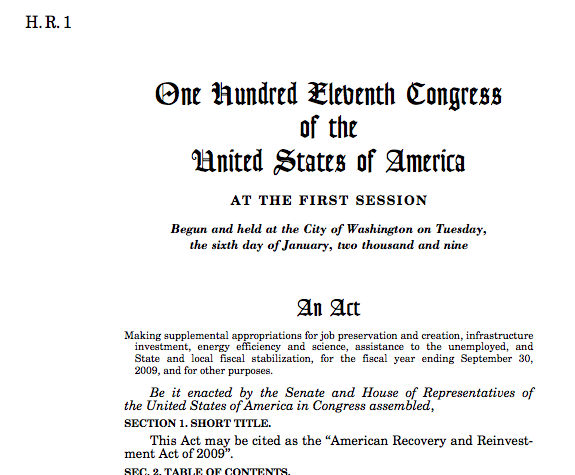
The way this happens now is by making it too damn hard for the American people to keep track of what’s happening to American law. For example, let’s say you’re curious about the actual legislation that was passed in the recovery bill. Look that up online, and here’s the first thing you find:

But that’s the HR1 version, not the Senate version, and it’s not immediately clear (to me, anyway) whether what you’re looking at is what passed in the House initially, or after the conference committee with the Senate over its version. Lawmakers love conference committees: it allows them to make major modifications to legislation after all the news reporting has been done on the House and Senate versions, and it’s where our system of governance runs with all the smoothness and commitment to justice as Zimbabwe’s.

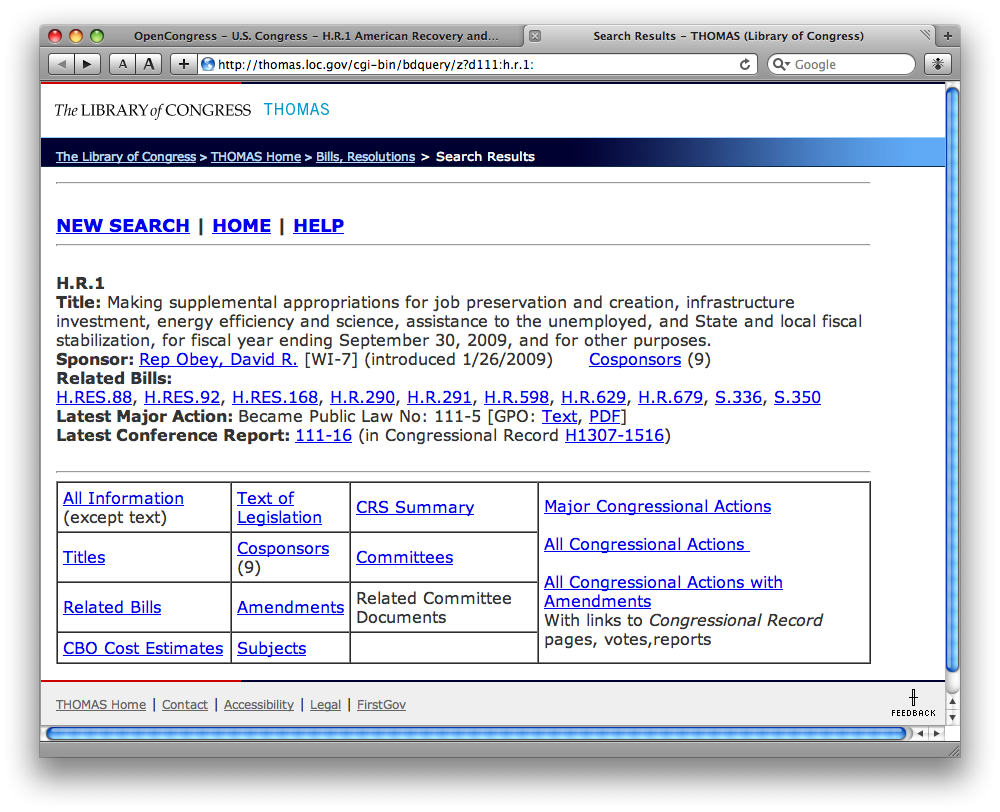
If you prefer to track the changes made to legislation, you can use THOMAS, and you’ll get something like this:

which leads to this:

and finally, this:

Call me crazy, but I’m thinking that not only will maybe five Americans read through all that, but that this system is designed to ensure that only five Americans will read through all that.

There’s a much better way to do this, and we already have one example. Instead of reading through the 407 pages of the HR1 PDF, you can read any of the information that’s being posted to recovery.gov, which generally purports to explain in plain English just what the hell is going on with all that legalese.

And, importantly, we know who wrote this bill: no matter what changes were added in Congress, the perceived author is Barack Obama. But that also means he takes the credit or blame for subsection dccxlviii, paragraph 322, where Congressman Waldo added three lines which builds the Prairie Canyon Lookout Point and Sniper Range in Keokuk.

How about this, instead? We normal Americans have had the ability, since 1989 or so, to create documents that use “tables” and “comments”. So let’s pass a law—the last indecipherable one—which requires all future legislation to look like this fictitious example:

Text Author Intent
(A) 75 percent of the amounts available for each fiscal
year shall be allocated to States based on the share of
each State of households that participate in the supple-
mental nutrition assistance program as reported to the
Department of Agriculture for the most recent 12-month
period for which data are available, adjusted by the Sec-
retary (as of the date of enactment) for participation in
disaster programs under section 5(h) of the Food and Nutri-
tion Act of 2008 (7 U.S.C. 2014(h));
Rep. James Waldo, D-IA Send nutritional aid to the states which need it.

This would have the following very important impact:

  1. Every paragraph (or even line) of legislation has a direct lineage. This need not be a member of Congress. If Barack Obama wrote it, he can take credit. If a Congressional staffer wrote it and the member wishes, the staffer’s authorship can be retained. If a lobbyist wrote it, he can be listed. However, the member who introduced the amendment must be appended.
  2. If a lobbyist, or a very special friend, wrote it and a compliant member of Congress wants to cover up that fact, then he has to put in his own name instead. Someone always claims authorship. And if a lobbyist writes an entire bill wholesale, then either he or the member of Congress has to add that paragraph-by-paragraph statement of intent, each entry with someone’s name on it.
  3. Every paragraph has a plain-text explanation of what it’s supposed to do. This need not be comprehensive, literate, or even particularly accurate. However, if the law is passed and the Intent section is incomplete, wrong, or misleading, then everyone in that member’s district can damn well know about it by the next election.

And just like that, we’re done. Every earmark is a law. You want to reform earmarks? This does that; Representative Waldo can stand or fall based on the sum total of the money he steers to Keokuk, and it’ll be easily searchable for all to see.

Here are the best things about this proposal:

  1. It’s easy. Everyone who has a hand in writing legislation knows exactly what he’s trying to do when he writes it. All he has to do is write it down. In programming terms, this is simply a question of enforcing self-documenting code.
  2. It’s accountable. If someone deliberately tries to obfuscate the intent entry, his name is right next to it. Or if not his name, his boss’s—the one who has to stand for re-election.
  3. It’s political dynamite. Let’s say there’s a grassroots movement to pass this into law. You’re an entrenched lobbyist or member of Congress who wants to keep doing business as usual. Here’s my question: how exactly do you spin your argument in favor of collusion, opacity, and back-room dealing? I can’t imagine many elected officials of either party would love this bill—and I can’t see how they would oppose it.

This idea is all yours, Mr. Obama. Feel free to use it.

Republican collective amnesia about terrorism

It’s still a Republican talking point that Bush kept us safe, on the theory that “we haven’t been hit again since September 11.”

Apparently, either biological terrorism no longer counts, or on the Republican calendar, September 18, 2001 comes before September 11, 2001. Like 9/11, we think we know who attacked us; like 9/11, there is controversy over whether there are other criminals who may still be dangerous who were involved; and like 9/11, the perpetrators of 9/18 were never prosecuted.

Oh, wait. My mistake. We don’t refer to the anthrax attacks by the moniker “9/18”. Perhaps because the people who popularized “9/11” as a political rallying cry for their own Machiavellian needs didn’t want to draw attention to the fact that they, in fact, had not kept us safe.

Speaking personally, the only times I’ve personally felt terrorized—which I still think is a good definition of “terrorism”—was in the weeks following 10/2. 10/2? This would be 2002 I’m referring to, which also precedes 9/11/2001 on the GOP calendar. 10/2 was the beginning of the Beltway sniper attacks, when for several weeks many residents of DC learned to walk zigzag and in a halting gait. I was one of them. I felt silly when I was doing it. But I did it.

So, please, defenders of Mr. Bush: there are hundreds of ways in which we can argue the question as to whether Iraq and Afghanistan, Guantanamo, and Dick Cheney’s personal team of assassins improved or lessened our security. But even on the specific point you wish to make, that George W. Bush magically prevented domestic terrorism between September 12, 2001, and January 20, 2009, you’re either being deceitful or suffering from dementia. We were attacked, and Americans died. Just perhaps not enough to hold your attention.

Predicting the technology we can’t understand

I’m fascinated by the idea of technologies that outstrip a generation’s capacity to integrate them. We all know of gadgets that confounded our parents and grandparents, but what’s really interesting are the social shifts that result. My favorite recent example was coordinating a dinner meeting with a friend who’s in her eighties; her idea of planning included coming up with several plans B and C in case anyone was running late, the weather was bad, etc.

I pointed out, as politely as I know how, “We all have cell phones, so if anything comes up, we can coordinate then?” Of course she knew that, but cell phones came along too late to break a lifetime of habits and etiquette based on landlines.

So I’ve been on the lookout for the technologies that will confound my generation, the one that grew up with the first home computers and generally looked upon their pre-digital parents as Neanderthals. So far, I haven’t seen them; there are certainly technologies that are more popular among the younger crowd, but I haven’t heard of one yet that so fundamentally changes the landscape that we should expect to be left behind.

That said, these are my current candidates:

1. Ubiquitous mobile location. Projects like Google Latitude, and the general trend to put GPS chips into anything larger than a grain of rice, herald a future where every mobile object, living or inanimate, can have its location known. This shift is equivalent to the day Wikipedia passed its tipping point as a generally reliable source of universal trivia; how many things do you casually look up, which you would have previously ignored in the days before Wikipedia and Google existed to instantly satisfy your curiosity?

My personal examples: the last four things I looked up in Wikipedia were the minor DC comic book character Holly Robinson; the history of Fannie Mae and Freddie Mac; the corporate ownership of PayPal; and the television production history of my fraternity brother Ron Moore. How many of these would I have researched if the friction involved, say, going to a library or picking up a phone? Precisely zero.

So I think the friction-free future of locating mobile objects (i.e., people) is going to be substantively different than our present. During the transition time between now and then, I expect all sorts of privacy nightmares while our legal and social systems scramble to catch up–those were built by people who weren’t used to being a data point in the global positioning wiki. But the generation that grows up with it will disregard physical location even more than we do, with our fancy “email and telecommuting” schemes; as cell phones killed the temporal aspect of advance planning, I expect this technology to kill the spatial aspect of it. Why plan when you can flash mob?

2. In the future, you will be a porn star for 15 minutes. Technology already breaks us up into two distinct generations: people who started getting naked with other people when cameras used film, and people who did so after cameras went digital. I suspect those two groups already have very different photographic records of their relationship history. But God help the first generation of kids who became sexually active when digital cameras met Internet upload.

Here in the early 21st century, cameras are widespread and easy to hide, so there are any number of ways you can unwittingly star in an online video, starting with trusting the wrong partner. I’m actually rather surprised that this isn’t already extremely common. My guess is that it is, but it’s just not yet particularly well-known or centralized… and it will be the next Internet scandal when some enterprising offshore website becomes the YouTube of semiconsented amateur porn, starring primarily American and European teens and 20somethings.

(Yes, I know that such amateur porn sites exist, but AFAIK there’s no centralized web site that allows someone to Google for whether they, or their friends and enemies, have been included. This seems like such an obvious extension of current technology and human vituperative nature that I expect it’s only a matter of time.)

The effects seem obvious to me: a few years of self-enforced sexual prudishness by people who think their lives will be ruined if they’re displayed online in flagrante, followed by a new normalcy when having been in an Internet porn video carries the same opprobrium that we feel when we think about how much we used to drink in college. (I.e., not much at all.) You’ll be held responsible for what you personally choose to post to your social networking sites, in much the same way that it’s unwise to post drunken bashes on LinkedIn portfolios today. But since none of us can control what other people post about us (and since most of us, in retrospect, have less than perfect track records selecting our intimate partners), those taboos will fade away.

Unsubstantiated corollary: since it seems to me that it is much more common that males will piggishly circulate revealing photos of their female sexual conquests than the reverse, I wonder if this might be the first time in history when naked pictures of women will be less damaging to their reputations than naked pictures of men? If so, it’s about damn time.

3. Forever friends. A new idea which I’m still developing, but which was inspired by a veritable tidal wave of people from my past showing up on Facebook. I think I’m in touch with around 100 people with whom I hadn’t talked in a decade or two; for some of these people, the question is literally, “so, what have you been up to since your bar mitzvah?”

I think there are some fascinating corollary questions that arise from this. For example, I’m generally amazed how large my network is; there were a lot of people, places, and events that faded until something else in the network jogs that memory. And as large as this network seems, it’s still only a fraction of my “Platonic network ideal”; I can think of several organizations I joined, and hundreds of dimly-remembered people, which aren’t yet represented in my online social network.

There are indications that Facebook, LinkedIn, and Googling your ex-girlfriends, as amusing as these can be, run contrary to long-standing human traits. There are biological theories that there are evolutionary constraints to the number of people we can have in our metaphorical tribes; I’ve heard the number 150 being the average upper limit of close friends you can have. Meanwhile, sociological theory states that reinvention is one of the cornerstones of the American mythos and culture; we each have a manifest destiny to blow off our friends, our family, and our existing self-image, and metaphorically go West to dig for gold. Or at least, we did.

So here at the dawn of the social networking age, I can tell you that an old friend from high school, whom I haven’t seen since 1988 or so, suffered from RSI on Sunday. Which is weirder: the idea that people from our past are no longer just memories? Or the certainty that people we meet today, no matter what age we are, run a high likelihood of being caught up in these online avatar nets, and quite likely will become a permanent fixture in our networks?

What does it mean to obsolesce the meaning of the phrase, “people from our past”? How important is it to be able to leave people behind, deliberately or otherwise? I’ve spent a fair amount of my activist life advocating for consciously living in a global community of six billion people, but that doesn’t mean I have any idea how, when we’re wired for numbers closer to six hundred.

Call this a social change for everyone, but I’d expect that the generation that is born into it is going to come up with radical solutions for understanding and solving it.

4. Personal soundscapes and holography. Another new idea, introduced to me by Woody Norris’ TEDTalk about his invention of a directional sound speaker. Essentially, he can point his speaker at a crowded audience, and only the people at the aural focal point of the speaker will hear the sound coming out of it; everyone else hears nothing. It seems very similar to the parabolic directional sound mirrors at the Franklin Institute, where you can speak into a metal ring and be heard on the other side of the room.

Except that Norris’ invention is industrial, handheld, and can be incorporated into anything that currently produces electronic sound, such as iPods, cell phones, megaphones, and military sonic weaponry.

The military just deployed some of these to Iraq, where you can put fake troop movements a quarter-mile away on a hillside. Or you can whisper in the ear of a supposed terrorist, some biblical verse. We put it on a turret, with a camera, so that when they shoot at you, you’re over there [points left] and it’s there [points right].

It seems to me that this technology is transformational in the same way that iPods and Walkmen were; many people think that the “bowling alone” culture is caused or correlated with our ability to live in our own virtual worlds even when we’re among a crowd. But at least headphones provide a visual cue that we’re off in our own world; invisible directed sound waves are less obvious.

This is something I’ve already been thinking about since silent electric cars started hitting the streets. I’m a pedestrian who, after years of exposure to internal combustion engines, has become acclimated to letting my ears do the “looking both ways” for me some of the time. It seems the more Priuses and Teslas that hit the street, the more this trait will become less common, for strictly Darwinian reasons.

I’m not sure what it will mean when the people around me may be seeing or hearing completely different things than I am, without any of us hallucinating. But I’m pretty sure that the younger you are, the more easily you’ll be able to deal with it.

Retagging jeffporten.com

Everyone once in a while I come up with a new categorization tree for this place, on the theory that it makes sense to give my readers a chance to filter out some of my posts and focus on what interests them. In the twelve years since I started this blog, I haven’t met anyone who actually uses these categories, but it pleases me anyway.

I just made some minor changes to the catalog tree here, which you can ignore if you’re happy skimming the sum total of my output. Unfortunately, I haven’t yet figured out how to turn these categories into separate RSS feeds, which I assume is a WordPress feature; if anyone wants it and knows what plugin turns that on, say so. Here’s my current taxonomy:

Conspiracy Theories: essay length and/or reasonably thought-out posts. I’m naming this after the overall title of the blog, but it could just as easily be called, “Jeff’s Self-Diagnosed Important Thinking.” Your mileage may vary.

Illuminatus: short blurbs and links to other web and mass media. Several incarnations of jeffporten.com ago, I had these broken out as a separate blog, but it still seems like that’s too much navel-gazing.

Mac Guru: technical diatribes about various Mac issues. I might add an Internet Guru category in the future, or I might rename this as a general catch-all for when I geek out about gadgets or the Internet.

Publications and Software: it’s rare, but when I publish words or bits, I generally want to highlight them here, and I’ll continue doing so.

I have a half-dozen other, older categories which I don’t use any more; those are now grouped under “Arcanum” in the right sidebar for anyone who’s interested. Chances are that if I revive an old category, I’ll promote it back out of this historical dustbin.

As I said, I strongly suspect that maybe two people on the planet other than me might care about this; if you do, and you have any input on making my site a more interesting way to procrastinate, feel free to let me know.

A bad way to start my day

I am woken up this morning by loud winds outside my apartment. I get up to go to the bathroom, stumbling in still half-asleep.

When I get there, I’m flummoxed by something I’m not expecting — the toilet is missing. The carpeting extends to the wall as if it’s perfectly natural to have a small room with a sink, a mirror, some cabinetry, and no toilet.

I lean against the sink, wondering, “What the hell? Someone broke in, stole my toilet, and recarpeted my bathroom? Since 2 AM?” This strikes me as somewhat farfetched. I am still pretty confused when….

I am woken up by loud winds outside my apartment. I realize, “Oh, that explains it. I was still sleeping before.” I get up to go to the bathroom, which is now completely empty; apparently my apartment now comes equipped with a walk-in closet.

At this point, I’m pretty bemused, but distracted by the problem that I really need to use a bathroom.

Next thing I know, I am woken up by loud winds outside my apartment. I look around my bedroom, establishing that this time I feel really awake. I enter the bathroom with some trepidation, and huzzah! the toilet is in its rightful position. Then I notice the mirror is gone.

So I’m staring at the newly blank wall, thinking that I now have a conundrum. Four cups of coffee are insisting that it’s time to leave my bladder. The toilet is right there. And despite the fact that I am now upright and walking around my apartment, the missing mirror is telling me that, in fact, I am most likely still in bed on a windy day with four cups of coffee insistently wanting to leave my bladder.

In short, going to the bathroom right now strikes me as a very bad idea.

At this point my memory becomes pretty fuzzy — there’s something about being at a wedding and staying in room 301 of a hotel, none of which involves bathrooms. This is all normal dreaming without the lucid sensation of being awake and controlling my actions. When I wake up again, I head to the bathroom and find it all astonishingly and thankfully normal.

I also notice something I missed all morning: the bathroom that had been vexing me wasn’t my bathroom. The layout was entirely wrong. Somehow I managed to miss that detail.

It would be nice to say at the end that this has been a creative writing exercise, but I’m not that creative. Sadly, this is a true story.

Stimulating information

As I’ve mentioned here before, I consume a metric truckload of news on a daily basis. And yet, it occurs to me that I don’t know the answers to the following questions about the stimulus:

1) Given all the hoopla over Obama’s tax cut concessions to the Republicans, are these tax cuts the ones he campaigned on, or different ones more common to Republican policy?

2) After tax cuts, and ignoring the 0.7% of the stimulus that the Republicans are arguing with (I, for one, think the National Mall is damn well in need of sod), just what the hell are we spending the other 99.3% on?

I mean, we’re spending $816 billion here. That should be newsworthy. And not to imply that we have a blitheringly incompetent news media, but at the moment the word “stimulus” does not appear on CNN’s home page. (Headlines: WWII vet frozen to death leaves $$$ to hospital; Sarah Palin takes on Ashley Judd; Boy, 10, gets porn text on birthday phone.) Amusingly, the CNN home page that does not include the word “stimulus” does include a story about how hard it is to understand the concept of “trillion”, called “Numb and Number”.

Accurate, if only they we’re talking about their own news room.

So, as a public service: here is the PDF of the Congressional Budget Office report which summarizes the costs of the bill, by explicating some of them. However, they have a habit of saying things like “$6.4 billion for other purposes”. So here is the complete text of H.R. 1, while these are the amendments in the House and the Senate.

The full text prints to a 362 page PDF, if you’re so inclined. It’s a shame we don’t have an industry whose job it is to analyze proposed legislation and report it to the public; perhaps we should do something about that.

How Obama can make Bush look good

I just had a bit of a revelation upon hearing this NPR report about CIA missile strikes in Pakistan:

CIA-directed airstrikes against al-Qaida leaders and facilities in Pakistan over the past six to nine months have been so successful, according to senior U.S. officials, that it is now possible to foresee a “complete al-Qaida defeat” in the mountainous region along the border with Afghanistan….

The intelligence reports have been shared with President Barack Obama and underlie his decision to authorize the continued use of unmanned aircraft to launch missile and precision-guided bombs against suspected al-Qaida targets in Pakistan’s border region….

The CIA has been using drone aircraft to carry out attacks on suspected al-Qaida and Taliban targets in Pakistan for several years, but such attacks were significantly expanded last summer under orders from President George W. Bush.

My epiphany relates to the attack of “Bush hatred” that’s frequently leveled against progressives, i.e., “you’re so blinded by irrational rage, you can’t acknowledge when he does something good.” And what I just realized was this: it wasn’t about rage, it was about trust.

Fact is, if I had heard this report 15 days ago, I would have immediately assumed it was bullshit. Even hearing it now, especially the claim that al-Qaeda is “defeated”, makes me wonder a bit about whether this is coming from the Obama military apparatus or holdovers. (NPR, all of your sources are anonymous. Stop it. You’re better than that.)

But today my first reaction is to think this is good news, whereas in December I would have needed a book of E-ticket passes to the newly-opened Peshawar Disneyland before I believed anything W said about the region.

So when this president says something good about what the last president did, well, props where props are due. It’s not that George couldn’t do anything right. It’s that he lied to us so often, we couldn’t believe him when he did.

Prove me wrong, Mr. President

I have to admit, Mr. President, you’ve got me really confused.

You’ve taken office with huge partisan majorities in Congress, and an approval rating that makes Jesus gnash his teeth with envy. Hell, you’ve even got adorable daughters to keep us all captivated. This is the sort of political momentum that gave most of your predecessors (especially the last one) the green light for a slash-and-burn, salt-the-earth crusade for his legislative agenda.

Remember “I’ve got political capital, and I intend to spend it”? That came of a few thousand votes in Ohio. If he had political capital, you’re King Midas.

And what have you done with this? Let’s see: you’ve got a Republican heading your military. Another one heading Transportation, which last time I checked was a pretty major item on the infrastructure agenda. And word is that you want another one to take over at Commerce.

Military, infrastructure, and commerce. Um. Pardon me, but aren’t those three issues on which you pretty much whomped the Republican party? If George Mitchell had negotiated those appointments as part of a cease-fire agreement after the war you won in November, he’d be a shoo-in for the Nobel Peace Prize.

And yet, each day of the news cycle is filling us up with the constant complaints of John Boehner and Mitch McConnell, who are still getting a 2 to 1 advantage getting their message across. What am I missing here? The Republican strategy is obvious: weaken your proposals as much as possible, and blame you when they fail. Or, if you succeed, claim that Republican policies would have been oh so much better. Either way they try to take a chunk out of your majorities in 2010 and lessen your political advantage.

I repeat, your political advantage. I.e., the power you have now which you are currently not using.

Mr. President, I think you’re actually pretty damn savvy, and you have some kind of long game you’re playing with these initial attempts at bipartisan outreach. I think that there’s a flinty Chicago plan for how you’re going to turn that goose egg House vote to your political favor. And I think you’re genuine when you say you want to change the way the game in Washington is played; the problem is that this bipartisan thing so far is making you look as naive as Jefferson Smith.

I don’t buy that for a second. But at the same time, I sure as hell can’t explain to myself why you’re governing as if the election was a tie. You don’t inspire by finding the center. You inspire by picking a direction, grabbing a multicolored banner, and leading the parade with the audacity of Harold fucking Hill.

But you know that, and you’re still looking for centrism. It makes me wonder about your game plan. It’s certainly not what I expected, and it reminds me of past disappointment. I hope you’re better than that, Mr. Obama, so please, prove me wrong.

It’s finally over (continued)

I was called out today on my past errors, in Brian Greenberg’s eulogy for the Bush administration. Specifically, among Bush’s many other accomplishments which I did not anticipate, he refrained from large-scale invasions of more than two foreign powers, and he did not pardon himself or others for war crimes.

In both cases, not only do I freely admit to being wrong, but I also freely admit that I was hoping to be wrong. Unlike some who find it “disappointing” when they don’t find weapons of mass destruction, I’d rather have a less-than-perfect oracular record when that means that the world is a better place than I expected it to be.

Likewise, I’ll stipulate that I was glued to my news feed for the 72 hours prior to the Obama inauguration, watching for and expecting last minute abuses of presidential power. I can say that I am pleasantly surprised by Mr. Bush’s actions here as well.

I don’t have any good explanations for why Bush declined to be a greater failure in his last two months in office, but if I had to guess, I’d say he was just too damn tired. After the election, you just got the feeling that he was ready to go home, and the following two months were his prolonged Senior Week before graduation.

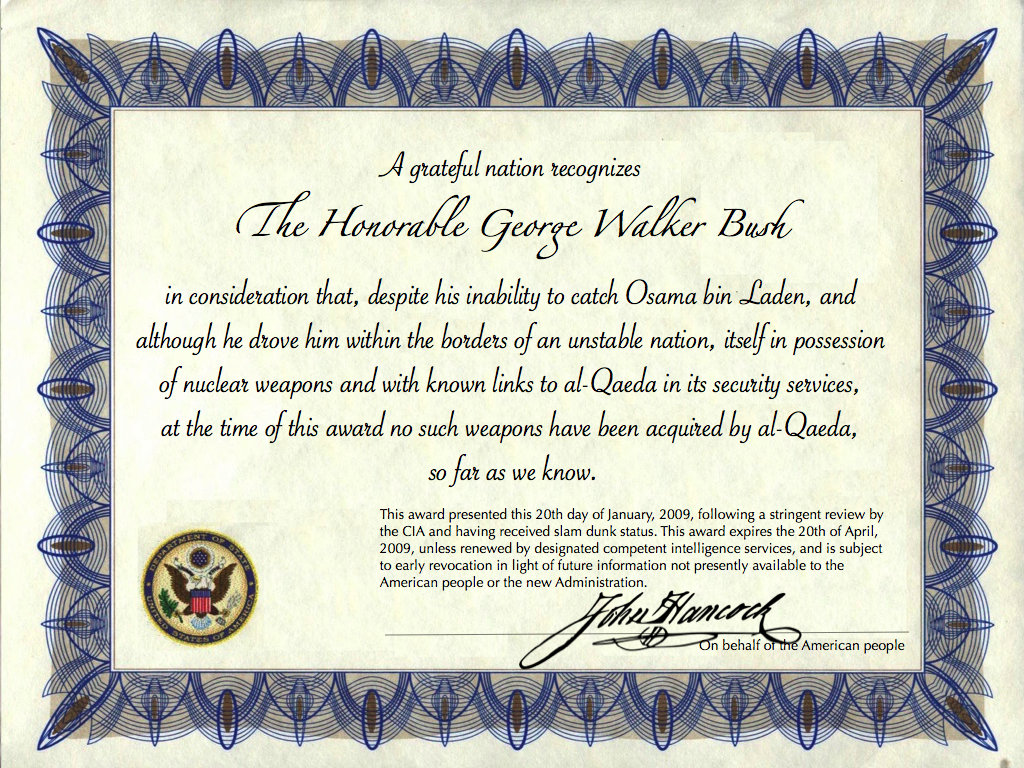
Brian points out all sorts of specific ways in which the United States currently differs from a 3,000-mile wide smoking nuclear crater, and suggests that each of these specifics are reasons to be grateful to 43 for not screwing up more.

And there, well, I have to agree with him from a philosophical perspective. It is, in fact, possible to envision a Platonic dystopia in which George W. Bush was even more misfeasant than he was in reality—say, by using Syria to stage the Iraqi invasion—which logically implies that he is actually less than perfectly awful. At the same time, it’s hard to figure out what you’d put on that Certificate of Merit.

I find it amusing how often Bush defenders (and the man himself) raise the question of how he’ll be viewed by history as a way of deflecting present criticism and debate, as if history doesn’t count until suitably large numbers of decades have passed. Unfortunately, history already has very clear opinions: Of presidents who entered into temporarily popular, but extended and unsuccessful wars. Of presidents who suspended Constitutional rights for some people, especially of a particular racial group. Of presidents who presided over great shocks in the nation’s economy after implementing their own brand of economic policy.

If you know history, it is not difficult to guess how history will view Mr. Bush. And it is not difficult to guess where he will end up—like other failed presidents, he himself will be the answer to the trivia question, remembered rarely, and generally thought of only when the next list is drawn up comparing Tyler to Buchanan to Harding to Bush.

Or perhaps, like Hoover, he’ll be remembered mainly in contrast to the president who succeeded him.

Avoiding Bush’s last great mistake

It’s already been an interesting year on the torture front, starting with both Bush and Cheney discussing their direct involvement with “enhanced interrogation” techniques, through to yesterday’s decision by the top judge at Gitmo that, well, “enhanced interrogation” is an enhanced way of saying the word “torture.”

Personally, I think it’s pretty damned odd. For seven years, the only official discussion of high-level involvement in America’s movement to the dark side has come through clenched teeth. What little has been said to the public has been sculpted to give two simultaneous and contradictory messages about our top leadership: they’re badasses whom you don’t want to mess with, and they’re completely uninvolved with this war crime stuff. But now, in the waning week of the Bush II presidency, it’s suddenly okay to open up?

I can think of two reasons why they might do this. On the one hand, given the general way that it seems like everything Bush has managed in the last eight years has gone completely into the toilet, they might think that it’s worth buffing up what little shine they can on the situation before they leave the presidential limelight.

On the other, more paranoid hand, for the next five days, George W. Bush still has an absolute power to grant pardons, and this might be the warm-up to a blanket Get Out of Jail Free card.

I’ve been hearing a few murmurs about how irredeemably awful this would be, mainly from the sort of people who already think W is irredeemably awful. I happen to agree on both counts. However, I can think of at least one reason why granting a pardon would be a Very Bad Idea for both the country, and for the people receiving the pardon.

Let’s go back to the halcyon days of the 1990s, when people like Saddam Hussein ran countries and had a fondness of torturing the unfortunate people who found themselves in them. Since those national governments had little interest in enforcing criminal laws against their own dictators, it was generally agreed that it would be a good idea if the world had a set of criminal standards that could be applied when national systems broke down, or were deliberately designed to fail. And so the International Criminal Court came into being.

The United States signed the treaty but did not ratify it, and we’re currently on record as having no interest in joining the Court. The Bush Administration claims that this gives the international community too much power over Americans who are accused of war crimes, and the Democratic party to date has shown few signs of official disagreement.

Back in the day, those of us who were in favor of the ICC, and appalled that the US might not join it, pointed out two very good reasons why Americans were effectively immune to ICC prosecution: 1) Americans very rarely commit war crimes, and 2) we have a functioning legal system. The ICC only has jurisdiction when national rule of law fails; if a national system is “unwilling or unable” to prosecute the accused, then the ICC can serve as the court of last resort.

Perhaps you see where I’m going with this. But if not: as I read it, there is absolutely no way that George W. Bush himself or anyone in his administration can be prosecuted for war crimes in an international tribunal. As of today, that is. But anyone who receives a presidential pardon is untouchable by our judicial system, and therefore might fall into ICC jurisdiction.

(That is, if they authorized or committed war crimes in Afghanistan. The US and Iraq never joined the ICC, so Americans and Iraqis can torture the bejesus out of each other in either country, and the ICC can’t do squat about it.)

Call me crazy, but I’ve always been of the opinion that war crimes are the sort of thing Americans should avoid, and prosecuting people who appear to have committed war crimes is an excellent way to deter such behavior in the future. But I wouldn’t wager money on it. Counting on Democratic spinelessness is quite possibly the best way for the Bush administration, not to put too fine a point on it, to get away with murder. The problem comes if they decide they want more insurance.

If this administration falls under ICC jurisdiction, it would be a clusterfuck of galactic proportions. I can think of a thousand ways it would splinter both the domestic and international political arenas, making enemies out of natural allies, and mortal enemies out of people who would be otherwise more civil. It would not be good for the accused, and it would not be good for the country.

And at the same time, if Bush issues even a single torture pardon, the ICC cannot even think about backing down from its jurisdictional requirements. The last message you want to send to war criminals is, “Make your country powerful enough, and you have nothing to worry about.”

The best way to handle this is at home. And that means a credible investigation, whether it leads to dismissing or indictments, acquittal or conviction. I personally expect that anyone who committed or authorized torture in the last seven years will get off scot-free. But let them do so legally.

How to handle an emergency

I have a freelance article percolating its way to print, in which I once again disparage the Alert DC network. If I wanted the weather and traffic reports Alert DC sends me, I’d sign up for them elsewhere; when I hear them daily from Alert DC I get the impression that they’re looking to justify their existence (and lessening the value of an emergency alert system in the process).

But I received a note today from them that impressed me, which I reproduce here:

Update: FEMS reports smoke on metro train at 5200 Wisconsin Ave. NW at the Friendship Heights Metro Station. FEMS reports no fire on train. FEMS confirmed that This is NOT a Mass Casualty Incident. Having the Mass Casualty Unit report on scene is a standard procedure for this type of incident. Two patients have been transported to Sibley Hospital. Friendship Heights Metro Station is CLOSED.   

Sent by Eustace Mark Bellille

Sent by DC HSEMA to e-mail
Powered by the Roam Secure Alert Network
———————————–
– You received this alert because you are subscribed to Alert DC.  To update your account & preferences, go to alert.ema.dc.gov/reregister.php
– To authenticate this alert go to https://textalert.ema.dc.gov/myalertlog.php?s_alert_id=4764
– Tell a friend about Alert DC!  Signup at alert.ema.dc.gov

What’s good about this alert:

  • DC acknowledges the likely inferences people will make if they happen upon a closed Metro station with a Mass Casualty Unit outside. It tells me what I need to know—there’s a problem, but not a major problem—and that I shouldn’t panic.
  • Someone’s name is attached to the message. I have no idea who Eustace Bellille is, but someone else does, so there’s accountability in the chain that is transparent to the user.
  • The link to confirm the alert is standard, and becomes more useful in direct correlation with the scope of the emergency.
  • Finally, another email arrived 15 minutes later, also with someone’s name attached, telling me that Friendship Heights Metro was open again. So if I had any lingering concerns about this being a threat to my safety, they’d be dismissed very quickly.

That said, there are two issues here that should be addressed. First, I have no idea what FEMS or DC HSEMA is, nor do I care. Emergency services should communicate in English, not bureaucratese, and should also not appear to be marketing their acronyms during an emergency announcement. Nor do I give a damn about which private company is sucking at the teat of DHS funding to send me this email.

But the bigger question is, why in God’s name does the Mass Casualty Unit apparently have a sign on it saying that it’s a Mass Casualty Unit? For that matter, why name it that in the first place? If you asked me, I’d define a mass casualty as numbering in the hundreds, and if I saw a Mass Casualty Unit on a scene, my first reaction would be to run like hell in an upwind direction.

Language matters. If you need to have a mass casualty unit, call it the Emergency Response Unit. And make it look like a plain old fire truck. No bystander is served by seeing the Mass Casualty Unit drive by, and no victim will be reassured to hear that he is one of the mass casualties. About the only vehicle better designed to inspire panic would a Large Radius Nuclear Biohazard Hearse.