Thank you, Mary Soentgen

Every once in a while, the universe shows that it has a deep sense of irony. This was demonstrated to me yesterday when my podcast rotation came up with a CBC podcast called The Peril of Preemies.

Which reminds me that there’s something I’ve long neglected to do on my blog. So to Dr. Mary L. Soentgen, and everyone else who was working at Jefferson University Hospital between 39 years ago yesterday and February, 1970: thank you for saving my life.

Meanwhile, in the rest of the world

Verbatim transcript from yesterday’s BBC Global News podcast:

The day [Jean-Pierre] Bemba’s troops arrived [in Bossangoa, Central African Republic], I was at home with my husband, our children and my mother. We heard gunshots. They went from house to house. Then soldiers burst through our door. They told my husband to lie down, and then shot him in front of us all.

I fell onto the body of my husband. Then six of them grabbed me and held me down. I was raped where I lay on his corpse. One man tried to cut my throat, but I was struggling so much that he slashed my mouth instead, all the way up to my ear. I have since discovered that I am HIV positive, and now I am alone, with nobody to help me feed my children.

Storm

Watch. Something is happening. It is only the second something that has ever happened.

For four hundred million years, the universe has been a blindingly bright soup of atoms, hot and dense, apparently a picture of near-perfect uniformity. It is important that you watch, because there are no other observers. The universe contains nothing but hydrogen and helium, elements too simple to allow for the creation of complex structures, if the environment even allowed such combinations to occur. Which, until now, it has not.

But space is growing, and in some places dimming, and the first differences in the congregation of matter are beginning to appear. Here and there, a few trillion trillion particles of elementary matter start to coalesce in a gravitational whirlpool. The rules that allow for the existence of gravity are the same as those that allow the subatomic bits that form hydrogen and helium. Quarks and gravitons come popping out of a 248-dimensional mathematical manifold which hold these and all other possible matter and energy in its symmetrical lattice.

Within that design are The Rules for Everything.

Someday it will be said that it is the lattice itself that is reality, that what the creatures living within perceive as real are only the Platonic shadows cast upon the walls of the cave. But for now there is no one to say this, nor are there cave walls or shadows.

Today, a conglomeration of matter has condensed enough to create the first nuclear furnace, in the heart of an early member of the first generation of stars. Perhaps it is at 10 AM on a Tuesday. Choose a minute, an hour, a day of the week, and you will have a 10,080-1 chance of being right, for there once was a first star, and human abstractions like time may be extended back as far as we wish. Never mind that this was 712 billion Tuesdays ago.

Skip ahead 100 or so billion Tuesdays. You might as well, as there is nothing to see here but protostars, leftover gas clouds from the Big Bang, and cooling background radiation. The universe has been a boring and empty place. But now, the first star and its brethren are running out of fuel. It is poetic to surmise that the first star was the first to die, but in reality it is based more on the vagaries of how much gas was collected by each star, which in turn set the hard limits on the first nuclear reactors.

Watch. This is the third thing that ever happened, as the first dying star loses the propulsive force that kept it from collapsing in upon itself. Its mass contracts spasmodically, falling to the doom of its unitary existence. In some but not all stars, this causes a last violent burst of nuclear activity, blowing the star apart and scattering its mass—its indestructible, immortal mass—out into the cosmos.

For the first time, an oxygen molecule roams outward, with a dozen other newly released elements, moving on their parabolic trajectories into the gravitational minuet. We need not worry about the oxygen causing havoc to any iron atoms it meets, because there is still no iron, nor other heavy elements. The first stars were not sufficiently large to create them. We must wait for the cycle to repeat, perhaps several times, before those elements are introduced.

Skip ahead another three hundred billion Tuesdays. The universe has become a far more eventful place, so this particular day is not important to it, only to us. Another cloud of gas has begun to collapse inward, but it is rotating sufficiently fast to keep some of its mass in varying orbits. Over eighty percent of this orbital matter is eventually drawn to a single planet just over forty light minutes from the center of the system, leaving behind a motley collection of gases and heavier elements to form seven more planets and several hundred thousand smaller entities.

On one of these planets, a multibillion year process will eventually form mollusks and trees, built of the elements blown out of long-dead stars. One of its species, built out of these same elements, will eventually fashion such items into shrimp toast and coffee cups. It will be in vogue for that species to believe that they are the beneficiaries of a galactic omniscient intelligence, or simply fantastically lucky, that their planet was so wonderfully placed so as to allow for the existence of self-aware beings who could teach themselves to strain near-boiling water through pulverized plant embryos.

Of course, they are wrong. It is true that a small variation in the collection of gases and minerals making up the Earth would have created a vastly different playing field for evolution, with unimaginably differing results. But as one of their species noted, using as his example a “cat” made of heavier elements, it is more accurate to see their world as merely one of a nearly infinite set of possible outcomes.

Humans are not lucky to be living on their Earth; rather, all possible Earths exist simultaneously in multidimensional space, and the humans experiencing this one are not lucky; they are preordained as existing in a universe in which everything that can happen, does happen. And if it can happen once, it happens an infinite number of times through the same branching that led to their existence in the first place. Somewhere next door to the Earths covered with humans are the ones inhabited by extremophiles, who believe that 1,000 °Kelvin is a chilly day requiring warm socks.

But perhaps we can forgive humanity their conceits; a species that can mistake matter as being “real” may believe any number of strange things.

On one of those Earth worlds, an Earthmass of approximately seventy kilograms reaches out for a collection of molecules fashioned out of water, paper, wax, and trace biological products into a “coffee cup”. If you asked me, I would tell you that I chose to reach for my cup to take another sip, that I wanted to drink the coffee before it grew too cold. A neurobiologist would tell you otherwise, that the electrical impulse to reach for my cup occurs about 500 milliseconds before my conscious awareness of my desire to do so. This awareness, the “I”, appears to be a story I tell myself after the fact of my action.

Watching the movement of electrons in our brains, those elementary particles ordained in the dawn of the universe from a supersymmetrical mathematical structure, we read a message from reality that our free will may not be what we think it is. The choice to drink coffee may be as automatic as the choice to beat our hearts; it is the subsequent feeling of choice that may be the only difference. And what is it to say that we “think” it is something, without referencing our free will to begin with? We can follow that logic down into the fractal mollusk spiral, wrapping tighter and tighter curves, and discovering the unending Mandelbrot complexity in its center. Alice’s rabbit hole was never so deep.

I sip my coffee. Several billion trillion molecules of water join the self-aware mass forming “me”, carrying with them a far smaller number of caffeine molecules. Some of these in turn will enter my bloodstream and cross the blood-brain barrier, where they will goose the production of adenosine compounds, and temporarily increase the electrical activity in parts of my brain.

I experience this as a pleasant rush of sharpness, as the laws of chemistry interact with the programmatic results of the four billion years of evolution, and the five hundred years of commerce, that led to my cup of coffee on a warm spring day. Subatomic particles continue to create the web of forces within and outside of us, so unknowable that we were forced to invent concepts like “solid” and “visible” to describe their effects. Divergent realities branch off by the trillions as the universe collides into itself at nanoscopic scales, creating all that is and the tiny fraction of it that remains ours.

The subatomic dance creates, for now, both the environment and the “us” that observes it. Each of us experiences our own center of this chaos, taking in its macroscopic scale and believing ourselves to be, at heart, the reason for it. The violence of physics and unimaginable spans of time have combined to result in humanity, the I of the storm.

Jeff’s podcast mix: how to waste a lot of time with your iPod

Here’s a feature I want in the next version of iTunes: a pop-up window that appears every time I subscribe to a podcast which asks, “Are you insane?”

That would be easier to program than what I really want: an information window that adds up all the podcasts you subscribe to and totals the number of hours per week entering the in-basket.

Since that feature doesn’t exist yet, and since I always seem to be running way behind the incoming podcast total, I sat down and figured out how much I’ve subscribed to. Which makes this the first blog post which I’ve ever written an explicit database to generate.

My total: 65 hours, 20 minutes. Per week. Ye Gods, no wonder I have seven gigs of backlog. (Totaling at the moment: six days and 10 minutes. I.e., 144 hours and 20 minutes.)

I actually do have a system to keep this manageable, and I’ll detail it in a future post. For now, though, since I am frequently asked about my media diet, here’s the current podcast mix.

And The Winner Is…, 1 hour per week

Weekly selection of award-winning radio from the CBC.

Apple Keynotes, 0 hours per week

Video from Apple keynotes from MacWorld, WWDC, and special events. Rarely has new content, but a big whopping download when it does.

The Best of Definitely Not The Opera, .5 hours per week

Weekly CBC show “taking pop culture seriously.” I think of this show as being a Canadian version of “This American Life.” Quirky and usually interesting.

The Best of Ideas, 1 hour per week

Excellent show from the CBC with in-depth coverage of news events and historical topics. I’m only learning right now that the podcast is just one hour from a daily hour broadcast — if the CBC ever puts the full feed up, I’d subscribe immediately and to hell with how much I’m overloaded.

Car Talk, 1 hour per week

C’mon, it’s Car Talk. What, you don’t know about Car Talk? Okay, let’s put it this way: I’ve never learned how to drive, and I’ve listened to this show for 20 years.

Crossing Continents, 0.5 hours per week

International news from the BBC. Just started listening to this one, so I don’t have a feel for it yet.

Democracy Now, 5 hours per week

Daily news show from Pacifica Radio. This should be required listening for anyone who believes that the news media is liberally biased. This is left-wing radio, covering a wide variety of stories that I literally never hear elsewhere… at least, not until they get picked up months after Amy Goodman has broken them.

The Diane Rehm Show, 10 hours per week

Two hours daily of news analysis, book reviews, and intelligent discussion. Probably the best of breed of the NPR talk radio genre, but the topics are frequently skippable. Friday is always a news review of the week; if you miss it over that weekend, it doesn’t have much lasting value.

Discovery, .5 hours per week

Weekly science news show from the BBC.

Dispatches, 1 hour per week

Foreign affairs journalism from the CBC.

Documentaries, 2 hours per week

Selections from the BBC World Service archive. Most shows are good, some are outstanding; usually covers topics that don’t get much focus in US media.

The Ethicist, 0.1 hour per week

Randy Cohen narrates his weekly column in the New York Times. If you already read it, it’s the same content here. But his voice is amusingly snarky.

File on 4, .5 hours per week

BBC investigative journalism.

FLOSS Weekly, 1.25 hours per week

In-depth interviews each week with creators of open-source software. Skippable some weeks when I’m not interested in the topic, but I’ve learned about many cool projects via this show.

Forum: A World of Ideas, .75 hours per week

Weekly debate with academics about some “big idea” topic. Just started listening to this, but I think it’s going to become a fave.

Fresh Air, 5 hours per week

Interview show from Philly’s WHYY. Probably the best interviews on the radio, covering news and the arts. A near-fave: I don’t like every show, but some are spectacular.

Global News, 7 hours per week

Twice-daily half-hour summary of news from BBC World Service. Really, what more needs be said? The gold standard of radio news.

In Our Time, 1 hour per week

Weekly discussion of some very obscure academic topic. Instantly became one of my favorite shows. Earlier today I was listening to “Gödel’s Incompleteness Theorem” during dinner.

Intelligence Squared, 0.25 hours per week

Monthly “Oxford style” debates on a wide range of topics. Oxford style debates means that the participants actually ask each other questions and have to know what they’re talking about. Always worthwhile.

Kasper Hauser Comedy Podcast, 0 hours per week

Fantastic comedy from the guys who brought you the SkyMaul catalog. Unfortunately hasn’t been updated in a year.

Krulwich on Science, .2 hours per week

Short, funny reviews of science topics. More of a comedy show than a science show.

Le Show, 1 hour per week

Weekly satire from Harry Shearer. Occasionally brilliant, usually very good.

MacBreak Tech, 0 hours per week

Great show getting into technical details about the Mac. Seemingly either on hiatus or a very sporadic release schedule.

MacBreak Weekly, 1.25 hours per week

Weekly Mac news show masquerading as a bullshit session between very funny people. This show is a fave whenever Andy Ihnatko is on, otherwise it’s merely very good.

MacNotables, 1 hour per week

Discussion of various Mac topics by various Mac experts. Honestly, part of the reason why I listen is that I’ve met most of these people and I feel like I’m listening to friends chat about interesting issues. I expect any regular readers of MacWorld or TidBITS will be interested in this.

MacVoices, 1.5 hours per week

Interviews with various people in the Mac community: software programmers, book authors, etc. Sometimes skippable, but a good source for Mac news overviews.

Marketplace, 2.5 hours per week

Daily half-hour business news show on NPR. Great commentary, but I wish it were an enhanced podcast so I could skip stories I’m not interested in.

The Material World, .5 hours per week

Weekly science show from the BBC.

The News Quiz, .5 hours per week

BBC version of “Wait, Wait”.

NewsPod, 2.5 hours per week

Half-hour daily news summary from the BBC. Some overlap with the BBC World Service daily reports, but so far not enough to justify unsubscribing.

NPR Shuffle, 2.5 hours per week

Half-hour sampler of stories from Morning Edition, All Things Considered, Day to Day, and other shows.

The Onion News Network, 0.25 hours per week

Onion parody of CNN-style news videos. I have to watch each episode twice: once for the video, and again to read the headline crawl.

The Onion Radio News, .1 hour per week

Daily “news” broadcast from the Onion.

Open Source Sex, .1 hour per week

Interesting discussions led by sex educator and writer Violet Blue. Definitely NSFW. Extremely sporadic release schedule of late.

Quirks and Quarks, 1 hour per week

Weekly science coverage from the CBC. This show is one of my favorites.

Radio 4 Choice, .5 hours per week

Weekly documentary from the BBC. Just added.

Real Time with Bill Maher, 1.25 hours per week

Audio of the HBO show, plus a few minutes extra. Just started a hiatus until February.

Savage Love, 0.75 hours per week

Weekly podcast from Dan Savage, author of the Savage Love sex column in your local free weekly. This is not the same stuff that’s in the column; frank, funny, and usually featuring him savaging a clueless caller or their clueless significant other. Definitely a favorite.

Science Friday, 2 hours per week

Fantastic in-depth science review show. Better yet, they release each story as a separate podcast, so it’s easy to skip the few topics not worthwhile.

Science in Action, .5 hours per week

Weekly science news show from the BBC. More technical than some other science shows, and very good because of it.

Search Engine, 0.25 hours per week

Weekly CBC show about societal impacts of the Internet. This used to be a regular radio show, and survives as podcast-only after its cancellation. Quality has been a bit hit-or-miss since then, but still worth a listen.

Spark, 0.5 hours per week

Weekly tech news and social affairs show from the CBC. Eclectic coverage and point of view.

Studio 360, 1 hour per week

Excellent weekly show about creativity and the arts; they’ve done shows on everything from Superman to Aaron Copland, and the one I just downloaded is about Tesla. A fave.

TEDTalks, 1.75 hours per week

Fantastic, frequently jaw-dropping videos of talks from the TED conferences. A top fave.

Thinking Allowed, .5 hours per week

Weekly BBC discussion of sociology. Just added, but likely to be a fave.

This American Life, 1 hour per week

Brilliant, funny radio show from NPR. Really, if you’ve never heard The Santaland Diaries, then drop everything and go listen to it right now. A top fave.

The Unger Report, .1 hour per week

Weekly news satire. Hit or miss.

Wait, Wait… Don’t Tell Me!, 1 hour per week

Weekly comedy show covering the news in a quiz format. One of my faves.

The Writer’s Almanac, 0.5 hours per week

Daily five-minute “this day in the history of literature”, narrated by Garrison Keillor, with a daily poem. Wryly amusing and usually includes at least one daily bit of information I didn’t know and am glad to learn.

You Look Nice Today, .5 hours per week

Impossible to fully describe, but basically an improv comedy show from three very amusing, very geeky guys, including Merlin Mann. Frequently laugh-out-loud funny.

More Joe

Well, looks like Jeff’s reads were pretty much spot on. The New York Times reports that Joe is a registered Republican, along with quite a lot of other information about Joe that really isn’t any of our frickin’ business — and so the poor bastard is probably not entirely thrilled about his 15 minutes.

Key graf that made my day: “You know, I’ve always wanted to ask one of these guys a question and really corner them and get them to answer a question for once instead of tap dancing around it….”

More sounds and images

Followup notes to the debate.

First, it’s amazing how different the debate looked to me on PBS, where there was no splitscreen and the McCain reaction shots came from a lateral camera that showed Obama in profile and McCain in 3/4s. I wrote that I couldn’t tell if McCain was angry, but that he looked like he was trying to keep it under control.

Switch to the splitscreen clips like the one below, and I’m willing to take that back. There are more tics on display here than at a Saturday night 2 AM 2-4 Hold ’em game after everyone’s been doing shots.

Incidentally, at 1:57 in this video, you get to see a McCain tongue jut, which was introduced to me in Joe Navarro’s Read ‘Em and Reap. Navarro says it’s something people do when they think they’ve gotten away with something; McCain uses it when he gets to toss in a rehearsed talking point, both in debates and in media interviews. (He uses it here while Obama is speaking, so it means something else in that context. It’s also a more languid jut than usual, which also implies a secondary meaning.)

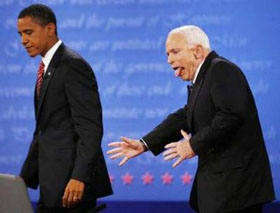
Speaking of tongues, it struck me as odd that McCain, in the post-debate wave to the audience, put up his arms and stuck out his tongue, smiling. It was like Richard Nixon meets Gene Simmons. A photo circulating this morning indicates why you perhaps shouldn’t do that when you’re running for president.

Finally, here’s the interview with Joe the Plumber. If you haven’t watched it yet, really, do so. I’ll wait.

What’s striking to me is how respectfully Obama answers the man, and how thoroughly. What’s more striking is Joe’s body language:

    0:41: Joe jumps in to ask a question, after nodding his head a few times. Obama keeps talking, and he immediately crosses his arms. Read: Joe had a prepared question, and wanted to put Obama on the defensive about a tax plan he doesn’t like. Crossed arms means he’s still waiting for his opportunity.

    0:52: Joe scratches his head and cheek, and drops his arms. That’s a comfort signal; he’s aware he’s on national television, and it’s making him nervous. Perhaps he’s consciously aware that he crossed his arms — that’s a read that most people know about, and most people don’t want to be that visibly defensive.

    1:16: “Well, the reason that I asked you about the American Dream….” Actually, that’s the first mention of it. Again, implies that Joe had a prepared question he didn’t get to articulate.

    1:40: Joe’s hands go on his hips. More of a comfort stance, less defensive than crossed arms. Obama starts asking specific questions about his business.

    1:57: Joe starts to put his hands up, doesn’t try to say anything. Obama agrees with him when Joe says he works hard. Joe agrees with Obama when he talks about people working hard making less than Joe does.

    2:39: Licked lips and tight smile after Obama says that Joe would have done better ten years ago.

    2:47: Obama: “we’ve cut taxes a lot for folks like me who make a lot more than two-fifty”.

    3:05: “I’m going to cut taxes more for folks who are most in need….” Joe leans back and looks up and right. I think he agrees with this more than he wants to, and the defensive rock is a shifting of his argument.

    3:27: “It’s not that I want to punish your success.” Much more genuine smile from Joe.

    3:37: Joe asks about a flat tax. He’s well-informed, slightly switching the terms of the discussion. When Joe looks skeptical of Obama’s claim of a 40% sales tax being needed, Obama catches it and immediately explains.

    4:46: Another genuine smile when Obama says, “even if I don’t get your vote”.

    5:15: When Obama starts talking about zero capital gains taxes for small businesses, Joe’s head cocks. He’s clearly listening to something he didn’t know before.

So, what do I make of this? First, that it’s somewhat fascinating that this exchange has been boiled down to Obama’s use of the phrase “spread the wealth” in the talking heads section of the media. This back-and-forth between a candidate and an informed voter who is hostile on an issue is probably the epitome of what we want retail politics to be. But if Joe hadn’t been used as a ping-pong ball last night, few of us would have seen this.

Second, I’m guessing based on what Joe prepared to ask that he’s probably a solid McCain voter. (Granted, interviews with Joe today help reinforce this idea.) But what Obama does here is engage him and try to find areas of persuasion — and to a small extent, it succeeds. Obama and Joe both acknowledge this dynamic when Obama says he won’t get his vote; Joe’s smile is tacit agreement. But I think Joe got something different than he was expecting, and just maybe that changes his point of view — if not in November, then maybe between here and 2012.

I don’t remember seeing a politician ever doing this so well before. (Perhaps I’d feel differently if I had YouTube in 1992.) Obama is present in the moment of his discussion with Joe, and my gut feeling — unfortunately, no camera angle on Obama’s expressions to support this — is that he really gives a damn. I can see Bush and McCain doing this with their supporters — but with the opposition? Snowball’s chance in hell.

Debate #3

9:10 PM: wasn’t going to liveblog tonight, but I have to say — what’s up with McCain tonight? Yeah, I get that the points he’s trying to make are a bit more brutal than he’s tried before, but his demeanor is just rambling and repetitive. He reminds me of Old Cranky Guy (who won’t let the young guy complete a sentence).

9:13 PM: someone should have told McCain that his stripey tie makes weird moire patterns on non-HD sets. (Hmm… Obama’s too.)

9:16 PM: Bob signs on for neo-Hooverism. Obama signs on. McCain waves his magic wand to increase home values, but digresses from spending cuts before talking about his spending freeze (which apparently won’t freeze much after his exceptions). Trust him, he knows how to cut programs.

9:19 PM: Again with the overhead projector. John, it’s a planetarium projector. The one at the Franklin Institute constituted about 85% of my science education in elementary school. And it’s damn cool.

9:20 PM: I still don’t understand why a man in office for eight years submitted only five budgets.

9:21 PM: “If you wanted to run against George Bush…”, McCain’s rehearsed line, probably came about two months too late. He’s clearly pleased with himself, didn’t get to see if there was a tongue jut to go with it. What’s the over-under on whether McCain repeats himself in the next 70 minutes?

9:23 PM: “Even Fox News disputes it.” Okay, I laughed out loud when Obama said that.

9:24 PM: I don’t know what that puffy thing on the side of McCain’s face is, but it’s much puffier tonight. And McCain seems to enjoy talking over both Obama and the moderator.

9:25 PM: Bonus points for the “will you say this to his face” question. McCain whiffs the answer by talking about it’s because mean Barack wouldn’t talk to him 10 more times. Huh? Says that the problem is John Lewis. Yeah, it’s not about the people calling for presidential assassinations at McCain’s rallies. Three minutes in, McCain hasn’t said one word about what his campaign is saying.

9:28 PM: McCain lies about his campaign while discussing the conduct of his campaign. Wow, he really is turning to Sarah Palin for advice.

9:30 PM: McCain is pissed that he can’t afford to run ads during sporting events like Obama can.

9:33 PM: Geez, McCain cannot keep his mouth shut when Obama is talking. Am I crazy or is does this seem like it’s verging on psychological? And what the hell does military hats have to do with the point? Another lie: “I have repudiated every who’s out of line.” That’s about the most ridiculous statement he can make about it.

9:36 PM: Alright, we get to hear McCain going wingbat for the first time.

9:37 PM: I have also spent time being funded by Walter Annenberg. I guess I should be on the no-fly list, too.

9:39 PM: Does McCain realize that he just lost the point, and he’s just digging himself deeper now?

9:40 PM: “Why is your running mate better?” I heart Bob Schieffer.

9:42 PM: If I were a woman, I think I’d be really annoyed that McCain thinks Palin is my role model.

9:43 PM: “To sweep out the old-boy network and cronyism that I’ve fought against all these years.” That is a quote. Really, why tear down McCain when he’s doing it himself so well?

9:45 PM: Obama deliberately whiffs the Palin qualification question, but nice segue from autism to spending freeze. McCain sees Iraq uniting.

9:46 PM: Alright. The Republican administration just past spent $5 trillion more than they took in. If that doesn’t cause a national moratorium on Republicans calling Democrats spendthrifts, then we need to do some serious activism on the topic.

9:47 PM: The Republican just said, “you can’t just unilaterally renegotiate treaties”. Ibid.

9:49 PM: Obama again talks drilling the one year’s worth of oil we have offshore, which loses Jeff points, but he regains most of them by pointing out immediately that it’s an unsustainable idea.

9:51 PM: McCain, of course, implies that drilling at home will solve all our problems.

9:52 PM: There’s that tongue jut, when McCain said that Obama never went south. And his smile got wider. He’s running through his debate point checklist, but I think the problem is that it’s not about debating points, it’s about going for a clear win that he’s just not getting.

9:56 PM: Fill me in here: does anyone think it’s credible to compare a 2008 Democrat to a 1928 Republican?

9:59 PM: How does McCain get his clinics and programs during a spending freeze?

9:59 PM: Prediction: “Joe the Plumber” is going to be an Internet joke meme for the next eighteen months.

10:03 PM: I’ve realized what’s so creepy about McCain’s smile. He’s doing the best he can to seem bemused and confident, regardless of what’s being said. But we’re not discussing bemusing things. Compare that to Obama — he’s smiling in response to things McCain actually says. Otherwise, he seems, well, neutral.

10:05 PM: McCain continues to repeat things that, if not lies, are at least in direct conflict with what Obama says. And in that case, it comes down to what you say to support your assertions, and I think Obama is actually bothering to do that in a way that McCain isn’t.

10:08 PM: “I will find the best people in the world” for the Supreme Court. Another laugh out loud moment.

10:11 PM: Washington Monthly thinks McCain looks angry. No, I think he’s doing everything in his power not to look angry. Whether he is or not, I’m not sure. Wouldn’t blame him if he is, because he seems to be blowing it.

10:15 PM: John, being “eloquent” is not an insult. Is this supposed to win over the undecideds, that the other guy is too good?

10:20 PM: Pardon me if this is an unfair question, but how exactly is a retired soldier automatically qualified to teach children by virtue of his military service?

10:23 PM: McCain just forgot Michelle Obama’s name.

10:25 PM: After a strong middle, McCain is reverting to old man ramble in the homestretch.

10:37 PM: Thought Obama’s closing was surprisingly weak.

Overall: I think this could have gone for three hours. Much better discussion, much better television.

Debate liveblog

All the cool kids are doing it, so my thinking during the debate tonight:

9:06 PM: Neither one has any idea who they’re appointing Treasury Secretary, or they’re not saying. A bit surprising, that would make a difference in the coming weeks.

9:12 PM: Is it just me, or do you think that “cronies” are people that old people are more likely to have than middle-class people?

9:20 PM: Five George Bush budgets? Shouldn’t that number be eight? I like the hit on the $5 trillion increase since 2000, but I’m skeptical if people are actually taking in that number.

9:21 PM: And here’s your classic example of innumeracy: McCain talks about programs that are drops in the overall bucket. Does bipartisanship play as a reply when the question is “how can we trust either of you?”

9:23 PM: Wonder if Obama will bring up the McCain Medicare cuts in his rebuttal. Whoops, looks like Brokaw beat him to it.

9:24 PM: meta note, I was assuming McCain would try some game-changing approach tonight. If he is, it’s not on the table yet. So far, he’s fairly soporific. So is Obama, but he can afford to be.

9:26 PM: watch the body language in the audience. So far, I see two or three Obama skeptics, but 50/50 when McCain is talking. Waiting for a McCain audience shot to confirm this.

9:28 PM: how anyone thinks that any answer can be contained in one minute is absolutely beyond me.

9:29 PM: dayenu with the overhead projector, John.

9:31 PM: Is McCain wandering around aimlessly in the background?

9:33 PM: Noting that McCain’s line is “Americans can do it”, Obama’s is “more shared sacrifice.”

9:36 PM: McCain is comparing Obama to Hoover? Really? Does anyone remember who Hoover was? (You’d think McCain would.)

9:40 PM: Fortune 500 CEO is Obama’s overheard projector.

9:41 PM: So McCain is saying that he’s unpopular with both parties? Yeah, that’s a great selling point.

9:48 PM: Clearly, McCain didn’t vote for the bailout plan thanks to its goodies. No, wait….

9:52 PM: My question for both candidates: are there any problems that aren’t “major challenges that have to be solved in the next two years?” Sounds to me like the gestalt of all these issues is that we’re already halfway to hell.

9:57 PM: An hour in, and Obama and McCain camera angles aren’t showing the same audience members. I’m seeing much more blue background with McCain. Hard to compare audience reactions when you can’t see them.

10:00 PM: Cheap shot alert: I guess a 6,000-year-old Earth still has corners.

10:04 PM: Brokaw: explain the Obama and McCain Doctrines. You have 90 seconds. Go.

10:07 PM: I have trouble understanding why McCain thinks he’s perceived as the cool hand at the tiller.

10:08 PM: McCain is saying that staying in Iraq has improved our reputation and our ability to act elsewhere? That seems to be the corollary of his argument not to leave.

10:12 PM: Wait, am I crazy, or were many of the “Afghan freedom fighters” the people who went on to be warlords and Taliban extremists?

10:12 PM: I’ll freely admit that I’m concerned about Obama’s plans for expansion of the Afghan war, but it seems to me that he’s phrasing that belligerence as clearly and specifically as one could hope. What part of “as the Commander-in-Chief, I’ll act in favor of American sovereignty” doesn’t he understand? I thought Republicans were supposed to be solid behind that.

10:15 PM: McCain: “I’ll follow Osama to the gates of hell, and I know how to do it, but stay vewwy vewwy quiet while I’m hunting wabbits.”

10:18 PM: We have to do all sorts of things differently, but we have to maintain the same strategy. Huh? What am I missing here?

10:20 PM: Shorter McCain: “We’re not going to have another Cold War with Russia. Instead, it’s much better to risk a hot war with Russia.”

10:22 PM: Obama answer not much better. Am I being too harsh to both of them that I want better specifics in their ninety seconds?

10:24 PM: McCain, “if I say yes”, seems to think he’s already president? Can’t imagine that Obama could get away with that kind of phrasing.

10:26 PM: Funny, the bald guy in the red shirt with the question about Israel doesn’t look Jewish.

10:26 PM: McCain dodging the question on unilateral defense of Israel. Obama talking about nukes, also just saying that “all options are on the table”. Wish either one of them would point out that after a medium-sized nuclear attack on Israel, there’d be nothing left to defend — after that, it’d all be about retaliation over the smoking crater.

10:33 PM: Again with the “we’re really in the shitter” language from McCain. Want to go back and see if this has only been from him and Brokaw, or if Obama also joined in.

Initial response: I’d call this one pretty much a tie — that is, I think Obama’s answers were more thoughtful and responsive to the questions, but then, I would think that, so I might be wrong. But I’d also say a tie goes in Obama’s favor; working on the theory that McCain needs to do something to turn the electoral tide, he sure as hell didn’t have it prepped for this evening.

Incoherent ramblings about the failed bailout

I’ve just spent most of the afternoon watching what I’d expect 1929 would look like if we had CNN back then, and attempting to form some vague kind of educated opinion on the whole mess. Have to say, I’m still largely flummoxed.

As best as I can tell, the timeline of the bailout plan is as follows:

  1. The White House: the markets are in desperate need of liquidity, so give us up to $700 billion to spend as we see fit.
  2. Congressional Democrats: we don’t trust you, so we’ll make modifications to the plan1 to make it more palatable; with these modifications, we’re still not thrilled about it, but it’s better than doing nothing.
    1. The White House: alright, if that’s what we can get, that’s what we’ll take.
  3. Congressional Republicans: forget it, because:
    1. we have strong political beliefs in opposition to this kind of big government intervention in the marketplace, and/or
    2. our districts are 90% red-meat Red Staters who think Medicare is socialism, and there’s no way in hell that we won’t get our butts kicked in five weeks if we agree to this.2 Therefore:
    3. we want to use a private insurance fund instead.3
    4. John McCain: I agree with the House Republicans.4
  4. White House and House Democrats: WTF?
    1. 1/3rd of House Democrats: Look, if the other guys aren’t getting on board, I’m not exactly happy with the faxes I’m getting today either….
  5. Bailout collapses.

    1 Still pretty unclear to me exactly what these modifications were, as none of the media I’m reading will tell me with specifics, except that they have something to do with equity stakes and protecting homeowners. How, exactly, remains a mystery as these facts aren’t fit for widespread consumption.

    2 Electoral Armageddon inferred from reports today of Congressional offices being “flooded” with requests to vote against the bailout. I’m inferring that some politicians, based on their constituencies, are more vulnerable to this than others.

    3 Which won’t work, for the same reason that you can’t buy insurance when your house is on fire.

    4 According to this story in the Washington Post.

What’s left out of the whole thing so far, despite my reading around 1,000 pages of “news” about the bailout, is a compelling argument that I can get behind. I’m still not entirely sure if I’m rooting for Barney Frank, George Bush, or John Boehner. And really, that’s a rare state of affairs.

So far, the best I can come up with in terms of an informed opinion is this:

  1. The markets need an infusion of liquidity to prevent a 1929-style meltdown. The problem is wide enough that the usual players don’t have the money to buy out bad debts on good terms, so only the debt-saddled government is able to magically go further into debt in order to put more money into play.
  2. The problem, as I see it, is that if it were a private entity making these purchases, they’d do what capitalism dictates: that is, rape the hell out of the companies with their backs against the wall, buying their assets at steeply discounted prices over their true values even in today’s market, because you don’t cut a break to companies who are desperate to deal.
  3. The bailout plan as proposed by Paulson doesn’t really imply that the government will act in the same way that private companies will act. In other words, we’re likely to overpay for these assets, because that’s the only way to get capital into the markets. And “overpaying for assets” sounds a lot to me like “let’s screw over the public, since they’re unlikely to understand how bad these deals are.”
  4. The normal alternative way of putting capital into markets is to simply buy stock or entire companies, which strikes me as pretty much the fair way of putting government money in play. Apparently this is the Sweden formula. Apparently, also, we can’t do this in the US, because it’s somehow bad when the government invests in business the way most people do, rather than just hand out money.

And that’s as far as I’ve gotten. I’d be somewhat further along if, for example, there were a viable Democratic alternative on the table (as opposed to Democratic tinkering with the One True Plan), which laid out the aspects of Sweden-style or nationalizing methods they have in mind. Or, alternately, if there were more debate about these issues in the stories about the bailout—most of what I’ve written here comes from link-surfing off Paul Krugman and Brad DeLong’s blog postings, without which my barest understandings of the issues would be reduced to a tiny glimmer.

What I really learned came from watching four hours of CNN today, starting with Wolf Blitzer having near-orgasms on live television as he got to bombastically announce that today was the worst point drop in history (I rather had the impression he was rooting for it, so he could say it), to Lou Dobbs saying that this is all the Democrats’ fault for not using their majority to rubber-stamp the Bush proposal. That’s when I turned off the TV.

In all that time, I heard nothing that added to my understanding of the crisis, the bailout, the alternatives to the bailout, or that allowed me to form an opinion about what would be better for the country. I did get to hear hours of debate about whether the Pelosi speech scotched the deal. Maybe I’d care about that more if I had the slightest clue as to whether that was preferable.

Maybe the reason we’re so deep in the shitter is that this is what passes for news and informed debate, and has passed for such in the years leading up to today.

US Announces Massive Bailout of Warner Brothers

September 29, 2008: Washington released the final results of its $713.2 billion bailout plan today, surprising investors and capital markets by announcing the whole sum to go into a debt purchase and equity investment in the venerable 90-year-old firm Warner Brothers.

In a live address to the nation, President George W. Bush announced that “the merry-go-round broke down.” Warning of severe consequences to the American economy, Bush stated, “The failure of additional American banks will inevitably lead to the demolition of their buildings, and a plague of unreliable singing frogs will be unleashed upon the nation, causing untold ruin to all taxpayers who believe they can get them to perform before an audience.”

Government intervention was believed to be inevitable after rumors arose that Disney was eyeing Warner Brothers for private acquisition. Former Senator Phil Gramm said, “The merger of Looney Tunes and Merry Melodies with Silly Symphonies would cause an unfortunate monopolistic position in the crucial category of amusing orchestration.”

Additional concerns were raised that allowing Warner Brothers to collapse would cause its characters to form numerous and multicolored terrorist cels.

The decision is not without controversy. Longtime Bush contributor and Texas native Frederick Bean “Tex” Avery will lead the government distribution of funds, while colleague Mel Blanc was left out of negotiations after suspicions were raised that he was French.

Additional details of the plan as of press time:

1. Investment in the American entrepreneurial spirit, and continued innovation and product R&D, is ensured by making the Acme Corporation the sole supplier of the US military, the Army Corps of Engineers, FEMA, and the Department of Agriculture. Acme spokesman Leon Schlesinger said Thursday, “The equity position the US government is taking in Acme is predicted to value at 3.7 gazillion simoleans by 2013.”

2. Furthering Bush administration plans to switch to clean energy, 20% of the nation’s automobiles to be powered by PU-38 by 2016. 15,000 jobs are expected to be created in the high-energy physics and engineering sector to develop and implement Explosive Space Modulator Deactivator technologies.

3. A special committee at the Department of Commerce will release statistics tracking the value of government investments, highlighting those increasing in value. The What’s Up DOC memorandum will be released monthly at Kirtland Air Force Base, just left of Albuquerque, New Mexico.

4. To prevent a collapse of the value of the dollar on international currency markets, a basket of international treasury bills will be maintained, termed Loosely Entangled Pricing in Euro Wealth. The LEPEW is expected to maintain the dollar in 4 1/6 Eurocent increments, with currency equality termed “24 carrots”.

5. Bull and bear markets to be replaced with “rabbit seasons” and “duck seasons”. Periods when “the market is not functioning normally” to be called “Elmer seasons”.

McCain-Palin-??? ’08

Spotted on Philly’s Action News this morning: a news report saying first what speeches Obama and Palin gave yesterday, followed by news about what Biden and McCain were up to. Interesting match up, and indicative of a sort of political dyslexia going on about who exactly is running for the presidency.

Some of my regular readers might be surprised to hear that I think that this is proper, to some extent, thanks to an actuarial tidbit I heard reported the other day: a 72-year-old man has, on average, a 1 in 3 chance of making it to 80. Or, put another way, the odds are 2 out of 3 that a McCain vice-president will assume the presidency if he is elected to two terms. I’m tempted to do some research about what the odds are that he’ll see 76, but considering that we’re talking about a septuagenarian who has had cancer and has spent time in a prison camp, I’m not sure how relevant averages are to the complete story. (And, to be fair, his mother is well into her 90s, which makes predictions even more difficult.)

So I would love to hear much more discussion about the fact that electing the Republican ticket makes it quite likely that we’re electing two presidents: a McCain presidency followed by a Palin presidency. Open debate about this could go either way: I expect that it would make the Christian Right moose dressing faction even more rapturous, as it were, about electing them to office, but considering how much of our political debate has been dominated by the War on Lack of Fear on Terror in the last seven years, I wonder how many people are giving any consideration to the possibility of having President Palin running the show in six months.

Vice-presidential tea leaves

Finally caught the Palin debutante speech from the GOP convention, and I have to admit, I just don’t get it. Something about her speaking style put me back into a high school auditorium listening to a lecture about dental hygiene.

The GOP faithful are treating her as the second coming of the Virgin Mary (and she’s got the edge on Mary, with two immaculate conceptions in one year). So far the selection of Vice President Fátima has indeed magically erased the memory of McCain as a weak candidate. Already some Democrats are gulping Xanax and waiting to see how we fuck it up this time. Really, we’re the party of the Grinch Who Gave Away Christmas.

We’re all reduced to reading the tea leaves about Sarah Palin, because 99.78% of us had never heard of her before Labor Day (and the fact that that’s not telling us something is what causes me to reach for the Xanax). We’re debating earmarks on bridges and whether she tried to ban books in a local library, as the major ingredients of a national debate. Why? Because those are the largest things we have to talk about in figuring her out.

A few more leaves for the tea, courtesy of Talking Points Memo:

Here’s the interesting bit that I had missed until I saw that report: Alaskans find the phrase “Bridge to Nowhere” to be offensive. Huh. With 10 seconds’ consideration, it occurred to me: of course they do. It’s the same way I feel whenever someone refers to Philadelphia dismissively in comparison to New York.

Yet the governor of Alaska immediately uses that rhetoric as soon as she’s on nationwide camera, and the hell with how it plays at home. She might publicly despise the Washington insider media, but she’ll happily play with their tropes when it suits her. I’m willing to call that a character issue; she can lie about what she did with 200 million federal dollars while at the same time not demeaning the people who put her on the national stage. But she doesn’t.

More tea leaves: as I write this, the first clips are circulating of the Charlie Gibson interview with Palin (supplanting People magazine as the most incisive news gatherers to have access to her). It starts off with this excerpt:

GIBSON: Can you look the country in the eye and say “I have the experience and I have the ability to be not just vice president, but perhaps president of the United States of America?”

PALIN: I do, Charlie, and on January 20, when John McCain and I are sworn in, if we are so privileged to be elected to serve this country, we’ll be ready. I’m ready.

GIBSON: And you didn’t say to yourself, “Am I experienced enough? Am I ready? Do I know enough about international affairs? Do I — will I feel comfortable enough on the national stage to do this?”

PALIN: I didn’t hesitate, no.

GIBSON: Didn’t that take some hubris?

PALIN: I — I answered him yes because I have the confidence in that readiness and knowing that you can’t blink, you have to be wired in a way of being so committed to the mission, the mission that we’re on, reform of this country and victory in the war, you can’t blink.

Now, you’ve got two ways of looking at that statement: either it’s admirable self-confidence, or it’s terrifying overconfidence. I’d prefer to hear something which perhaps would be more truthful, such as, “Like most of America, I was surprised to be asked, and the enormity of it didn’t immediately set in. But I realized I could do it when John and I talked about it.”

The problem with overconfidence is obvious, but it’s even worse when it’s tested in a state of national crisis — which would be pretty much the definition of any ascension of Sarah Palin to the presidency before 2017. It’s what scared me about George W. Bush on 9/11 — no, not The Pet Goat clip, I didn’t see that until years later, but rather his noontime speech to the nation with that deer-in-the-headlights million-yard stare and the talk of crusade.

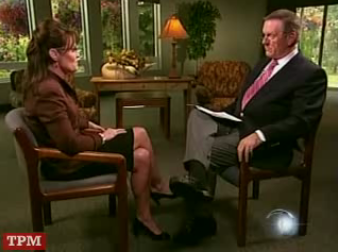
So if I saw that in Palin, I’d be concerned. And I am concerned. Again, this is tea leaf tasseomancy, but check out this clip in which, as TPM points out, Palin is caught with no idea what she’s talking about:

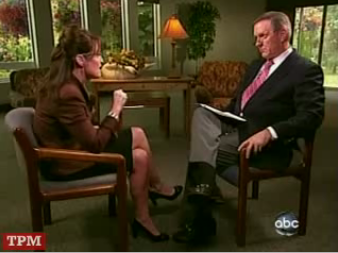
It doesn’t bother me that she didn’t know the term; I think I’ve heard “the Powell Doctrine” more often than I’ve heard “the Bush Doctrine” in the last eight years. What bothers me is her instinctive response to the question. Don’t just listen to what she says; that’s the part that’s prepared. Check out what she does. Note her posture at the beginning of the clip:

And about halfway through:

Her shoulders hunch. Her arm is raised and held in front of her torso. In her answer, you can see her lips purse. These are classic limbic system signals for “I wasn’t ready for this and now I’m afraid of screwing it up.” A confident person would remain physically relaxed during these questions, regardless of what she actually said. You can watch her try to regain her footing, literally; as she answers Gibson’s questions, she waves her foot in time with the key words of her statement, probably the ones she thinks put her back in control of the interview.

But her body language remains crouched against attack. She’s not confident, on a level that goes beyond coaching. You can’t coach for this.

So we have a candidate who wants to project the image of perfect confidence, but can be thrown off by a question she can’t answer. I’m calling her on it because the language of “blink” tries to imply instinctive confidence. That’s pretty much both the image and the shortcomings we have in the White House now, and in my view it was that fear of failure that psychologically helped lead to seven years of political swaggering and military force.

Thankfully, we’re at least two major events from the concern of watching President Palin face that kind of crucible. Even so, I trust this kind of read more than the next two months of airbrushed pablum I’m going to be fed, and I’m quite comfortable saying that I’ll be scared shitless if she finds herself behind the desk of the Oval Office.

Only You

Back in 1990, I spent a year in the Penn Glee Club, performing with a group of singers and musicians who were uniformly more talented than I am. We went on the road in Austria and Hungary that summer, I formed several lifelong friendships, and I learned never, ever to eat sauerschnitzel again.

The thing about performing the same show twenty or thirty times is that most of it loses its magic to the listener, but two songs in the show still stand out in my mind. The first was my buddy Mike Weinmayr’s performance of the song “Home” from the obscure musical The Adventures of Betty Boop, which still plays on my mental soundtrack whenever the plane touches down.

The other was a solo performance by my classmate Marvin Lyon. Marvin had a grace on the stage that made me understand as a straight guy why the girls were swooning in the audience. And his voice… damn, that boy had pipes. The song was “Only You” by Yazoo, and Marvin did it better.

Marvin died a few years ago, which is why, when his song popped up on Pandora today and I heard it for the first time in 15 years, I felt the need to say: Marvin, you moved me. Thank you.

On Chinese blogging and American free speech

Once again, I have done more effort to blog on someone else’s site than on my own. Over on I Should Be Sleeping, a discussion on Chinese Internet usage and governmental control led to the following comment to Brian. Cross-posting here, comments shut off so we can keep discussion all in one place on Brian’s site.

Comment follows:

If “Great Firewall of China” is a new term to you, I strongly recommend you waste an evening Googling articles about the Chinese Internet — the combination of the Internet, hundreds of millions of Chinese users, and an authoritarian state makes for some fascinating reading.

In brief, though, it’s definitely true that you’ll see things on the Chinese Internet that you wouldn’t expect to see. The fact is that most Westerners never see them — and that’s due to what I think is an amazing aspect of the Internet: almost all US observers assume that the English segment of the Internet is “the” Internet, and completely ignore the vast swaths of it that they can’t read. Hence, the world’s largest social networking sites, online MMORPGs, and blog forums are completely invisible. This does not occur in the opposite direction; there is a large plurality of non-native English speakers on the Internet who have some English facility. (And, of course, major English properties are frequently translated.)

A few thoughts to get you started on your reading:

1) one of the interesting aspects of China’s Internet policy is that everything gets read by the government. At first, China threw huge resources at reading everything that was posted internally — estimates of over 100,000 government viewers were made — so that no subversive thought could go unpunished. Today, the job is mostly done electronically, with things such as keyword filtering, text analysis, and cameras at public Internet cafes. China’s internal routers are designed to allow for this to occur at the IP level, so you don’t need to post in a public forum to attract governmental attention.

I strongly encourage you to read more about what has happened in China and elsewhere on this front, because it informs my opinions about the ease of creating such a totalitarian state here. To date, American advances in this regard include the ISP filters watching domestic Internet traffic, the ECHELON and other transnational systems that review all incoming and outbound phone and Internet international traffic, individuals being increasingly tracked by the government through cameras and data mining, and the moves by the TSA to put dissenters on terrorist watch lists. (Did you catch the news that, to fly without ID, you need to provide the government with details of your past addresses? I.e., what you say at the airport is checked against their pre-existing databases on you.)

We are completely in agreement that today we have much freer expression than people in other countries; my fear is that this is a temporary situation, thanks to lack of concern about how we nibble at the edges of free speech. It’s a fairly simple tautology: a) future terrorist attacks and threats will induce a greater clampdown on American freedoms; b) future terrorist attacks and threats are largely assumed to be inevitable. Ergo, it’s a question of when, not if, we will lose more of our current civil liberties.

2) in authoritarian states, there is a complicated pax de deus whereby the government signals its people what things may be discussed and what may not. Generally, this is far more subtle than having a presidential aide tell the country that they have to watch what they say. What you’re seeing on the Chinese Internet is a result of all communication which have already passed through these internal filters. I don’t think it’s particularly heartening that dissent about Chinese management is online; history proves that such dissent exists in all authoritarian states. What you see online is, by and large, only the approved dissent, which is up there with “free speech zones” in the realm of inherently contradictory concepts.

That said, what I find much more heartening is the potential of technology to provide ways to bypass government filters in repressive regimes. Encryption and proxy servers can go a long way towards giving authoritarian government headaches; authoritarian governments respond by making such technologies themselves illegal.

Hence, I would argue that the affordances of such technology are highly political: people who have access to such technologies and frequently use them are likely to enjoy greater civil liberties, and are likely to continue enjoying these liberties. Put another way, a polity that currently enjoys a high level of civil liberty is likely to stanch the authoritarian impulse in their governments by making it nontrivial for them to casually review their communications, and to make it more difficult for them to casually impose new restrictions and monitoring.

In short, once the question is asked, “What do you have to hide?”, the presumption that you have to choose what is hidden is already made for you. Likewise, if your answer is “I have nothing to hide”, then your lack of concern makes it more likely that this will cease to be a choice, but rather a regular state of existence.

Which is why I think it would be excellent if more Americans paid regular attention to what it is like to live in China. America in 2008 bears political features which we despised in the 1988 Soviet Union, and this transition has occurred organically. It seems to me that if we do not wish to live in a Chinese-style environment in 2028, we should pay attention to the current sociological demonstrations of such cultures that we have available to us.

Mac mutants in training

Hidden paparazzi shot this picture of TidBITS editor Adam Engst, in training in the Danger Room East at Castle Rhuddlan, site of a recent battle against Dr. Doom:

Engst’s mutant powers are unrevealed at press time, but are rumored to include superhuman endurance, the ability to withstand inhuman terrain and weather conditions at his secret base in Ithaca, and the Bondi Blue Beam o’ Correct Punctuation.

Movie titles of the damned

In the dream I was having when I woke up this morning, I was making plans to go see a movie called “The Xeriactive Chrondriac”. Piecing together Greek and Latin roots, this appears to mean “the man with an extremely dry stomach.”

I infer that this movie is a foreign import, translated into English by a crack team of Oxbridge linguists, with estimated opening weekend box office receipts of $24. I’m also somewhat relieved that I woke up before actually seeing the movie.