
Someone forgot to mention the war ended in 1918.
Someone forgot to mention the war ended in 1918.

Empty airports are eerie.
Above the fold today at The Pirate Bay:
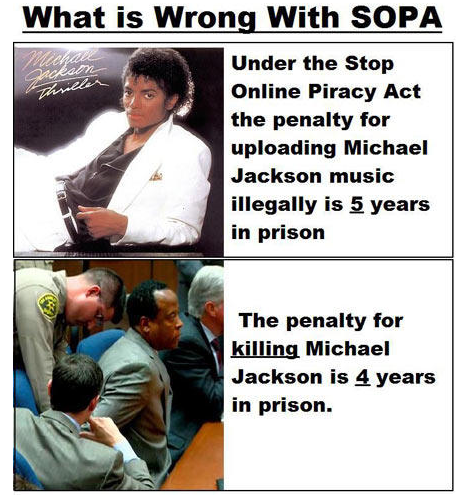
Under the Stop Online Privacy Act the penalty for uploading Michael Jackson music illegally is 5 years in prison. The penalty for killing Michael Jackson is 4 years in prison.
Good analysis on the eTextbook thing at Macworld.
The day before the event, the Macalope was chatting with a community college math professor who said the textbook his students needed to buy was almost $300. Two books like that and there’s your iPad. The Macalope also wouldn’t be surprised if we saw a cheaper iPad this year.
“It is the opinion of this court that the Constitution was crafted in such a manner as to uphold and encourage practices that are not right and, ideally, are very wrong,” Justice Antonin Scalia wrote for the majority, which also included Justices Clarence Thomas, Samuel Alito, Anthony Kennedy, and John Roberts. “Despite the compelling case for goodness, truth, and justice made by our predecessors in the case of Right v. Wrong, we firmly believe that malice, dishonesty, and injustice were the framers’ original intent.”
I don’t really have the mathematics to understand this, but it sounds pretty exciting.
The Fourier transform is one of the most fundamental concepts in the information sciences. It’s a method for representing an irregular signal — such as the voltage fluctuations in the wire that connects an MP3 player to a loudspeaker — as a combination of pure frequencies. It’s universal in signal processing, but it can also be used to compress image and audio files, solve differential equations and price stock options, among other things.
A group of MIT researchers will present a new algorithm that, in a large range of practically important cases, improves on the fast Fourier transform. Under some circumstances, the improvement can be dramatic — a tenfold increase in speed. The new algorithm could be particularly useful for image compression, enabling, say, smartphones to wirelessly transmit large video files without draining their batteries or consuming their monthly bandwidth allotments.
The new top-level domains are making the news again, and based on the mass media I’ve been sampling, they’re coming with a great deal of sturm und drang about how this will ruin the Internet, make everyone’s lives miserable, or force you to watch porn while Russian mobsters raid your bank account.
I think that’s all more than silly, so I’m linking to an article I wrote for TidBITS last February. Shorter version: top-level domains are mostly as important as your area code in determining how worthwhile you are.
Clearly, God must hate America. There’s no other logical explanation.
2011–through its entirety–was record-setting for extreme precipitation in the U.S. dating back 100 years. Jeff Masters at Wunderground was the first to blog about this and offered the evidence…. To me, as striking as the fraction of the country affected by these extremes was the close proximity between the downpours and the desiccation.
Every once in a while, you have to look at a new discovery and think, “Man, that is utterly fucking impossible.”
Researchers at I.B.M. have stored and retrieved digital 1s and 0s from an array of just 12 atoms, pushing the boundaries of the magnetic storage of information to the edge of what is possible.
Just once, it would be nice to have a Republican front-runner who isn’t a sociopath.
Romney talks about paying for health insurance as if it were the same as getting a pedicure, hiring an escort or getting the fancy wax at a car wash. It’s a luxury service being provided to him, and he doesn’t like it, he can take his business elsewhere. Romney’s is the language of a man who has never wanted for anything, never worried about where his next paycheck would come from, never worried about going bankrupt if he got sick.
Excellent essay by MG Siegler detailing how Android has failed to live up to its original promise. I don’t know if the original plan was ever possible, but there’s no question in my mind that this model is better for consumers and technological development than the one we have now.
Apple, for all the shit they get for being “closed” and “evil”, has actually done far more to wrestle control back from the carriers and put it into the hands of consumers. Google set off to help in this goal, then stabbed us all in the back and went the complete other way, to the side of the carriers. And because they smiled the entire time they were doing it and fed us this “open” bullshit, we thanked them for it. We’re still thanking them for it!
Intel gets caught with their pants down on a CES demo, showing a movie instead of a live game. This is one reason why I’m very interested by the OnLive gaming model, which virtualizes gaming servers and turns your computer into a thin gaming client: not only does it make the speed of your graphic chip irrelevant, but it does the same for your OS. PlayStation gaming on an Android tablet? No problem.
Via Gruber, an interesting post across the transom by MG Siegler about Google’s addition of Google+ results to all search results. Siegler in turn links to John Battelle’s thoughts on the matter:
Google hasn’t made peace with Facebook, and therefore is not crawling Facebook data…. Facebook, in turn, has not made most of what happens inside Facebook available to search engines. It’s a standoff, because neither company really knows how to value the other company’s partnership.
And it sucks for the web. The unwillingness of Facebook and Google to share a public commons when it comes to the intersection of search and social is corrosive to the connective tissue of our shared culture.
Personally, I have trouble seeing this as an antitrust issue so long as ease-of-posting to multiple social networks remains available. Most folks I know publish simultaneously to Facebook and Twitter, and will probably include Google+ once there’s enough critical mass there to make publishing to that site valuable. (Hasn’t much happened yet; aside from a few diehards, I’m still not getting a Google+ stream anywhere near as worth checking as what I get from the Big Two.) What makes the social networks viable is the personal content they publish, so as long as most people are cross-posting, then there’s no monopoly as everyone has access to data that they can republish with ads.
Call me in favor of Google’s move, because I’ve been waiting for Google+ to do something to make itself relevant. Right now it’s not; I’ll glance at Google+ every once in a while when the GoogleBar reminds me to, but it’s not yet a destination. Start making my content on Google+ appear in front of the people who’ve circled me, and suddenly I have a real incentive to be there–both for my own edification, and to stay on the radar of people in my network.
What makes the Big Two the Big Two? Facebook finally realized the dream of sixdegrees.com by hitting the critical mass that made it the place to be, and then used that goodwill by creating the biggest walled garden since AOL. Twitter realized that everyday chit-chat with interesting people had no analogue on the web and created it. In the US at least, everyone else is an also-ran (I’m still trying to figure out what LinkedIn is good for).
But what makes Google+ exciting is precisely the cross-application connections between data that no one else can provide. I wouldn’t mind seeing intelligent agents that alert me–when privacy permissions allow–that several of my contacts are attending the same event, or that a particular web page is getting buzz (so to speak) in Reader among my circles.
We have plenty of examples proving that crowdsourcing is one of the best ways of creating solid information by magic, without any extra effort on the part of the participants. My microcrowds are filled with some very smart cookies; Google+ has an opportunity to stand out by starting to aggregate what they’re doing and keeping me informed of it.
In the first and second parts of this diatribe against the idiocy that is Microsoft’s vision of the future, I highlighted a bunch of depicted technologies that are a) extremely likely to be impossible in 2021, b) completely at odds with how we use Internet technologies today, c) an affront to the intelligence of any human watching the video, or d) all of the above.
But the worst thing about this video is that it is so damned pedestrian. There is just so, so, so little here than shows me that Microsoft has any vision for the future, let alone how they intend to be a part of it. Fuck impossible holograms. Here’s the world I want to live in in 2021, and here’s how Microsoft fails to indicate that they have any interest in building it.
 |
This is literally the opening second of the video, and what are we watching? An executive rolling her carry-on bag to the magical pickup that’s been arranged with Microsoft technologies. We know two things about this carry-on: it weighs 44 fricking pounds, and she’s schlepped it for the last 24 hours from Sydney to Johannesburg with at least one layover.
How’s this for a better idea? In the grand data-integrated future, my hotel and air carrier can actually talk to each other, and my luggage can show up in my damned hotel room without my having to touch it.
 |
Here we see that in 2021, airport tarmac, which is driven upon by actual cars, is a Microsoft display surface. This is called out because it is So. Fucking. Stupid. I would have given this some credence if it were shown to be a projection from the ceiling, but no: it doesn’t appear projected on the limo when it arrives.
But even worse is the display behind Ayla. It’s a standard airport sign, and it’s needlessly animated. A printed sign works just fine for me when I’ve been in a dozen countries where I don’t speak the language; why in God’s name would you put a display surface here? Put up a goddamn sign that’s useful for anyone even if they don’t have thousands of dollars worth of portable technology. This is an airport in Africa. It’s ten years in the future. Get real.
 |
A second example of So. Fucking. Stupid. 1) You just put a display surface where it’s invisible to the user and useless to anyone else. 2) You want us to believe that a pair of eyeglasses is both translating a spoken announcement and blocking out the ambient sound of the original announcement. Hey, Einsteins at Microsoft: eyeglasses cover your eyes. Your ears are what you hear with, while your ass is what you find with both hands on a good day. You couldn’t show us a rendition of the Bluetooth headset of 2021? Because that would actually make sense.
PS: eyeglasses = display surface, if you can stick one on a business card. That’s a hell of a lot simpler than the hoops you jump through for the rest of the video.
 |
I have to bring back this picture because it’s just so many different kinds of stupid, as well as a missed Microsoft opportunity.
First: counting down the seconds is useful for any timer where precision to the second is actually feasible. I.e., a cab ride is not a useful place to display “15:24 remaining”. It’s useless and inaccurate information, and shows a sensibility that’s designed by engineers, not humans. Hint: the Apple display would say “about 15 minutes”.
Second: yes, I get it. You’ve got the Kinect, and that’s actually the only technology you do have that might give you a leg up on this future. I’d love to see your ideas on how you intend to Kinectify our future devices, because this is where you could really grab our mindsets by their collective balls and make us think you’ve got something important coming up.
Pointing in midair and drawing a heart ain’t it. In fact, it’s just the first of many depictions of a technology that’s more suited for 2221 than 2021, because it posits the existence of a Strong AI operating system that can anticipate the desires of the user and perform them instantaneously.
In this picture, is Ayla drawing a heart in midair? Or is she attempting to tap on her touchpad? Maybe she’s about to point for the driver? Scratch her knee? The magical device in her hand Just Knows and Responds Accordingly.
Bullshit. It tells me, instead, that no one at Microsoft is being serious about this video.
 |
Note that the countdown timer is faintly visible in the window.
 |
Note that my taxi just told anyone who’s watching where my meeting is tomorrow. As well as any other information that Microsoft decides to display on my car window.
Eyeglasses. Just. Use. The. Eyeglasses.
 |
Could you possibly demonstrate any more thoroughly how completely you are missing the point?
It’s 2021. Why in the name of all that’s holy am I checking into my hotel manually from the taxicab? That is something that should be done for me when my GPS signal is detected at the airport gate before takeoff, and confirmed for me when it takes off on time. If vehicles are sending maintenance messages, then my airplane should damn well be calling my hotel to tell it when I’ve got a weather delay. And if there’s some problem and my hotel gets overbooked, find me another goddamned room.
If that happens, send me an alert and give me an interface. Otherwise, all you’ve done with the future is put a very pretty rotary dial on your iPhone.
 |
This is where I start to question your marketing message. Our friend Ayla has the kind of job where she flies from Sydney to Johannesburg for a meeting, sure, but it’s not really clear how important she is until she gets here. After all, it’s 2021. Don’t you want to present a future where everyone has the dynamic kind of job where she’s constantly talking to colleagues on three continents?
So why does Ayla have an executive suite? I mean, never mind that the cheapest flight from Sydney to Jo’burg is $8,000. That hotel room is probably going to match that bill in three days. So your message is: if you’re as rich as Croesus, hoo boy, do we have the future for you!
That’s funny. I thought you were the guys with a motto of “a computer on every desk,” and that you made most of your money by sticking your OS on every piece of crappy commodity hardware you could find. Ayla is apparently the kind of person whose Microsoft Bing Navigator with Holographic Maps has a standing preference to avoid the “We Are the 99%” Protest Hooverville that should be visible from just about any fucking view of Johannesburg.
Which kind of brings me to this:
 |
Really? Really? You set your future in Johannesburg, and your prominent black person is a Bellhop Assistant? Does this mean something different in 2021 than it does today? Are you aware that you could have put any number of white collar titles on this man’s display and avoided all of this?
I mean, shit, just make Anya’s surname “de Klerk” and be done with it.
 |
Don’t think I didn’t notice that the time on Qin’s phone is the same as the time on Ayla’s phone. This is what I completely fail to understand about this video. You put so much effort into production values for everything but the products. It’s just goddamn sloppy. And that’s before I noticed that the mockup was apparently intended for an American audience before you stuck the actor in Hong Kong.
Now that I’m getting to see what your UI is actually like: Christ almighty, no thanks. That’s the most cluttered combination of totally extraneous elements I’ve ever seen, and you seem to be user-hostile about letting us focus on anything. That’s the device of the guy who wants to spend his entire day on Twitter and Facebook. Your vision of the future is awful. This is truly the best you can do?
Hint: the Apple video would show a clock and subway timetable on the home screen. If a new email arrived, it sure as hell wouldn’t pop up fullscreen without being asked.
(Which reminds me: in your future, Australian cell phones get holograms in Johannesburg, people have broadband in subway tunnels, but you can’t get online in a plane. Have you visited Earth recently? It’s kind of the opposite where we live.)
 |
This single image says, “We have 1,000 marketers for every software engineer, and no one competent about computers or UI design was consulted in the making of this video.” It’s just that bad. This tells me that the future of Microsoft is being charted by the people who came up with the brown Zune.
 |
I wrote software to determine exactly how long this image appears on screen, and it’s 0.7 seconds. Wendy is 32. Qin spoke to her 15 days ago. The software suggests he send her a gift. The very next scene: Qin puts down his phone and looks up and away with body language that pretty clearly says, “yeah, fuck that.”
What exactly are you trying to convey here? Because it’s not attractive.
 |
This is bugfuck nuts. Seriously. The benefit concert is presumably playing in many stations, but the musician depicted immediately responds to the user’s action? You think that people will be more charitable when the musician is not physically standing on the platform performing? Has it ever occurred to you why a musician needs to put out a guitar case and throw in his own five bucks to start the day?
Then you show us that the musician is trying to raise US$6,600. Most street musicians consider $50 to be a damn good day. Again, this shows that not only are you ignorant about the technology you’re selling, you’re ignorant about the people you’re selling to.
 |
Okay, just so we’re clear.
You’re demoing hardware—presumably not manufactured by Microsoft—that is capable of 3D input and holographic displays.
Microsoft Office 2021, in your vision, still works with 2D slides and documents.
Ayla works for a goddamn architectural firm. And her technology does not use the sort of 3D modeling and display work that is currently available in Google SketchUp.
You know, the idea that Microsoft will be this moribund in 10 years isn’t surprising at all. What is surprising is that you seem to agree.
 |
Of course you had some Microsoft executive insist on including a QWERTY keyboard, because obviously you don’t want to scare away all of the gray-haired people who might watch this video. I even like the suggestion that Excel is still going to be vaguely useful in your future.
But what blows it is how you’ve lined up the keyboard perfectly with the hardware monitor. This isn’t a work desk, it’s a place where you’ve bolted down a keyboard and monitor for a demo. Make the keyboard askew. Show how all of the tabletop UI aligns itself with the keyboard to make it actually useful for a human user.
And for God’s sake, get rid of the drafting light. There’s not a single thing in this office that requires something this archaic. You might as well replace the keyboard with an Underwood typewriter.
 |
We’ve just seen Ayla’s hotel workspace. Would you mind explaining the UI and/or AI that perfectly frames her upper torso for this video call, and then knows exactly which of several dozen interface elements spread out over three continents that this Kinect gesture applies to? You’re not demoing technology here. You’re demoing telepathy.
 |
Two questions:
1) why is Qin arriving at 2 PM for his 11 AM meeting?
2) what exactly does he need to carry in that knapsack? All of the documents that were printed out on paper by Microsoft Office 2021?
 |
In this segment Qin drags a graph off of his tablet and it “drops” along his line of sight to the display surface behind it. But everything is a display surface. What happens if it accidentally appears on the far wall? Can it fall out the window? And why did you neglect to include a bullshit holographic midair image with this motion, where the animation would actually be useful?
Also, why is there a hole in his tablet? Is that a cheeseboard?
 |
If I’m reading the implication correctly, Microsoft Office 2021 will comprehend the actual language and mathematics used in documents, and will make suggestions as to how designs can be improved.
“It looks like you’re trying to create a design that requires a master’s degree in architecture, a Ph.D. in environmental engineering, and sentience. Would you like help with that?”
Again, this is appropriate for a video set in 2221, not ten years from now. Get serious. I could easily write another 1,000 words on all of the impossible things requiring Strong AI in the next 15 seconds of video.
 |
I’m impressed how Sydney/Shannon has a completely clean physical workspace, and the most cluttered invisible spatial interface known to mankind in her tablet. Just one question: is her Ritalin dosage measured in milligrams or actual grams?
“It’s lo-og, it’s lo-og, it’s big, it’s heavy, it’s wood! It’s lo-og, it’s lo-og, it’s better than bad, it’s good!” I’m especially impressed that Shannon/Sydney has both a diary and a log. Because that’s not using geek language that an 11-year-old would never use at all.
Another question: just what the hell is that “Ideas for bake sale” window doing there before Sydney/Shannon asks it to find 1,296 recipes? Did she get that far in setting up this project, then get distracted? Does she need a bigger dose of Ritalin?
 |
Nothing says, “Mom, I love you,” like a handwritten note that gets immediately converted into a handwritten font. Or like a note that says, “Drop everything and pay attention to me immediately, goddammit.”
By the way, Shannon/Sydney? It’s 4 PM Monday. Your fucking bake sale is tomorrow. Could you possibly have found any better time to pick out a goddamn pie? Ask your Dad, he’s home and presumably unemployed. Hell, he even chips in to make dinner one goddamn night a week, while your Mom takes care of all that woman stuff with her fabulous Microsoft technology the rest of the week, no matter what continent she’s on.
 |
In 2021, Microsoft will have the foresight to use a graphic design popularized by South Park in the 1990s for children being born today.
 |
Nothing says “technology of the future” like woodgrain finish.
 |
Nothing says “technology of the future” like transparent aluminum. Seriously, Microsoft, what the fuck?
 |
Question: how is a chocolate tart “more like” an apple pie, and less like a chocolate brownie? What if I wanted more desserts with fucking apples? And how exactly does an Australian family with a Czech surname arrive at the idea of a South African melktert on the next page just because Mom happens to be there at the moment? I mean, that’s one hell of a coincidence. Or is Ayla really Afrikaner? (In which case, please cf. “only black guy in Microsoft’s South Africa is a bellhop.”)
 |
Mom has just started a 70 minute recipe with her daughter. Meanwhile, her company has flown her 6,867 miles and put her in an executive suite for three days in order to attend a meeting in a strange town in a black building on the horizon that starts in 24 goddamn minutes.
 |
I’m amazed that the magic transparent fridge can’t just make a melktert from scratch on its own.
 |
Again, no way is that dude any less than 12 years older than his wife. Although considering how clean the kitchen is, I’m pretty sure he’s gay.
In the previous installment of this post, I discussed a number of raging errors in Microsoft’s demo of the future, possible only if the designers hold a deep contempt for both their audience and the details included in their HD broadcast. If we take the video at face value, nearly everyone depicted is living a largely joyless, obsessive-compulsive existence. To not take this video at face value, one wonders what kind of management by committee would be necessary to make these kinds of howling mistakes.
For example, a phone call originates at 7:30 AM on April 12th in Johannesburg, and is received on February 19th in Hong Kong. So not only will our future Microsoft Zune iPads have holographic technology, they’ll also be remanufactured out of discarded TARDISes.
In any case, we’re now back to more insane user interfaces, and having already written a few thousand words, I’m caught up to a whole forty seconds into the video.
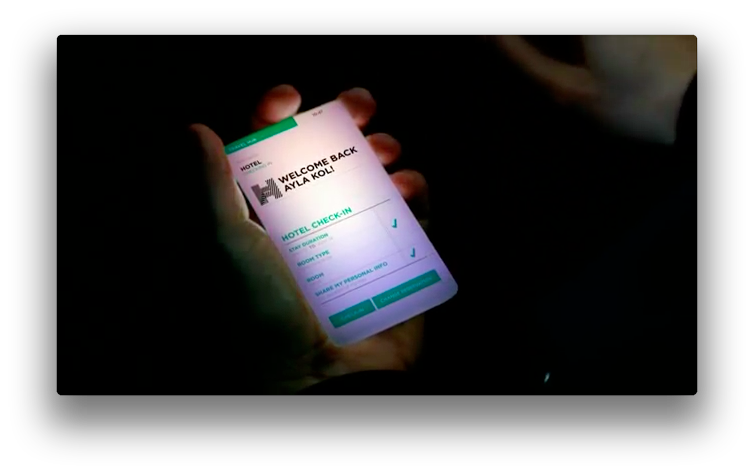 |
Without referring to the video, what do you suppose the above picture indicates? The text states “Stay Duration”, no check; “Room Type”, check; “Room”, no check; “Share My Personal Info”, check. The Share Info check is blank at first but then appears, presumably in response to a voice command. This immediately precedes Impeccably Tailored Bellhop Assistant looking at his impossible business card display.
The problem here is that it’s mixing multiple modes with the same UI. Presumably, the first three items are Ayla’s room preferences. The checks must mean hotel confirmation that she’s received her preference prior to checkin. Or it’s some kind of bizarre personal checklist to confirm that the hotel has kissed her ass appropriately. Or, most likely, it means absolutely nothing at all, because it’s hard to understand how she has her room type confirmed without a room number.
Meanwhile, the last entry is a user control that she can toggle, and it appears with an identical interface in a list of items of a completely different type. This is meant to show us how useful and intuitive Microsoft interfaces will be in 2021.
(You may interrupt at this point to say that I’m being too nitpicky. I’ll remind you that this kind of demonstration is the whole fricking point of the video.)
Cut to our buddy Qin, who had to sacrifice his Sunday afternoon, but at least he didn’t have to stay up all night like that poor bastard Jeff Zheng. Or is that Zeng? Qin’s phone can’t quite decide which it is.
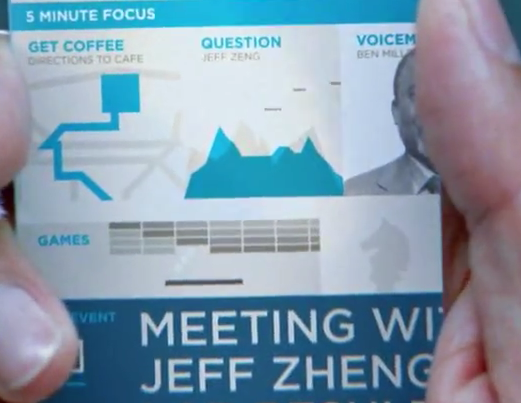 |
We arrive at this screen as follows: first we see the home screen for this Hong Kong resident standing in a Hong Kong subway station. The top headline of the day: the Senate has passed a new environmental regulation. Either Bing News is having a bad day, or the Chinese government will go through some changes in the next 10 years.
Qin taps on a picture captioned “Social,” which scrolls him to a lower page (not the second page, as the home page is shown to extend in all directions) instead of doing anything social or resembling a button press. Here we find that he has a portal called “five minute focus,” presumably with the things he needs to do in the next five minutes. Again, Microsoft believes this should be on a subpage, not in the primary display.
In the next five minutes, Qin is instructed how to get coffee, presented with an email message with attachments and an IM history, and has an incoming voicemail. Meanwhile, it’s 10:34 AM and his meeting is at 11 AM, so let’s hope that the subway is quick. Of course, nothing about this futuristic interface says anything about travel time or subway arrivals. I guess in the future, everyone in Hong Kong is Jewish and no one cares if you’re late.
The email from Jeff Z(h)eng pops up onscreen without a user request; unlike similar interactions in Ayla’s cab, it’s hard to believe that this is supposed to be a voice command because a) he’s on a crowded subway platform, and b) there’s a goddamn benefit concert going on over his left shoulder. So Microsoft devices apparently decide for you which email you need to read right now. And tell you about someone’s birthday—again in a pop-up with no user input.
This is still labeled “five-minute focus.” Considering how many fucking things we’re expected to get done in five minutes in Microsoft’s future, it really sucks that we’re working 160 hours a week.
Fortunately, Qin is also waiting on some lab results, so with any luck he’s picked up a drug-resistant Asian flu and will get to be bedridden for a long while.
We then get what could be the most bugfuck insane prediction of the video. A voicemail message is transcribed, “Can you approve the order?” A message appears saying “Creating reply interface…,” and Microsoft Bugfuck for Windows Phone with No Windows displays a numeric scroller which Qin uses to change “35” to “40.”
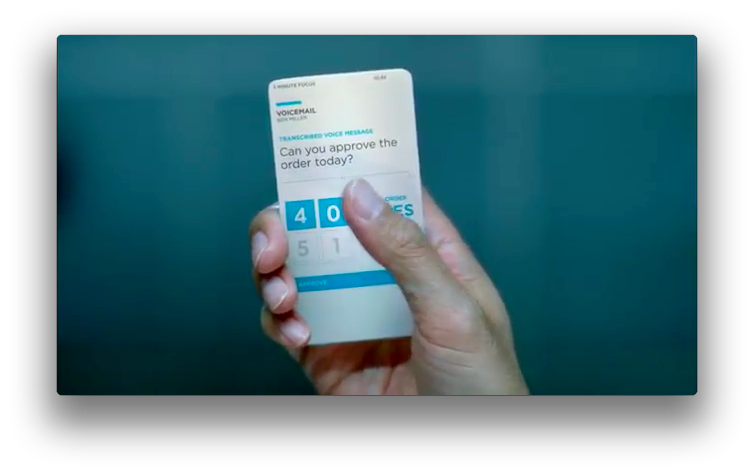 |
That’s the only interface for a transcribed voice message. Qin can hit an “Approve” or “Place Order” button. He can’t, for example, reply to the message. Or call Ben back. Or take a look at some document indicating whether he’s purchasing 40 liters of potassium nitrate or plutonium. Or cancel the order. About the only thing this advanced user interface allows him to do is to order 80 or 90 liters by mistake when some commuter jostles his arm.
Microsoft depicts a future where pretty much any flat object is a display and control surface, and they all instantaneously integrate with the gadgets you’re carrying. In Ayla’s taxi, the window provides a heads-up display showing remarkably worthless information about her trip; in her hotel room, a wallscreen and a tablet apparently included with the hotel room immediately context-switches to whatever she’s doing.
 |
Here she’s picked up the tablet while her back is to the wall; the wall switches from a “good morning Johannesburg” hotel info display to provide her instead with something relating to the work that’s on the tablet.
Of course, the first question is why she needs the tablet at all. The entire fricking table it’s on has the same controls, and presumably they’re all brimming with holograms. The purpose of the tablet appears to be so she can sit on the edge of the bed and use a touch interface, instead of the holograms in the much better wall display, or the much larger table by the window. This places her focus in her lap, which means that anything supplementary that appears on the wall (and presumably her iPod touch) is either intended as a distraction, or is important information that isn’t in her peripheral vision.
Later, a phone call arrives from her daughter, miraculously during the 18.8 seconds of downtime she has available this morning. Ayla, of course, takes the time to pick out a recipe for her, while the wallscreen merrily follows along with supplementary information. At this point, I was expecting her to pull a piece of pie out of the hologram so she could see how the recipes tasted.
Back home in Sydney, a large whiteboard receives the messages Ayla sent to her daughter, as opposed to having them go to Sydney’s dedicated tablet. (The daughter and the city are both named Sydney. Or her name is Shannon. It changes. No, really.) Unnamed Ayla husband is reminded by the AI in his car to schedule a tune-up, which he drags with a smile to his busy schedule. Offscreen, an unnamed mechanic receives a message telling him to reconfigure his entire schedule for His Eminence, because there’s no indication that this scheduling had anything to do with the mechanic’s workload.
Credit where credit is due: the idea that all sorts of display surfaces will configure themselves to your liking is a premise that’s both possible and useful. I’m less sanguine about whether a hotel in 2021 would provide a flatscreen and tablet computer that automatically hosts these services instead of, say, advertising $99 for one day’s Internet connection and a reminder of all of the movies I haven’t seen on pay-per-view. Indeed, the dystopian insanity of having my entire world reconfigured to show me advertisements is the main reason why I think I’d prefer to drop dead before existing in Microsoft’s world.
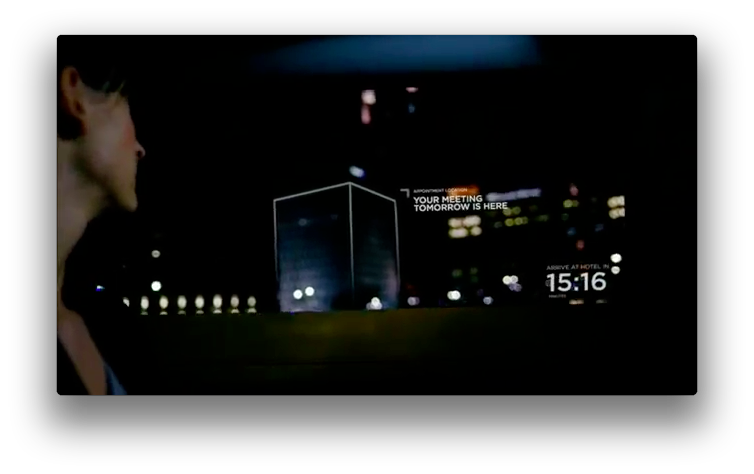
For example, here is the clean, uncluttered view out of a cab window in 2021, according to Microsoft:
|
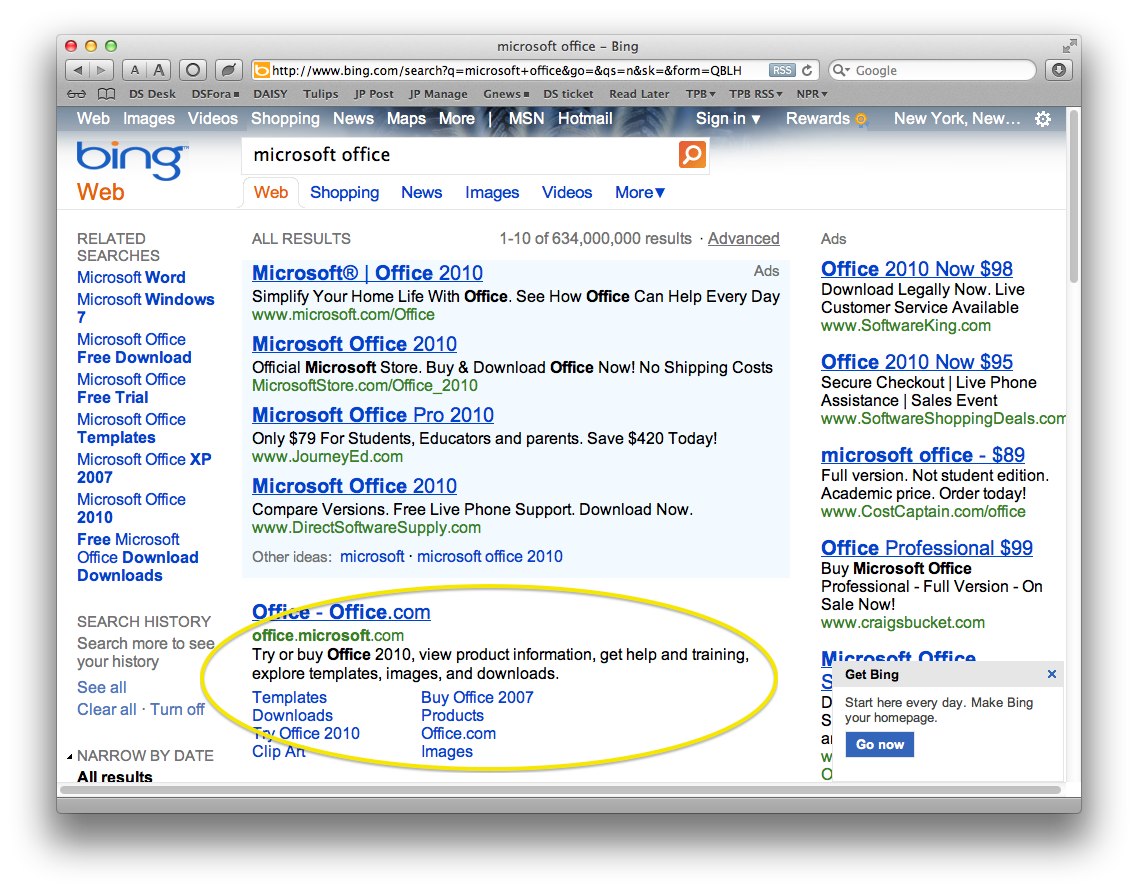
And here is the clean, uncluttered view of a Bing search in 2011, according to Microsoft. The highlight indicates the search result.
|
In other words: in the future, the killer app will be a Flash blocker for real life.
Coming next: how a competent designer or futurist would have presented a completely different view of technologies that are not bugfuck insane.
There’s a meme going around to critique the latest concept video out of Microsoft telling us all how we’re going to live in the future. Gruber points out that, like the 1987 Apple Knowledge Navigator video, this is a corporate exercise in vaporware that says nothing about what the company is developing or any real products. Other critiques mention that the haptic interfaces of the future are clearly fictional, and on top of that, your wife is probably sleeping around.
I’ll point out one other major difference between the Apple Navigator demo and the Microsoft 2011 version: Apple showed me a future that I wanted to live in. (With many flaws, which I’ll come back to in another post.) I was so confused by what this video was depicting that I downloaded the HD version to try to figure out what kind of world Microsoft wants us to live in. We’re supposed to believe that this is a cool vision of the future where computers make our lives easier. It’s not. It’s a dystopian hellscape of despair.
Let’s start with the work culture we’ll be experiencing in the Brave New World of 2021. Ayla, our hero, has just arrived in Johannesburg from Sydney on a Sunday afternoon. She’s arriving at night and we learn later that she only had a 9-hour incoming flight; check Kayak and, hey, turns out she sacrificed her entire weekend for this trip. It’s at least a 24-hour flight, and she had to leave as early as Saturday morning or Friday night. (The only alternative: Qantas flies airplanes that are 44% faster in ten years, and completely changes its arrivals schedule.)
Despite this hellacious trip, Ayla immediately gets down to work in the cab. She’s got “new” messages that arrived in the last few hours, so despite the holographic speeds her Australian data plan achieves while roaming in Africa, her plane didn’t have an Internet connection. Meanwhile, her daughter was awake at 5 AM in Sydney to wish her a safe flight.
It’s 10:34 PM in Jo’burg and Ayla has already reviewed five tasks in the cab. Her colleagues in Hong Kong also work weekends. One sent her an email while she was in the air this afternoon, the other emailed her at 3:30 AM his time. Ayla lets the first guy know that she’ll get to his work first thing, and sets a reminder… which will take place 3 hours after the meeting he needs it for. Apparently futuristic Microsoft devices have trouble with time zones. This might also be why the email was dated Sunday 4/21/2021, which can’t happen.
Something odd happens in the cab; she’s only 15 minutes away from the hotel when her meeting is pointed out, but 15 minutes later the cab says she’s at the hotel when clearly she’s not much further down the same road. The bellhop’s watch says it’s noon in Australia, making it around 4 AM before she gets to her room.
We get to see how technology organizes the work of the bellhop assistant. According to his schedule, he has 15 minutes to stand around looking impeccably tailored, after which eight people (one of whom is handicapped) will need his services in the space of six minutes. That’s some fine AI agenting he’s got there.
Unfortunately, Ayla has set a 7:30 alarm in order to blow that Hong Kong deadline by only three hours, so it’s a good thing she’s a high-powered executive who can fly for 24 hours and then get only 2 hours of sleep. Indeed, by 7:36 AM she’s fully dressed and the bed has not been slept in. Her meeting is scheduled in 84 minutes and is apparently either a 15-minute or a 6-hour drive across town. Oddly, none of her information appliances mention travel time or say anything about it on her schedule. So she has plenty of time to jump into a meeting with colleagues in Hong Kong and the US (local time: 9 PM – 12 AM Sunday night) and to pick out a bake sale goodie for her daughter.
So in the grand Microsoft future, all of us work 24/7 and pretty much conduct our social lives through our devices. Good thing Ayla is able to mother her child over the live video link. It’s less clear how Microsoft expects us to handle the constant sleep deprivation.
When Ayla arrives at the airport curbside, there’s almost no one else there, which pretty much never happens at an international airport. Her flights are on Qantas, so we know that she doesn’t have a private jet. Ergo, we must assume that her flight was nearly empty, maybe a result of the still-ongoing global depression. Or perhaps we can take the hint that her daughter wrote her at 5 AM to wish her a safe flight on what is currently one of the safest airlines on Earth. Is terrorism that much of a concern in the Microsoft future, to keep a child awake all night? Perhaps this also explains why there was no Internet connection on the plane; lingering radioactive fallout may play havoc with the signal, or perhaps even a major airline can’t afford the amenity when the plane is flying nearly empty.
Ayla is clearly a top executive, as indicated by her executive suite. But at the other end of the economic scale, we see that plenty of jobs have been made available at the entry level, where the only black man who is featured in the video has the grand title of Bellhop Assistant. The only black man in a video set in Johannesburg. Shine on, you crazy Microsoft diamond.
But Ayla has concerns: at the end of the day, there’s a large “1600” displayed on the health meter on her phone, next to her yoga log. Was that her caloric intake today? Her caloric target? Either starvation is common enough that wealthy women don’t get that much more to eat, or this already thin woman with a very active schedule is on a diet.
On the bright side, the husband of this important executive appears to be 10-15 years older than she is, and is at home raiding the fridge on a Monday afternoon while a tablet parents his kid, so it’s nice to know that the future will continue to benefit me with a gender gap in my favor.
The whole point of this video is supposed to be its depiction of the future. Meaning that these devices should have a basis in a reality that somewhat intersects our own. Instead, what we’re shown is frequently so batshit crazy that it ranges from the merely poorly-designed to the physically impossible.
 |
All of the flatscreens have what appear to be a window view on a 2-dimensional infinite plane that scrolls in any direction. Scrolling is somewhat constrained on the handheld professional devices, but have 360-degree zooming and scrolling on the tablets, as depicted by the above workspace that is deemed appropriate for a 11-year-old child.

These flatscreens have holographic output that extend past the boundaries of the display in what appears to be at least a hemispherical radius of several inches. Holographic input is also accepted at any angle to the device and at an equal radius. Devices are able to track eyelines of people glancing in the direction of the device in order to dynamically change information displays (the bellhop’s card) or determine when one surface is subjectively “behind” another (moving items from the tablet to the large desktop display). Despite three-dimensional input and output, navigation is always two-dimensional, as is data input.
So in other words: we’re discussing devices that constantly track all humans in the area and monitor all movement, sounds, and gestures in order to determine when these actions may be a command. These devices instantly network to each other and to any new devices in the area when they are detected. This is somehow deemed to be a good thing, in a world where we were forced to invent a word for butt-dialing.
 |
 |
Consider what needs to happen for this clip where the bellhop assistant takes a card out of his pocket, uses the dual touchscreen, then uses the dual transparent display. The card needs eye tracking to determine when it is being used, and when it’s merely being removed from his pocket. The card is transparent but there is not even a shadow of the reverse image when the card is flipped over, which means that it is redrawing when it detects it is exactly parallel to his eyes.
 |
If that’s not impossible enough for you, consider the close-up of the handheld display. That grid could be a background element on screen, but I doubt it’s coincidental that it mimics a close-up of an iPod retina display. On an iPod, each of those squares is a pixel, and that square is 0.00307 inches on a side. The text in the upper-left and the image to the left appear to mimic sub-pixel rendering on a current display, but for the rest of that text, clearly the designers just said “fuck it.” You want a curve like that “O” on a Retina display? I’m guessing that’s at least 10 more pixels within each 0.00307 of an inch, or 100 pixels per square, for a total of 1.06 billion pixels per square inch implied on this screen.
There is still more mock-up bullshit to come, to be continued in the next post.
Brilliant.
11. Historically, a story about people inside impressive buildings ignoring or even taunting people standing outside shouting at them turns out to be a story with an unhappy ending.
A post from Zach Holman by way of John Gruber, on the topic of dividing our friends into separate groups and applying these to social networking:
The problem is that, anecdotally, no one seems to use Lists. Twitter is filled with users who have carefully made a few lists, and then promptly forgot about them after they realized their clients don’t make it as easy to read List tweets as it is to read tweets from people you follow.
This is why I was never fascinated by Google+ and its concept of Circles.
Holman goes on to say that Facebook has the better idea, in that it can automatically intuit which groups are preferred by the user by using it’s existing networking data.
I call bullshit on this. Take the examples given in Holman’s screen shot: “close friends” (presumably a list), the city he lives in, the university he went to. I don’t know about you, but I have plenty of friends and followers in my city of residence whom aren’t exactly close friends, and I’m hard-pressed to think of hyperlocal content that I’d be interested in posting that would use a city limit as an interesting boundary.
On the other hand, Google+ does one thing that crucially escapes the shit work designation: you don’t organize your friends into circles, you are forced to add them to circles from the get-go. Create a new Google+ acquaintance and you can’t just add them to the master list; you’re forced at the point of sale to make a purchasing decision and categorize them into a circle. This mediates the work of organizing through UI design.
The downside is that this is still a pain in the ass and not particularly useful. Everyone who is in my college fraternity circle has to also get added to a friends or acquaintance circle; everyone who is in my scientific advocacy organization is subject to a brain fart that’s been going on since college where I might accidentally put them into my fraternity.
On the other hand, consider some heuristics that could automate this process. For example, how would you easily define “close friends” in a way that an algorithm could recognize?
Who has all of this data? Google. Who could use data-mining to come up with these suggestions automatically? Google. Who has access, additionally, to my phone records and calendars? You get the point. There’s some additional work to be done here where everyone needs to be incentivized to provide a more thorough curriculum vitae listing all of their associative groups to provide the seed data, but I expect that ice has already been broken by Facebook.
This references an old issue that arose as far back as the 80s, which few people get concerned about: different relationships leave different data trails. You probably consider information about whom you sleep with to be intensely personal, but it’s revealed in your data trail. People who sleep together have different data patterns than people who meet casually for dinner every so often.
This would be a stunning invasion of privacy, but depending upon the implementation, could also be a stunningly useful stunning invasion of privacy. To date, the only heuristic that’s been released into the wild, as best as I can tell, is Gmail’s guess at which email messages are deemed important. It seems to me that it’s only a matter of time before these heuristics become a standard feature of social networking, limited only by the data you’ve shared by the company, and by the social conventions that would lead users to riot in the streets if they’re released indelicately.