You might think that E. asinus spinal atrophy would be cured in 2008 by environmental factors, but you’d be wrong. Luckily, help is on the way.

You might think that E. asinus spinal atrophy would be cured in 2008 by environmental factors, but you’d be wrong. Luckily, help is on the way.
Current Jeff level of geeklust for an iPhone: 8 out of 10.
Odds that I’m actually going to buy one: about 1 out of 3.
Why? Because right now, it looks like Apple and AT&T are still crippling the single feature that I actually need: Bluetooth tethering, aka DUN. In plain English, this means “your Internet connection can actually go places other than your cell phone.”
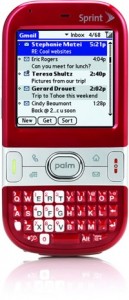 Back in January, I jumped ship on T-Mobile to switch to Sprint EVDO and a shiny new Palm Centro. The Centro is perfectly cromulent as a smartphone; as you can see in the attached photo, the user experience can best be described as “the wet dream of a road warrior… in 1998.” The Palm OS is getting very old and very creaky; it works well (especially in comparison with the Windows Mobile devices I’ve used), but most of the time when it’s doing something particularly cool, it feels like an Atari 2600 that’s been upgraded with a 16K RAM cartridge. Compared to the iPhone 2.0 demoed last week, there’s simply no contest.
But there’s one thing it excels at: dropping that EVDO connection into my MacBook anytime, and mostly anywhere. I’ve found that 50-60 KBps covers most of my Internet needs (exceptions: podcast updates, video streaming, and large software downloads), and I’m unwilling to go without it. At the time of this writing, AT&T is yet to say whether they’re going to offer 3G tethering with the iPhone.
Which is somewhat galling, as they offer tethering for Blackberry phones, and the iPhone 1.0 is perfectly capable of tethering with an unofficial hack. So if tethering is a must-have feature, there’s only one option right now: keep the Sprint phone and get an AT&T plan just for the iPhone.
Geeklust, yes. $200 a month worth of geeklust? Not so much.
Plan B is to go with the iPod Touch, which strips out a few iPhone features (notably GPS, which is on the “want but don’t need” list), but with Wifi-only access, its biggest drawback is that it’s only supercool about 50% of the time. That problem could be easily solved if the Touch could be used to tether to my Sprint phone—which again, is something I can do easily with my Palm TX. (Why would I tether a Palm TX to a Palm Centro? 480×320 screen resolution, versus 320×320 on the Centro, and a faster CPU.) Again, the jury is still out on whether this will be allowed by the corporate masters at Apple and AT&T.
I’ve been a happy uncustomer of AT&T Wireless since around 2000, when they hit me with a $500 charge for “going over” my unlimited minute rate plan. Yes, that still boggles my mind a little bit. My gut tells me that all of the various technology crippling I’m talking about here is based on some bean counter’s analysis at AT&T, not Apple, and I generally avoid companies with policies like these on general principles.
(For that matter, I’m less than impressed with my AT&T experience today, the first weekend that they’re offering the new free Wifi connection at Starbucks. I’ve been to two different hotspots today, and it’s taken over 15 minutes each time to reach the login screen, a sure sign that the servers are completely overloaded. I suspect that the same thing will occur when the 3G hits the shelves for a few weeks.)
I have no doubts whatsoever that these problems will all be solvable with third-party software upgrades; I have many doubts that Apple will allow such applications to be sold in the Application Store. But it’s for this reason that I’m very happy to hear that Apple is no longer sharing in the revenue of AT&T’s service contracts; since Apple keeps 30% of the revenue stream from application sales, that means they’re incented to offer software like this, and less likely to be in a binding contract with AT&T that prevents them from doing so.
Only time will tell whether that means we’ll see applications such as two-way tethering, VOIP, and (dare I dream?) online poker on the iPhone; give me the first and I’ll buy one. Give me the third and I’ll buy two.
So I’m spending a few months partially (and temporarily) deaf in one ear, thanks to evolution’s apparent inefficiencies in constructing working ear canals in my ancestors. (Or alternately, its inefficiency in preventing them from breeding, which implies I shouldn’t bitch too much about it.)
I’ve written the following extremely simple AppleScript to act as a tester to see how my ear is doing from day to day:
repeat with i from 1 to 7
	set volume i
	say i
end repeat
In my left ear, which is apparently working at full Jeff audio input capacity, I can easily hear “one”. In my right, I’m usually coming in between three and four. Trying to find a reference to translate “set volume i” into decibels so I can figure out exactly how bad my hearing is, but in the meantime relative results have been useful for comparison.
In any case, my hearing is bad enough that I have trouble with dialog at movies, so here’s the checklist for getting decent service with assistive devices, for those of you who also find yourselves temporarily needing them.
Taking a moment to vent: when I stepped out of the theater to get a new unit, the box office took the unit, took old batteries out of another one, and gave it back to me with those. I turned it on and got nothing; handed it back to her and said, “I’m deaf—can you hear anything with this?” “No.” “Then give me a new one like I asked you.” By this time, I’ve missed five minutes of archeological exposition and they’re looking at me with a bovine expression, not quite understanding that when I pay for a movie, I want to see it.
Incidentally, this is reinforcing my general belief that this is why movie theaters—and Hollywood—are in for a very rough time; when you pay ten bucks for a movie, what I believe you’re paying for is the experience of seeing it with theater-level quality. I caught Iron Man the other day, and most of the film was pocked with threading and other signs of wear. Now I’m seeing a movie I can’t hear. In both cases, I’d get a better experience watching the film on my laptop; my headphones are built-in audio assistive devices, thankyouverymuch. Theater number 1 was out of popcorn “butter”, theater number 2 treated me like crap when I complained about the audio; both are generally considered flagship theaters in the DC region. This does not exactly reinforce my desire to go to theaters.
My alternative is to wait twelve weeks and rent the DVD, or wait four to six weeks and download the DVD off the Internet. Oops, strike that—a DVD-quality version is available already, months in advance of the legal DVD release. A good theater can compete with this, and can continue getting their twenty bucks on a regular basis for admission and popcorn—the problem is that the industry seems to care so damned little about providing good theaters.
Listening to a Diane Rehm podcast about returning Iraq and Afghanistan veterans suffering from post-traumatic stress disorder and depression. The statistics show that the majority of these soldiers are basically screwed. One in five vets have one of these diagnoses; around 40% of them receive treatment.
Quick show of hands in the audience: how many people are surprised by this? Aside, of course, from administration planners.
Putting this into some raw numbers: according to Iraq and Afghanistan Veterans of America, 1.5 million troops have served in those wars. Using the specific percentages from the podcast, that means 240,000 soldiers with PTSD, and 240,000 more with depression; 105,000 have both diagnoses and are counted in each of the above figures, for a total of 300,000 veterans suffering from mental illness as a result of their deployment. 180,000 go undiagnosed or untreated. (No, the numbers don’t add up; I’m extrapolating from percentages in the podcast which have the same discrepancy.)
Personally, this is one of the things that made the $3 trillion cost of the Iraq war plausible to me; the 300,000 with potentially debilitating mental illnesses is only one of many long-term effects of the war that tend to be overlooked by the many Americans who were gung-ho about opening a can of whoop-ass on our enemies. And that’s really the issue here — having built the most powerful military in human history, a cursory reading of the last sixty years shows that Americans are damned comfortable with using it, certainly more comfortable than our self-image as peaceful would imply.
I think it’s well past time that we teach ourselves about the human costs of war. Never mind the 84,000 civilian casualties in Iraq; our tin ear to the suffering of foreigners is probably not going to change in the near future. But we certainly care about American casualties.
So next time, just for a lark, wouldn’t it be interesting if the American people demanded an accounting from an administration about what the statistical results are likely to be from going to war? We have six years of data from these wars; it shouldn’t be much of a leap to be able to say that if we send 100,000 soldiers into combat, we can expect N deaths, lifelong injuries, and mental disorders resulting. The 1.5 million figure above includes combat and noncombat positions; the odds of both injury and mental illness directly correlate, obviously, to combat exposure. We certainly collect specific data on combat casualties, and can use these when considering future deployments. Improvements in medical techniques between wars serve to both reduce the number of combat deaths, and increase the number of lifelong injuries; for these reasons, an accurate estimate should include both predictions based on past statistical results, as well as trendline modifiers for new techniques.
In this war, of course, any such predictions offered by the DoD would have been remarkably rosy, as their original plans were to roundtrip the troops there and back in under a year. But such predictions were never made; no one ever said, “For every 1,000 troops we send, 200 are coming home mentally ill, 21 are coming home wounded, and three come home on their shields.”
If such predictions had been made based on Gulf War I, the numbers would be far lower for killed and wounded in action — although long-term disability numbers are substantively similar. The Vietnam KIA and WIA equivalents are 22/1,000 and 117/1,000 respectively. Perhaps there might have been greater introspection upon the shift from a “shock and awe” war to one of occupation, if the shift from lower towards higher ratios were remembered as possible consequences.
What I do remember about the runup to war was talk of the financial cost we’d bear — numbers that were also laughably low and, to be charitable, optimistic. (To be accurate, lies and malfeasance.) Sure, there was plenty of vague talk about troop casualties, in that sort of “gee, it’s awful” tone we use about such things. I expect that my analysis here is extremely amateurish compared to the casualty estimates that they have at the Pentagon for any given military action, and these numbers should be made public and part of a public debate about any future war we consider. Some wars will still be self-evidently worth their predicted cost, but for others, perhaps it might be worth teaching America just what it takes to open up the can of whoop-ass.
The first part of my two-part article on how DRM technologies are destroying the world (slight exaggeration for dramatic effect) is up at TidBITS.com, and I’ve been linked for the first time in BoingBoing.
In case you’re not convinced to click over just yet, here’s my editorial blurb: “While attending CES last January, roving correspondent Jeff Porten realizes just how broken technology has become in the name of protecting intellectual property, causing him to ponder the societal costs of such a dependence on technology that is designed to fail.”
I had two thoughts today, pretty much back to back, which put me into a strangely contemplative mood.
The first was, “What the hell am I going to do with that wedding pitcher?”
The second was, “Jesus, it’s six months today.” Six months since my father died, when decisions such as “what the hell should I do with that pitcher” fell to me.
I think the two were coincidental. I have a mental block when it comes to the exact date of my father’s death, and I had to check a calendar to confirm that today is the semianniversary. The question of what to do with the pitcher is unchanged from what it was yesterday or what it will be tomorrow, but it’s the anniversary that got me to thinking this way, to wanting to write about it.
The pitcher is part of a collection made by my mother, who like many Jewish women of her generation, had display shelving which she mostly filled with expensive and pretty ceramic crap. About a third of that crap is my fault. I spent twenty years traveling around the world, looking for gifts to bring home. At an early age, I realized that if it was breakable, useless, and optionally Jewish, it had Mom written all over it. (Jewish was frequently difficult when shopping in Asia, so somewhere along the way kashrut was replaced with sake set.)
Those items are easy; these are the keepers. I’m highly sentimental, and these are part of my story with my parents. It’s not just a Hungarian tea set, it’s the Hungarian tea set which, after schlepping it across Eastern Europe on a bus for three weeks, and hand-carrying it onto the plane, returning home after a trek of 4,000 miles, I managed to drop the teapot lid from a height of two feet onto an equally breakable glass dining room table.
Miraculously, both held. Otherwise, my parents would have heard the Finno-Ugric blue vocabulary I had learned on my trip, at high volume.
It’s the rest of the pretty and breakable crap which is giving me trouble, and raising the question of just what a memento truly is. Take the wedding pitcher: it’s the size and shape of what might be used to serve lemonade on a hot day to a family of eight. My parents’ initials are engraved on it, in a font that screams “1965, and not the part that came anywhere near acid.” To the best of my recollection, I’ve never seen it used.
But I can tell you where it sat in the old house, and how it looked at an upward angle when my eyes were only three feet off the floor, and that a picture of my mother from her prom was on a shelf beneath it. It was a very attractive picture, and I don’t know if I still have it.
I can tell you today that the pitcher has very little meaning for me. But this isn’t really about today, it’s about who I’ll be and what I’ll remember thirty or more years from now, and what mental bits of my parents which I have now might be lost between now and then. What I might want to hold onto. And what might help me remember.
I doubt I’ll ever care about the pitcher. But how often do I think about the prom photo without the pitcher to lead me there? Do I lose one if I lose the other?
And perhaps to make it even more twisted, seeing as how this blog is as close to a permanent record as I have, and I expect to keep it available for my own use until I’m past the point of caring: does this essay, on the six-month anniversary of my father’s death, replace a glass pitcher?
I have no idea.
There’s one thing that’s always struck me about death, about the way things should work to my way of thinking. After the mourning, after the wound has started to close and life has gone on in the way that it does, it seems to me that a fair God would give you the chance, every once in a while, to just sit and kibitz with the people you’ve lost. Like Homecoming, without the football game and the brass band. I’d like to crack wise about what my father went through, needle him a little bit like my mother and I would have, and have him appreciate the humor, as he would have. And then to say, seriously, “That really sucked for you. I’m glad you’re past it. It’s good to see you again as I remember you.”
Then I’d ask, “hey, what should I do with the pitcher?”
A television show this week reminded me of an experience from a few years ago, when I briefly met Uma Thurman at a fundraiser. Our meeting led to a stunning epiphany:

Uma, you make Jewish men feel really, really short.
The WYSIWYG editor in WordPress 2.3 is completely borking any post I edit and half the posts I’m drafting. Bad enough bug that I would not have upgraded if I had known about this. More when I get a chance to fix this.
Yeesh. That was a pain in the ass. Site is now upgraded to WordPress 2.3 and ShadedGrey 2.0. You might note some changes to the sidebar, and other random functionality has been reworked. More changes might occur according to whim, but feel free to comment here if you approve or dislike something I’ve done.
I’m going to be mucking with the software here for a while. If anything breaks, blame the gremlins.
[W]e find that although on average all helmets attenuate invasive radio frequencies in either direction (either emanating from an outside source, or emanating from the cranium of the subject), certain frequencies are in fact greatly amplified. These amplified frequencies coincide with radio bands reserved for government use…. We speculate that the government may in fact have started the helmet craze for this reason.
I have regular debates with a friend who shall remain nameless about the nature of Mac security, after which (most of the time), I simply conclude that he and I actually live on separate but colocated planets where the computers work differently.
You know, like Earth-1 and Earth-2, Barry Allen meeting Jay Garrick.
I expect these debates will last until Doomsday, given the different facts on our respective Earths. That said, I suspect that one of the many causes of our disagreements is that we get our facts from different sources. I suspect (but really don’t know) that what he knows about the Mac comes from places that are a lot further away from the “bare metal” than mine are. (That’s one of the many advantages of hanging out with Mac developers. I’m sure the others will come to me eventually.)
So it was with some amount of glee that I read this takedown of a Business Week article by the Macalope. Maybe I don’t have the rhetorical chops to point out when mainstream tech writers are idiots. But it’s nice to know other folks do.
I was completely unable to figure out from a cursory Google search whether GrowlMail had ever been fixed for Leopard, so I spent an hour writing my own script rather than waste five more minutes seeing if it had been done before.
Added bonus: I hate seeing Growl notifications litter my screen when I’m actually staring at Mail.app, so this script does a check and only growls at you if Mail is not frontmost. I’d actually prefer it to not growl if I’m in the same Space as Mail.app, but I’m not insane enough to try coding that right now.
Code below, or download the attachment to this post. If you’re not sure how to attach an AppleScript rule to an incoming Mail message, here’s a good description.
on perform_mail_action(theData)
tell application “Mail”
set theSelectedMessages to |SelectedMessages| of theData
set theRule to |Rule| of theData
tell application “System Events” to set currApp to name of item 1 of (processes whose frontmost is true)
if currApp ? “Mail” then
repeat with a from 1 to count theSelectedMessages
do shell script “/usr/local/bin/growlnotify -a ‘Mail.app’ -m ‘” & subject of item a of theSelectedMessages & “‘ ‘” & sender of item a of theSelectedMessages & “‘”
end repeat
end if
end tell
end perform_mail_action
Attachment: DIY GrowlMail.scpt.zip
The Washington Post has a fascinating, groundbreaking article today, unfortunately buried on page A7: “McCain Mixes Up Iraqi Groups; Senator Misstates Which Extremists Are Aided by Iran.”
Perhaps I’m just jaded about the quality of journalism these days. Perhaps it’s the other articles in the paper commemorating the start of year six of the war in Iraq. But still: an article that leads with the statement, “A political leader in a position of authority made a factually incorrect statement today.” That’s revolutionary.
Compare that with the usual way that political statements are handled. Here’s the boilerplate:
[The president/chief of staff/Congressional leader] asserted something today about something important.
[S]he went on to say something else on the same topic, corroborating [his/her] first assertion.
If we do not do what [s]he wants about this issue, extremely bad things will occur.
The statements took place at [location and venue] on the occasion of [calendrical reference] to an audience of [people supporting the speaker].
[Opposition leader/representative of a nonprofit/random guy on the street] said afterwards, “no, [s]he’s wrong, that assertion has nothing to do with reality.”
[Ten paragraphs of analysis of the political implications about the statement]
So, what’s wrong with this picture? And how much better would it be if the template used was something similar to what they published on page A7 today?
[Senior official] said something today which contradicts all of the available information on the topic. [S]he repeated it several times, demonstrating that [s]he believes something in apparent opposition to what is known on the topic.
[Official’s campaign or legislative staff] did not provide any substantiating evidence to support these assertions, choosing instead to repeat the assertions using different words.
Of course, when new evidence is provided, that can certainly be the lead of the article. Likewise, when the argument is “our evidence is information that cannot be released for reasons of national security,” that could also be the lead to allow the reader to evaluate such comments themselves. And of course, statements about matters of opinion require a different structure.
But what a standard: requiring political statements to be factually accurate, or having the coverage be that the statement is wrong. I can’t help but wonder how Iraq might have gone in that case; certainly, if information opposing the invasion was available to me five years ago Friday, it was available to the newspapers.
Will we see more of this in the future? I’m not holding my breath.
I have some very strange friends, and sometimes they email me things.

Douglas told me in the strictest confidence exactly why 42. The answer is fascinating, extraordinary and, when you think hard about it, completely obvious. Nonetheless amazing for that. Remarkable really. But sadly I cannot share it with anyone and the secret must go with me to the grave. Pity, because it explains so much beyond the books. It really does explain the secret of life, the universe, and everything.
Here’s a question. I’m spending a lot of time in Atlantic City, and so I find myself carrying around a ton of coins. Rather than carrying my own personal maracas, I dump off the change when I get home.
So what I’m wondering: what’s the optimal change to take with me in the morning to minimize this phenomenon? There’s the obvious 3 quarters, one dime, two nickels, with which you can make any amount up to a dollar. That’s fine if I’m having one retail transaction a day — but there are usually more than that.
Some mathematician must’ve found a way to make his pockets go less jingle-jangle-langle, right?