Fascinating interview with Wade Davis

Just listened to an excellent CBC documentary called “Wade Davis and The End of the Wild”. (The link is to the program page, which currently has a graphic to the part 2 that’s coming out next week; scroll down the page if you’re reading this later. This is the direct MP3 link to part one.)

Davis makes one of my favorite points about anthropology very well — specifically, arguing against the mistake most of us make in thinking that aspects of our own culture must be common to all humanity:

We tend to view indigenous cultures around the world as quaint and colorful, but nevertheless somehow marginal to the overall thrust of history which we represent, moving inexorably forward in this technological modern world. To view cultures as marginal is to miss the central revelation of anthropology, and that is the idea that the world in which we live in does not exist in some absolute sense, but is just one model of reality.

We in our kind of arrogance assume that we are the stream of history, but we forget that other societies present other kinds of choices, which have different consequences. For example, if you walk by a homeless person on the streets of Toronto, you see that individual as the sad and unfortunate, but inevitable consequence of economic reality. But if you’re a Gabra, raised in the deserts of Kenya, you’re raised to believe that a poor man shames ourselves.

[Later in the interview, comparing the lives of a child in Borneo and Beverly Hills:] Then you start asking the more important questions, of the Beverly Hills kid, how many days did you spend with your Dad this month? Days? Are you crazy? We know statistically that the average father in America spends 17 minutes with their children every day, and we have the audacity to step back and assume that our society has the monopoly on the avenue to truth and social solidarity?

Davis concludes by equating E.O. Wilson’s famous comment about the 20th century — that it will be remembered, not for wars or technological advance, but for Earth’s massive loss of biodiversity — with the impact that it had on human cultural knowledge:

We are living through a period of time where literally half of humanity’s knowledge is being lost. Cultural diversity has flourished in the history of our species, but today we are living in a period of condensation that is astonishing. Of the 6,000 languages that were spoken when I was a young boy, over half are not being taught to schoolchildren. That means they’re effectively dead. There are only 300 languages today that are spoken by more than a million people.

Those half of the languages that are disappearing literally represent half of humanity’s repertoire. People say, “oh, we can make computers, we can make planes…”. No, I’m talking about the overall human adaptive repertoire to the common problems that afflict us all. Every time [a native stops learning or practicing his culture], a facet of the possibility of life is lost, and this is what this period of time represents.

Finally, he wraps up with a quote about how we view science that goes into my quote-of-the-year category:

Even those of us who like to think we love nature sometimes can miss the whole point of the wonder of biology. There was this horrific book that came out called The Secret Life of Plants that made this big deal about plants responding to Mozart. [My friend Timothy Plum] said to me: “Why would a plant give a shit about Mozart? And even if it did, why should that impress us? They can eat light. Isn’t that enough?”

Wikipedia eats its own dog food

I was aware that there are aspects of Wikipedia and the Wikipedia editing community which might be seen as, well, humorous to outsiders.

It did not occur to me that this would be considered a valid topic in Wikipedia.

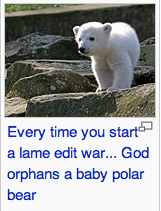
An adorable picture of a baby polar bear. Disgustingly adorable, in fact.Cute: is it [neutral point of view] to say the animal to the right has been called “cute”? Opinions vary.

Tiger: A revert war on whether the tiger can properly be described as the “most powerful living cat” (complete with accusations that people were “tiger fanboys”) gradually led to arguments about how tigers would match up vs. bears and crocodiles, complete with another revert war about the inclusion of a YouTube video showing a tiger fighting a crocodile.

Daffy Duck: Did Daffy Duck father any children? Should the events of certain animated films be taken to have occurred in “real life” while others should not?

List of fictional ducks: You read that right; edit warring over nonexistent waterfowl.

Predicting the technology we can’t understand

I’m fascinated by the idea of technologies that outstrip a generation’s capacity to integrate them. We all know of gadgets that confounded our parents and grandparents, but what’s really interesting are the social shifts that result. My favorite recent example was coordinating a dinner meeting with a friend who’s in her eighties; her idea of planning included coming up with several plans B and C in case anyone was running late, the weather was bad, etc.

I pointed out, as politely as I know how, “We all have cell phones, so if anything comes up, we can coordinate then?” Of course she knew that, but cell phones came along too late to break a lifetime of habits and etiquette based on landlines.

So I’ve been on the lookout for the technologies that will confound my generation, the one that grew up with the first home computers and generally looked upon their pre-digital parents as Neanderthals. So far, I haven’t seen them; there are certainly technologies that are more popular among the younger crowd, but I haven’t heard of one yet that so fundamentally changes the landscape that we should expect to be left behind.

That said, these are my current candidates:

1. Ubiquitous mobile location. Projects like Google Latitude, and the general trend to put GPS chips into anything larger than a grain of rice, herald a future where every mobile object, living or inanimate, can have its location known. This shift is equivalent to the day Wikipedia passed its tipping point as a generally reliable source of universal trivia; how many things do you casually look up, which you would have previously ignored in the days before Wikipedia and Google existed to instantly satisfy your curiosity?

My personal examples: the last four things I looked up in Wikipedia were the minor DC comic book character Holly Robinson; the history of Fannie Mae and Freddie Mac; the corporate ownership of PayPal; and the television production history of my fraternity brother Ron Moore. How many of these would I have researched if the friction involved, say, going to a library or picking up a phone? Precisely zero.

So I think the friction-free future of locating mobile objects (i.e., people) is going to be substantively different than our present. During the transition time between now and then, I expect all sorts of privacy nightmares while our legal and social systems scramble to catch up–those were built by people who weren’t used to being a data point in the global positioning wiki. But the generation that grows up with it will disregard physical location even more than we do, with our fancy “email and telecommuting” schemes; as cell phones killed the temporal aspect of advance planning, I expect this technology to kill the spatial aspect of it. Why plan when you can flash mob?

2. In the future, you will be a porn star for 15 minutes. Technology already breaks us up into two distinct generations: people who started getting naked with other people when cameras used film, and people who did so after cameras went digital. I suspect those two groups already have very different photographic records of their relationship history. But God help the first generation of kids who became sexually active when digital cameras met Internet upload.

Here in the early 21st century, cameras are widespread and easy to hide, so there are any number of ways you can unwittingly star in an online video, starting with trusting the wrong partner. I’m actually rather surprised that this isn’t already extremely common. My guess is that it is, but it’s just not yet particularly well-known or centralized… and it will be the next Internet scandal when some enterprising offshore website becomes the YouTube of semiconsented amateur porn, starring primarily American and European teens and 20somethings.

(Yes, I know that such amateur porn sites exist, but AFAIK there’s no centralized web site that allows someone to Google for whether they, or their friends and enemies, have been included. This seems like such an obvious extension of current technology and human vituperative nature that I expect it’s only a matter of time.)

The effects seem obvious to me: a few years of self-enforced sexual prudishness by people who think their lives will be ruined if they’re displayed online in flagrante, followed by a new normalcy when having been in an Internet porn video carries the same opprobrium that we feel when we think about how much we used to drink in college. (I.e., not much at all.) You’ll be held responsible for what you personally choose to post to your social networking sites, in much the same way that it’s unwise to post drunken bashes on LinkedIn portfolios today. But since none of us can control what other people post about us (and since most of us, in retrospect, have less than perfect track records selecting our intimate partners), those taboos will fade away.

Unsubstantiated corollary: since it seems to me that it is much more common that males will piggishly circulate revealing photos of their female sexual conquests than the reverse, I wonder if this might be the first time in history when naked pictures of women will be less damaging to their reputations than naked pictures of men? If so, it’s about damn time.

3. Forever friends. A new idea which I’m still developing, but which was inspired by a veritable tidal wave of people from my past showing up on Facebook. I think I’m in touch with around 100 people with whom I hadn’t talked in a decade or two; for some of these people, the question is literally, “so, what have you been up to since your bar mitzvah?”

I think there are some fascinating corollary questions that arise from this. For example, I’m generally amazed how large my network is; there were a lot of people, places, and events that faded until something else in the network jogs that memory. And as large as this network seems, it’s still only a fraction of my “Platonic network ideal”; I can think of several organizations I joined, and hundreds of dimly-remembered people, which aren’t yet represented in my online social network.

There are indications that Facebook, LinkedIn, and Googling your ex-girlfriends, as amusing as these can be, run contrary to long-standing human traits. There are biological theories that there are evolutionary constraints to the number of people we can have in our metaphorical tribes; I’ve heard the number 150 being the average upper limit of close friends you can have. Meanwhile, sociological theory states that reinvention is one of the cornerstones of the American mythos and culture; we each have a manifest destiny to blow off our friends, our family, and our existing self-image, and metaphorically go West to dig for gold. Or at least, we did.

So here at the dawn of the social networking age, I can tell you that an old friend from high school, whom I haven’t seen since 1988 or so, suffered from RSI on Sunday. Which is weirder: the idea that people from our past are no longer just memories? Or the certainty that people we meet today, no matter what age we are, run a high likelihood of being caught up in these online avatar nets, and quite likely will become a permanent fixture in our networks?

What does it mean to obsolesce the meaning of the phrase, “people from our past”? How important is it to be able to leave people behind, deliberately or otherwise? I’ve spent a fair amount of my activist life advocating for consciously living in a global community of six billion people, but that doesn’t mean I have any idea how, when we’re wired for numbers closer to six hundred.

Call this a social change for everyone, but I’d expect that the generation that is born into it is going to come up with radical solutions for understanding and solving it.

4. Personal soundscapes and holography. Another new idea, introduced to me by Woody Norris’ TEDTalk about his invention of a directional sound speaker. Essentially, he can point his speaker at a crowded audience, and only the people at the aural focal point of the speaker will hear the sound coming out of it; everyone else hears nothing. It seems very similar to the parabolic directional sound mirrors at the Franklin Institute, where you can speak into a metal ring and be heard on the other side of the room.

Except that Norris’ invention is industrial, handheld, and can be incorporated into anything that currently produces electronic sound, such as iPods, cell phones, megaphones, and military sonic weaponry.

The military just deployed some of these to Iraq, where you can put fake troop movements a quarter-mile away on a hillside. Or you can whisper in the ear of a supposed terrorist, some biblical verse. We put it on a turret, with a camera, so that when they shoot at you, you’re over there [points left] and it’s there [points right].

It seems to me that this technology is transformational in the same way that iPods and Walkmen were; many people think that the “bowling alone” culture is caused or correlated with our ability to live in our own virtual worlds even when we’re among a crowd. But at least headphones provide a visual cue that we’re off in our own world; invisible directed sound waves are less obvious.

This is something I’ve already been thinking about since silent electric cars started hitting the streets. I’m a pedestrian who, after years of exposure to internal combustion engines, has become acclimated to letting my ears do the “looking both ways” for me some of the time. It seems the more Priuses and Teslas that hit the street, the more this trait will become less common, for strictly Darwinian reasons.

I’m not sure what it will mean when the people around me may be seeing or hearing completely different things than I am, without any of us hallucinating. But I’m pretty sure that the younger you are, the more easily you’ll be able to deal with it.
Retagging jeffporten.com

Everyone once in a while I come up with a new categorization tree for this place, on the theory that it makes sense to give my readers a chance to filter out some of my posts and focus on what interests them. In the twelve years since I started this blog, I haven’t met anyone who actually uses these categories, but it pleases me anyway.

I just made some minor changes to the catalog tree here, which you can ignore if you’re happy skimming the sum total of my output. Unfortunately, I haven’t yet figured out how to turn these categories into separate RSS feeds, which I assume is a WordPress feature; if anyone wants it and knows what plugin turns that on, say so. Here’s my current taxonomy:

Conspiracy Theories: essay length and/or reasonably thought-out posts. I’m naming this after the overall title of the blog, but it could just as easily be called, “Jeff’s Self-Diagnosed Important Thinking.” Your mileage may vary.

Illuminatus: short blurbs and links to other web and mass media. Several incarnations of jeffporten.com ago, I had these broken out as a separate blog, but it still seems like that’s too much navel-gazing.

Mac Guru: technical diatribes about various Mac issues. I might add an Internet Guru category in the future, or I might rename this as a general catch-all for when I geek out about gadgets or the Internet.

Publications and Software: it’s rare, but when I publish words or bits, I generally want to highlight them here, and I’ll continue doing so.

I have a half-dozen other, older categories which I don’t use any more; those are now grouped under “Arcanum” in the right sidebar for anyone who’s interested. Chances are that if I revive an old category, I’ll promote it back out of this historical dustbin.

As I said, I strongly suspect that maybe two people on the planet other than me might care about this; if you do, and you have any input on making my site a more interesting way to procrastinate, feel free to let me know.

Obama displays missile defense sanity

For those of you who haven’t been following the Star Wars story since the 1980s or so, here’s a quick summary:

1) Missile defense doesn’t work. Really. Even tests that are rigged such that it’s nearly impossible for them to fail, fail.

2) Generally, the program serves two purposes: corporate welfare for military contractors, and a political sop to right-wingers who are still eating the Reagan jellybeans.

3) Therefore, some people were concerned when the Obama administration appeared to support continued research and deployment on these failed systems, as the only sane reason not to end the program immediately is to use it as a diplomatic bargaining chip. (Please, Br’er Rabbit, don’t make me cancel my useless multibillion dollar expenditure!)

Ergo, I’m really quite happy to see this report in the New York Times, even as I’m slightly disturbed by the short half-life of an Obama secret. (Unless this was a deliberate leak, which actually makes some sense in this case.)

Attention, Congress and WaPo: Twittering is good

Dana Milbank casts aspersions on the TV image of Congressmembers on thumbboards during the presidential speech tonight. I disagree. The preference is a “polite” Congress who spends the entire time pantomiming rapt attention to the president?

Please. We’ve had eight years of a Congress who rolled over for the president and kept their mouths shut, in both parties. Enough with the theater and the actuality of that. I’d rather have Republicans twittering:

Then there was Rep. Joe Barton (R-Tex.), in whose name this text message was sent at about the time the president spoke of the need to pull the country together: “Aggie basketball game is about to start on espn2 for those of you that aren’t going to bother watching pelosi smirk for the next hour.” A few minutes later, another message came through: “Disregard that last Tweet from a staffer.”

And I’d rather have his constituents accordingly think of him as a real human being with bad opinions of Pelosi, or a rude lout, or both.

Would also be nice to establish the rule that if your name is on it, it wasn’t written by a staffer—even if it was. And for politicians to learn that you can’t take back everything you say, and that our discourse will be improved with some off the cuff humanity anyway.

How to solve Mail.app slowdowns

Solved an email problem tonight which has been driving me nuts, documenting it here so the Google spiders can get this solution to other sufferers.

Symptoms: Mac OS X Mail.app takes a very long time to download new messages, and while a download is occurring, windows become temporarily unresponsive to clicks and keystrokes. (E.g., clicking another account takes a minute or longer before it appears in the window.) Download time is increased, apparently geometrically, when multiple accounts are checked or when a single account has many messages waiting. Activity window seems to spend a lot of time on “routing messages” and “processing mail rules” even when there are no rules to process.

Useless fixes: the usual cure-all for a Mail.app slowdown, rebuilding the database through message import by deleting the Envelope Index, doesn’t do diddly. Likewise the more drastic solution of moving ~/Library/Mail and reimporting the entire kaboodle. Ditto deleting all of the mail rules. Ditto deleting all of the plug-ins from the Mail library Bundles folder.

Actual fix: removing GrowlMail.mailbundle and ProxiMail.mailbundle from /Library/Mail/Bundles. Yes, Virginia, you have a system-level Mail library, and plug-ins there will affect all users on your system, despite being off in a dusty corner of your Mac OS where angels fear to tread. (I’m very glad I didn’t bother trying a mail import from a new account.)

In fairness, both of these bundles will Attempt to Do Something upon the receipt of any incoming message, so I have no idea which of these is the culprit. The other is probably blameless. Or maybe they’ve been beating up on each other and that’s the problem. Someday I will attempt to determine what went wrong here; in the meantime I’ll rest on the laurels of a bug well stomped.

Neanderthal 2.0

NYT reports that the Neanderthal genome has been reconstructed, raising the fascinating possibility that we might decide to resurrect the species. Which is somewhat poetic since homo sapiens is likely the species that exterminated Neanderthals in the first place, back when we did such things with big clubs and resource monopolization.

Interestingly, in my opinion the NYT whiffs on the question of whether humans and Neanderthals interbred: “An early inference that can be drawn from the new findings, which were announced Thursday in Leipzig, Germany, is that there is no significant trace of Neanderthal genes in modern humans. This confounds the speculation that modern humans could have interbred with Neanderthals, thus benefiting from the genes that adapted the Neanderthals to the cold climate that prevailed in Europe in last ice age, which ended 10,000 years ago.”

Well, not really. It means that there are no known surviving Neanderthal genes in human DNA, but early human tribes had a knack for intraspecies genocidal behavior, so it seems to me that a hybrid group could easily have been wiped out along the way by their neighbors or a harsh environment. And not to nitpick, but we’re still living in the “last ice age”, at least until we manage to melt both Poles; you probably meant to say the last “glaciation period,” Times. If you don’t get this right, no wonder few others do.

A bad way to start my day

I am woken up this morning by loud winds outside my apartment. I get up to go to the bathroom, stumbling in still half-asleep.

When I get there, I’m flummoxed by something I’m not expecting — the toilet is missing. The carpeting extends to the wall as if it’s perfectly natural to have a small room with a sink, a mirror, some cabinetry, and no toilet.

I lean against the sink, wondering, “What the hell? Someone broke in, stole my toilet, and recarpeted my bathroom? Since 2 AM?” This strikes me as somewhat farfetched. I am still pretty confused when….

I am woken up by loud winds outside my apartment. I realize, “Oh, that explains it. I was still sleeping before.” I get up to go to the bathroom, which is now completely empty; apparently my apartment now comes equipped with a walk-in closet.

At this point, I’m pretty bemused, but distracted by the problem that I really need to use a bathroom.

Next thing I know, I am woken up by loud winds outside my apartment. I look around my bedroom, establishing that this time I feel really awake. I enter the bathroom with some trepidation, and huzzah! the toilet is in its rightful position. Then I notice the mirror is gone.

So I’m staring at the newly blank wall, thinking that I now have a conundrum. Four cups of coffee are insisting that it’s time to leave my bladder. The toilet is right there. And despite the fact that I am now upright and walking around my apartment, the missing mirror is telling me that, in fact, I am most likely still in bed on a windy day with four cups of coffee insistently wanting to leave my bladder.

In short, going to the bathroom right now strikes me as a very bad idea.

At this point my memory becomes pretty fuzzy — there’s something about being at a wedding and staying in room 301 of a hotel, none of which involves bathrooms. This is all normal dreaming without the lucid sensation of being awake and controlling my actions. When I wake up again, I head to the bathroom and find it all astonishingly and thankfully normal.

I also notice something I missed all morning: the bathroom that had been vexing me wasn’t my bathroom. The layout was entirely wrong. Somehow I managed to miss that detail.

It would be nice to say at the end that this has been a creative writing exercise, but I’m not that creative. Sadly, this is a true story.

Securing the City

Listening to a fascinating interview on Fresh Air with Christopher Dickey, about his book on the NYPD counterterrorism unit. I don’t agree with some of the tactics he’s describing, but this should be cited as great evidence that the way to prevent and prosecute terrorism is as a police and a criminal matter. Somehow the NYPD operates without setting up a Gitmo; I wonder why the federal government could not.

Stimulating information

As I’ve mentioned here before, I consume a metric truckload of news on a daily basis. And yet, it occurs to me that I don’t know the answers to the following questions about the stimulus:

1) Given all the hoopla over Obama’s tax cut concessions to the Republicans, are these tax cuts the ones he campaigned on, or different ones more common to Republican policy?

2) After tax cuts, and ignoring the 0.7% of the stimulus that the Republicans are arguing with (I, for one, think the National Mall is damn well in need of sod), just what the hell are we spending the other 99.3% on?

I mean, we’re spending $816 billion here. That should be newsworthy. And not to imply that we have a blitheringly incompetent news media, but at the moment the word “stimulus” does not appear on CNN’s home page. (Headlines: WWII vet frozen to death leaves $$$ to hospital; Sarah Palin takes on Ashley Judd; Boy, 10, gets porn text on birthday phone.) Amusingly, the CNN home page that does not include the word “stimulus” does include a story about how hard it is to understand the concept of “trillion”, called “Numb and Number”.

Accurate, if only they we’re talking about their own news room.

So, as a public service: here is the PDF of the Congressional Budget Office report which summarizes the costs of the bill, by explicating some of them. However, they have a habit of saying things like “$6.4 billion for other purposes”. So here is the complete text of H.R. 1, while these are the amendments in the House and the Senate.

The full text prints to a 362 page PDF, if you’re so inclined. It’s a shame we don’t have an industry whose job it is to analyze proposed legislation and report it to the public; perhaps we should do something about that.