MoveOn is circulating a petition to the White House Correspondents’ Association asking them to give Helen Thomas’s White House press seat to NPR over Fox News. (The third organization in the race is Bloomberg.)
I’m not a huge fan of Internet petitions, but this one could make a difference, on the premise that WHCA might give a damn what their audience says about the matter.
The text of the petition (which IMHO is poorly worded):
Give Helen Thomas’ former briefing room seat to NPR, which has provided public interest coverage for decades – not Fox, which is a right-wing propaganda tool, not a legitimate news organization.
The comment I added:
“Better yet, give the seat to NPR for its track record in following Thomas’ footsteps by asking hard, factually-based questions of the administration, even when it is not popular to do so.”
Calacanis meets Brunson. Doyle has lunch.
Not sure how this missed my notice for so long. King of the new media douchebags plays a high-stakes game against the pros. Result: pure schadenfreude.
Is your brain melted? No. It will be after you read this.
So here’s how quantum computers will someday work: you will give it a problem, it will calculate all possible answers, pick out the right one and give it to you.
What strikes me most about this speech: the Taliban recruits see horrific displays of civilian casualties from US-led wars, and we—the beneficiaries of a free press—do not. The deaths of Neda Agha-Soltan and Saddam Hussein were probably viewed over a billion times by Americans and our allies, but no such viral network exists for video of Afghani wedding parties mistaken for insurgent convoys. Or, for that matter, the victims of the suicide bombings mentioned here.
Two reasons are generally given for this: 1) Western media has standards of good taste which prevents the broadcast of horrific violence. I’ve always thought this was a pretty weak argument, especially in the United States, where we consider grotesque violence to be excellent fodder for escapist movies. In my opinion, it’s only a matter of time before some network becomes the next phenomenon on the scale of Fox News by broadcasting such videos and garnering an audience—and not necessarily an anti-war audience, depending upon how they frame it.
2) Americans are more interested in the fate of a puppy in a well, or of a white girl stranded in the Indian Ocean, than they are about the fate of millions of people of different cultures and colors. I think this is true, but also circular: Americans aren’t interested in the world at large, or the atrocities in it, so their media don’t treat such events as newsworthy—despite having access to video which is profoundly sensationalistic—which then perpetuates the culture that Americans are more newsworthy than other people.
(Note: not an American phenomenon. This is arguably true of all cultures. But what makes America exceptional is the vast influence our government, media, and businesses have on the rest of the world.)
Which leads to the next thought: it’s only a matter of time before one of these videos goes viral. Picture the recent flap over the Apache helicopter killing of a dozen probably civilians in Iraq, including the wounding of two children, combined with video in color and high-def. What happens to the American taste for war when that becomes as widely viewed as a cute kitten YouTube video? What happens when this becomes a regular thing on the Internet and in our mass media?
If you missed it yesterday, here’s the TED video which started this line of thinking.
I’m toying with Wolfram’s idea of computational space in relation to the theory of universal evolution—which unfortunately is not covered under this name in Wikipedia. The theory, as I remember it, is that as black holes can theoretically spawn new universes in separate spacetimes, that each new universe would experience a slightly different set of laws of physics from its parent universe. Therefore, our own universe is the result of several million or billion generations of prior universes. This neatly answers the anthropomorphic fallacy, i.e., “why are the laws of physics suitable for the development of life?”, by stating that a universe with the basic requirements for humans was not only impossible earlier in universal evolution, but that it was also pretty much inevitable.
I’m fond of this theory, in that any time an impossible occurrence reaches a probability of 99.999%, there’s a certain beauty to the idea. Wolfram takes it a step further, though: just as a non-Euclidian geometry allows for all sorts of mathematics which can never apply to our universe, his computational theory allows for an infinite set of universes which is of a higher order than the infinity supposed by evolution. Evolutionary universes can be infinitely branching, but can never supercede certain starting states: for example, many of them may not have the conditions necessary to create hydrogen, but all of them may have to have the same basic subatomic particles in order to create hydrogen.
Or not. Maybe there’s an alternate path to matter. Just as the laws of physics dictate what’s possible in our universe, when you’re considering the range of theoretically possible sets of all such laws, then you’re operating from a deeper substrate than I think we can yet describe with science. (Or at least, any science I’m familiar with.) Wolfram’s method does away with “possible” as being a necessary concern; if his universes are mathematically consistent, then they can exist as models even if there’s no possible method that such a universe could ever actually occur.
In any case, the core thought that I keep coming back to with these kinds of ideas is this: not only does the universe appear to be infinite, but the methods in which it is infinite may be as well.
For example: the edge of the visible universe is precisely 13.7 billion light-years away from us in all directions. Why? Because that’s the farthest light can travel during the age of the universe. However, the universe is known to be larger; we can see the effects of the invisible universe on the edges of the visible, so we can tell, for example, that there’s an invisible body of N solar masses on the other side of a boundary which we can never cross. This is because while things within space are limited by light speed, space itself is not. The universe could have expanded at any speed—we know it was at least the speed of light, but it could have been faster, and it could have been infinite. (Note: space does not mean “outer space”. It’s more accurate to think of “space” as a four-dimensional mathematical grid in which the universe is housed; that’s the space which can expand at any speed.)
In case you haven’t stopped to think about the word “infinite”, a reminder: assuming the same distribution of physical materials throughout, then the number of yous who are reading this post, and the number of mes who wrote it, are also infinite. 1/10-100 * infinity = infinity. For this reason, I tend to believe that while the universe is mind-bogglingly huge—the visible universe may only be a tiny fraction of the whole of it—I think it’s likely to be sub-infinite. But not necessarily.
In the meantime, there’s also the many-world theory, which basically states: quantum physics is really strange, and things happen in terms of probability, but the word “happen” is a lot fuzzier than we’re used to. The math works out that when a particle is observed, it’s possible that all sorts of other things the particle is simultaneously doing just cease to exist—or it’s possible that all of those other things just go off and take place in other universes.
Usually when this is stated in science fiction, it’s said that, “Since you could have had coffee or tea this morning, one of you had coffee, and one of you had tea.” But this is more accurately happening at the level of the Brownian motion of the water while it’s still in the kettle. There are 1080 atoms in the universe, give or take, each made up of a menagerie of particles which we still can’t count. Every 1/1034 seconds, all of the stuff making up all of those atoms do things, and the things they don’t do might be spawning exact copies of the universe, except for what they’re not doing. So that’s 1080 atoms * 10??? particles * 1034 Planck timelengths per second * 4.32 * 1017 seconds since we all got here.
Yeah, that’s how big it all is. The age of the universe in seconds is the smallest number in the equation.
And each one of those universes goes on to do the same thing we’re doing, so every Planck time, you’re not duplicating the universe that many times; you’re multiplying by that number. Create 10100 universes the first second, and you’ll create 1010,000 the next. Except where I wrote 10,000, you really need to add a hell of a lot more zeroes. That’s not infinite—you don’t reach infinity with multiplication of finite numbers—but it’s still a lot of elbow room.
But there are still two rules bounding this entire thing: first, that it all starts with the Big Bang, and second, that all of these universes will suffer heat death. It’s all temporally finite, regardless of what else it is.
Which brings me back to universal evolution. Heat death makes no sense to me: a temporally finite universe is one in which only a limited number of things can happen. A temporally finite multiverse, such as the one described above, is sufficiently vast that everything that can happen within it does happen, somewhere, so long as it doesn’t break any physical laws. But then it all dies.
That doesn’t make much sense. It puts us back in the category of being infinitely lucky, since of all of Wolfram’s possible universes, in most of them there’s no matter and no life. You need one variable of infinite scope to make us inevitable—time seems to work, and spawning new baby universes in addition to the multiversal spawning listed above gives us both the infinite vector, as well as the guarantee that any universe which is created also sees every possible outcome of itself play out.
So our universe goes on through its multiversal existence, and spawns a few trillion trillion other universes in the process, which suddenly makes its own heat death… worthwhile? Don’t know what you’d call it, exactly. But at the very least you can call its existence a mathematical near-certainty.
Anyway… honestly, this really is how I think the universe works. Because it fits. Humanity spent over 200,000 years believing that the Earth was a few thousand years old, and then found out that our existence required both a really big planet and a really long time. And even then, if the solar system hadn’t whacked us a bunch of times with really big rocks, we’d still be dodging dinosaurs and the size of field mice today. (So I’d add a third component: it also needed a nearly infinite number of Earths. In our neighborhood, we’re at the top of the food chain. Elsewhere, we’re still field mice.)
We also found out that the 4.5 billion years or so that Earth had is only a third of how long the universe has been around. It took 500 million years for the first stars to form, and it took two more generations of stars going boom and reforming before they created elements that we find useful, like carbon, oxygen, and iron. In 100 years, we’ve gone from mostly thinking that the Milky Way was the universe, to knowing that there are more galaxies than the Milky Way has stars. (That we can see—there might be more. Cf. visible universe above.)
So that’s two cases in which the canvas is a hell of a lot larger than the artwork. All I’m saying is that we’re being awfully limited in assuming that’s all the canvas there is. It’s the nature of being human: we don’t have eyes that can see X-rays, so they didn’t exist for us until the Curies came along. Light was a much wider canvas than we thought.
Seems to me, since the universe is always wider than we thought, well, it makes sense to start expecting it in places where we don’t yet know how to look.
Every few months, I’m reminded that I really need to spend more time playing with Wolfram Alpha, because I have a gut feeling that it could be damned useful if I just figured out how to use it.
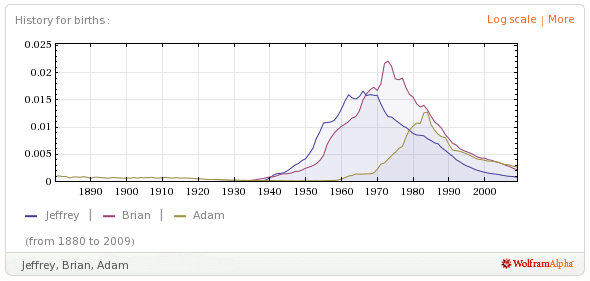
For example, consider this plot of three American first names:
As is made plainly visible, my buddy Adam got in on the ground floor in 1969, watching his market share soar until just before college, after which he lost ground but eventually took the lead over from Brian.
Brian, meanwhile, enjoyed a NASDAQ bubble during the Nixon and Ford administrations—which probably explains more than it should. Hopefully he unloaded his shares before Carter came along, but no Republican since has bother reversing his slide.
And as for me: pretty much instantaneously after I was able to pronounce my own name, Jeff plummeted off a cliff, and is apparently headed for an obscurity in the 21st century which will make teenagers look at me in my senescence as if I said, “Greetings, my name is Osgood Pfarthingworth.”
As for last names, neither Porten nor Sherr makes the cut, but Wolfram tells me that 0.64% of Greenbergs are Asian. Unfortunately, it can’t tell me how many of them are Jewish.
Here’s the Stephen Wolfram video which led me back to Alpha. I’ll have more to say afterwards, but as that post is going way off the rails in terms of content, I’ll save it for later.
An upper layer of Earth’s atmosphere recently collapsed in an unexpectedly large contraction, the sheer size of which has scientists scratching their heads, NASA announced Thursday.
An even better one…
Oh man, if I can find this in higher quality, it’s going to be my Desktop picture.
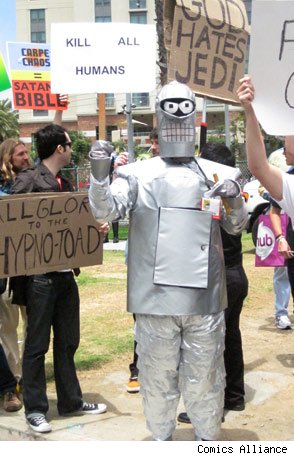
Counter-protest at Comic-Con
Fred Phelps and his crew of dipshits showed up at Comic-Con. So there was really only one thing to do:
My first iTunes video purchase. Thankfully, Macworld paid more than $1.99 for my article covering this release, so I’m still net profitable on the whole thing.
iPhone-grabbing thief picks wrong phone at wrong time
Thief pulls a snatch-and-grab from his bike on an iPhone… which was being used to test police GPS tracking software.
CEO David Kahn had asked Sturm to step outside — with a phone running A&R’s GPS live tracking app — so he could demonstrate the geographic tool to his PR folk. Moments after she walked out the door, the system came to life… and showed an indicator heading off down the street at high speed. Oops.
Carter Emmart demos a 3D atlas of the universe
I wish they had given this guy 20 minutes instead of 7. Note to self: go to New York and spend some serious time at the Hayden Planetarium.
NEW ORLEANS—Barely 24 hours after both market analysts and the technology industry were shocked by the announcement of a $7 billion merger between BP and the Apache Software Foundation, executives from both organizations are scrambling to explain a new contamination of the Gulf ecosystem, apparently by URLs, HTML tags, and other basic building blocks of the World Wide Web.
TAMU Professor of Oceanography John Kessler was the first to discover the bizarre contamination, posting to his blog this morning: “We were tracking a swarm of electric eels, when suddenly the entire population began rhythmically reversing polarity. Our underwater cameras revealed that they had accidentally strayed between two widely separated <blink> tags. Then a school of luminescent blowfish wandered into a CSS field and began changing size and colors. When several dolphins suddenly lined up and swam across the ocean floor, we knew we had a marquee on our hands.”
Web 2.0 researchers began arriving to aid marine scientists in shoreline Gulf territory by late evening, but aid efforts were halted when they discovered that AT&T coverage was nonexistent and none of their iPhones worked. Unable to tweet for emotional support and 75 miles from the nearest Starbucks, the best minds of the new media industry reverted to a state of nature, requiring environmental support groups to abandon brown pelicans in order to instruct them in the finer points of human survival. “It was really quite pathetic,” said Eve Lundstrom, a World Wildlife Fund volunteer from Minnesota. “After they were cut off from Facebook, they started questioning whether anything they did mattered if they couldn’t update their status. We found them trying to make lattes from seawater, and covering themselves in oil to resolve something they called ‘AntennaGate.’ When several of them stripped naked and swam straight out into the Gulf, we knew we had a real problem. The one we saved said they were looking for something called a fail whale.”
Sally Khudairi, Apache vice president of marketing, held a rapidly-called press conference on shore, within sight of a rapidly forming cluster of floating unmatched <div> tags. “Yes, we had begun integrating our technology into the reclamation efforts as of several weeks ago, and the servers we are using have worked perfectly for fifteen years. But for some reason, at the moment the Foundation signed the deal and entered into partnership with BP, all of our infrastructure suddenly began glitching. It was almost as if some sort of retroactive incompetence had been inflicted on the program code—which, of course, is impossible.
“Frankly, we have no idea how it is even possible for binary data to contaminate seawater as it has. But BP has promised that they will have a complete answer and solution to the problem in the next two weeks.”
Today’s announcement overshadowed continuing confusion stemming from the merger, about which both parties have been tight-lipped. The Apache Software Foundation gives away its software for free, and is generally believed to be financed by donations, so it is not known how they acquired the money for the all-cash deal, or how much they have left in reserve. BP issued this statement on an IRC channel in Finland early this morning: “We were as surprised as anyone when Apache approached us, and were unsure about the seriousness of their offer. But when they unzipped those dufflebags, and started piling bricks of cash and sacks of Krugerrands on the conference table, we stopped asking questions.”
Reaction to the announcement was highly negative, especially from the programming community which has contributed their time pro bono to Apache for years. “I’ve been living on nothing but off-brand Red Bull and 7-11 microwave burritos for nine years,” said one Linux programmer who identified himself only as Mar|<us. “It’s my code they’re using to work around an IE 6 bug with transitional XHTML 1.0, and what thanks have I gotten? A free pizza at the tweetup, and a LinkedIn blurb which hasn’t done shit for me in this economy.”
Apache has said nothing about the deal or why they made it, excepting a 4:42 AM EDT tweet from fundraising executive Serge Knystautas, which read in full: “‘Bout time you learned who really owns the web. Keep the Caymans transfers coming, boys. And fuck you, Stallman.” No further information has surfaced since, although speculation by Crunchgear blaming Apple and Steve Jobs personally for Apache’s apparent takeover of the Internet has been linked to by 14,482 blogs.
It is also unknown why the BP-Apache deal has apparently been subjected to a blackout moratorium on both Google’s and Yahoo’s search engines, both of which only show a single AP clipping posted on a Chinese language edition of the Epoch Times. A highly placed source within Google commented, in a quavering voice, “Man. You do not want to know what they threatened us with.”
When asked for comment at her press conference, Khudairi answered, “Klaatu barada nikto. Qapla’!”
At press time, reports are arriving from Austin that a viscous oily substance has begun leaking from the Ethernet ports on cable modems in homes and businesses throughout the city. Unconfirmed witnesses say that some wireless routers have begun spraying this substance in fine droplets in a 200-meter radius from the base station. Details are not available, but the phenomenon appears to be spreading outward to other cities in a drunken salesman pattern. Comcast issued a statement saying they were looking into the matter, but that this had absolutely nothing to do with BitTorrent throttling.
Old Spice Guy Remix
Michael Shermer: The pattern behind self-deception