Wow. Just… wow.
Check out all four of these suitcase decals, designed to be attached to your luggage. They’re… extremely distinctive.
 |
 |
Wow. Just… wow.
Check out all four of these suitcase decals, designed to be attached to your luggage. They’re… extremely distinctive.
|
|
The Bechdel Movie Test
I don’t entirely buy the argument being made here, but the questions it asks are interesting. More after the clip.
So—the question is, how many movies fail when men are subjected to the same test? Then what percentages are to be hand when an entire swath of movies is analyzed, as opposed to the montage in the video? Show me those comparisons, and I think you have the basis for demonstrating a trend. The absence of these numbers tells me that either the video’s authors didn’t compile them, or didn’t feel they were damning enough to share.
But the premise is valid, and worth asking regardless of all of our media.
Killed by Code: Software Transparency in Implantable Medical Devices
Turns out, only the hardware used for implants is inspected by the government. The software is a protected trade secret—much as it is in voting machines—and can only be reviewed in the event of catastrophe. So essentially, if you get a pacemaker, you have no way of knowing whether it’s running Mac OS X, Ubuntu, or Windows 3.1.
Best cupcake in human history
|
It happens rarely, but occasionally we are reminded that we are privileged to live on this Earth in the presence of genius. The designer of this cupcake tin is one such person. |
 |
Truck Accident That Killed Rafters in Canyon Sparks Truck-Canyon-Rafter Reform Debate
Once again, The Onion presents a headline which is not the most ridiculous thing I’ve seen all week in the news.
Truck Accident That Killed Rafters in Canyon Sparks Truck-Canyon-Rafter Reform Debate
Sam Harris: Science can answer moral questions
Sam Harris just become one of my favorite people.
Even Vegas can go too far
I enjoy gambling much more than the next guy, but this is ludicrous. Picture from Caesars Palace LV, and then retweeted 1,000 times.

|
Tron Legacy releases the week of my birthday, when I will be turning 12
Just knowing this movie is coming out makes me happy. Sort of like how I felt watching previews for Star Wars and Superman Returns. So I’m really hoping this doesn’t suck.
Lord of the Bling
Themed slot machines are nothing new, but even so, I’m surprised to see this. Not a subculture which I thought would translate to mindless gambling. (Except maybe the orcs.)
 |
A Better Facebook 1.0 simply ROCKS
Lex Friedman just posted this Safari 5 extension which mucks with Facebook to improve the display. Before and after below. This alone is a hell of a reason to use Safari.
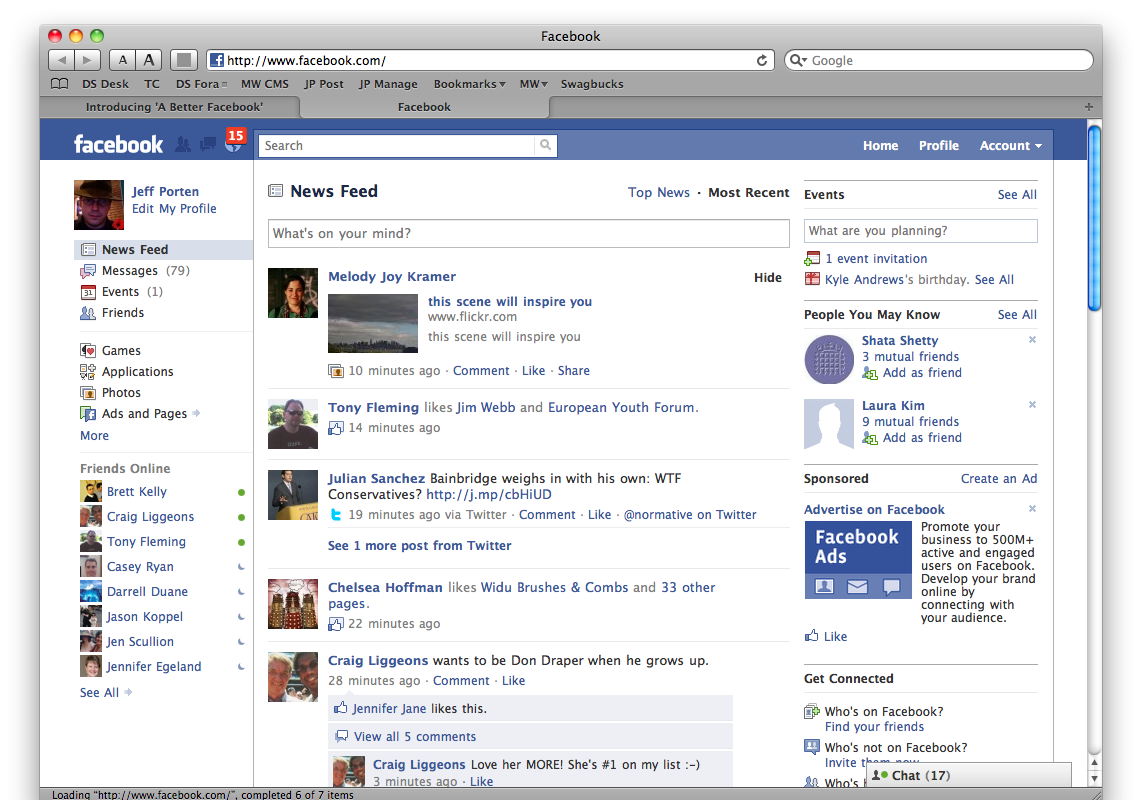 |
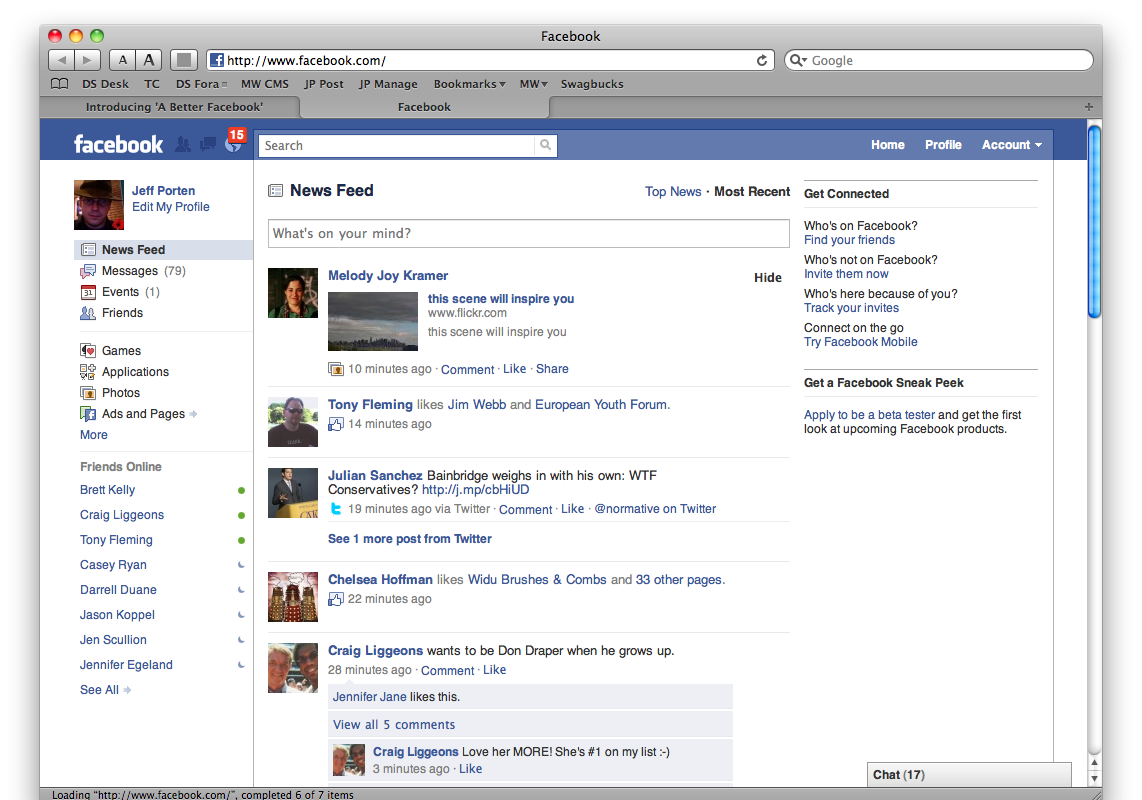 |
Clay Shirky: How cognitive surplus will change the world – Clay Shirky (2010)
I’m not a huge fan of Clay Shirky. His writing and speeches are always interesting, but I think a lot of what he has to say is restating the obvious. On the other hand, perhaps I’m undervaluing the value of the obvious, because many times he brings to light things that I haven’t yet given much thought to.
Reposting this video mainly because of his idea of cognitive surplus: the world gets one trillion hours a year of human leisure time, and some of it is spent on creative endeavors like the ones he highlights. Which raises an interesting question (to me, anyway): why do I blog? Why do I feel like I’m being lazy when I don’t blog? I’ve always chalked it up to just ego-stroking over my own self-satisfaction about the value of my opinions—but Shirky says something else is going on, with me and with everyone else who does it.
For those of you not keeping track, dark energy has been postulated in order to keep our old “Big Banged” universe in conformance with observation. The problem: all of the stuff which is receding from us—which is everything—is speeding up, which doesn’t make a whole lot of sense. Dark energy is the stuff which is proposed to be doing this. Unfortunately, a) no one’s seen it, b) no one’s quite sure how to see it, and c) in order to fit with observation, around three-fourths of the entire universe has to be made up the stuff.
Add that to dark matter, which is unseen but proven (we can see light bending through its gravitational lensing), then all of the stuff we can see in the universe—the stuff the normally we think about when we think about “the universe”—is around 7% of its actual content. In SAT terms, Actual Universe : Our Universe :: Cheese : Easy Cheese in an aerosol can.
But hey—this is the 21st century! Why go with the invisible stuff that no one can observe or explain, when we can jump right into realities that are batshit insane. Possibly real, but still batshit.
Reality option #2: time is running out. Literally. In this theory, the universe isn’t speeding up. Time is slowing down. Since time is the denominator, that makes it look like things are speeding up. So in this theory, the pressure exerted by the reservoir of time makes time come out more slowly when it starts to run low, much in the same way that violence in Iraq slows down after you’ve killed or moved all of the people who don’t pray like you do.
Reality option #3: turns out, that Big Bang thing? Optical illusion. The universe is actually infinite, but mass and space are actually interchangeable with length and time.
Let me say that again. In the future, I’ll be 84 kilograms tall and around 80-odd years wide.
Do the math on this one—or more accurately, read someone else’s math, because no one who isn’t Rain Man can understand it—and inconvenient features like the red shift of galaxies sort of pop out as automatic features. You get it for free. But this makes other observations, like 3 degree Kelvin background radiation, into inconvenient features.
My observation: in the history of science, there are two kinds of kludges which make theories work. There’s Einstein’s cosmological constant, which he believed to be completely wrong, but which turned out to be accurate. (So far.) And then there are things like “ether” and “God”, which turn out to be scientifically useless. Dark energy is in one of these categories—and historically speaking, it’s more likely to be the latter.
On the other hand, certain entirely human and very important concepts are wrapped up in the idea that Time is an arrow with only one direction. Like, say, mortality. If we discover that time has a certain sumpthin’ sumpthin’ which makes it completely unlike what we perceive it to be, then that sorta knocks a big hole into both the religious concept of “eternal afterlife” as well as the atheistic “you only make this scene once”.
These are ideas that I’ve been playing with in a novel, but I gotta say—the stuff I’m reading about on science blogs is a hell of a lot weirder than anything I can come up with.
Fake femme fatale shows social network risks
Hundreds of people in the information security, military and intelligence fields recently found themselves with egg on their faces after sharing personal information with a fictitious Navy cyberthreat analyst named “Robin Sage,” whose profile on prominent social networking sites was created by a security researcher to illustrate the risks of social networking.
Despite some patently obvious red flags — such as noting that the 25-year-old Sage had worked professionally for 10 years — the scheme worked. The connections to Sage, who was depicted as a real-life Abby Scuito, a fictional character in CBS’s NCIS television series, were established in less than a month.
Brian Cox: Why we need the explorers
Jaw-dropping and profoundly moving lecture on the importance of basic science.
Impersonations by Kevin Spacey
The amazing thing about these: Spacey nails the impersonations before he ever utters a word.
The Doctor Who Themes
47 years of key changes. Monty would be so proud.
Bush Tours America to Survey Damage Caused by His Disastrous Presidency
Somehow I missed this the first time around.
Bush Tours America To Survey Damage Caused By His Disastrous Presidency
Wow.
House vote on funding for 9/11 response workers suffering from health problems fails to pass. Anthony Weiner responds.
Best intro ever.
Interview with Brian Cox from the LHC project, on Skeptic’s Guide to the Universe, 10/7/2009:
Neil Denny: Hello, what’s your name?
Brian Cox: I’m Brian Cox, and I’m a professor of particle physics at CERN in Geneva.
Denny: It’s very kind of you to take a break from the very giant Bond villainesque maze underneath the countryside of Switzerland, where you physicists are basically plotting to destroy the world. Or the universe even. So why have you come to town?
Cox: Well, to give the world an extra week. Because if I’m not there, then obviously the process of destroying the universe is slowed.