CFP closed today with “Quick Takes”, a series of five-minute presentations. Bruce Schneier, the moderator, made a public call for spur-of-the-moment additions, so I took the stage to talk about something that’s been bugging me about privacy activism. I’ve already had a few people ask me to put it online, so it’s posted after the break.
I’m a huge fan of CFP; it attracts a huge diversity of points of view, healthy debate, and fascinating discussions about how to improve civil rights through the use of communications technology.
What depresses me, though, is what happens outside the conference….
Otaku: noun, referring to people with an obsessive interest in some obscure subculture. We’re the privacy otaku, a collection of policy wonks and technologists (some utopian, some Luddish, most somewhere in between). What makes CFP interesting is that we accommodate a huge variety of opinions on means, methods and goals… but all of us agree that the underlying questions we’re discussing are important and should be debated in the public sphere. We disagree on issues, but we agree on the meta-issue.
Step outside the conference hall onto H Street, however, and you’ll find that most people haven’t the slightest clue what we’re talking about.
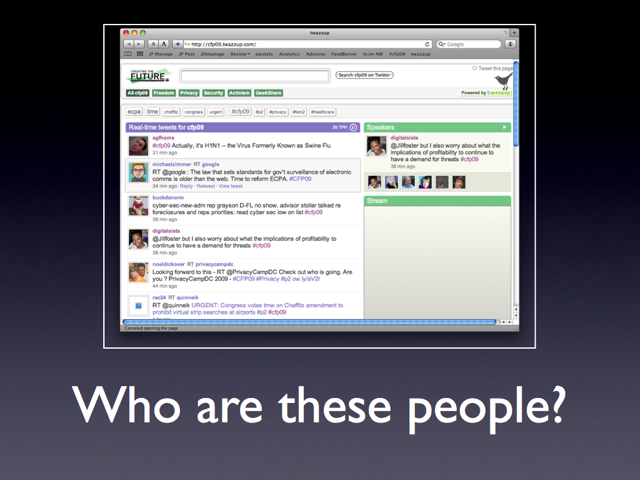
Here’s what I want to know: I’ve been keeping an eye on the #cfp09 Twitter feed, and there are a dozen names popping up regularly who are not at the conference — but who are clearly following the video feed and participating the back channel as actively as the rest of us in the peanut gallery.
The CFP meta-issue — that privacy and civil liberties are basic human rights and should be discussed and debated as such — clearly has a constituency outside the walls of this conference. Presumably, it has a constituency among the general population of people who have never heard of CFP, and probably aren’t ever going to be politically active enough to consider attending. What have we, as a collective activist community, done to reach out to these people?
It has been eighteen years since the first CFP conference, and in that time CFP has become a strong brand name among the privacy otaku, the “usual suspects” of individuals and organizations who show up at this conference and similar meetings on a regular basis.
But what has been done to create a “brand” on civil liberties in the public sphere? I can think of one organization which represents the most powerful mainstream liberty brand: the ACLU. 45% of America may hate them, and 95% of Fox News reporters may call them a socialistic cabal attempting to erode our security and hand us all over to the terrorists — but when you say ACLU, you say something that has a specific meaning in the mainstream political discussion.
There is no equivalent acronym in the public space for what we’re discussing here. EFF, EPIC, CPSR, ACM — all of these have strong meanings among the otaku. Some of these reach a wider variety of otaku than others. But if you stop someone at random on the street and ask them about the ACLU, they’ll have a familiarity with that organization (possibly a distorted one, but a familiarity nonetheless). We haven’t created any kind of similar brand for our definition of civil liberties among the general public.
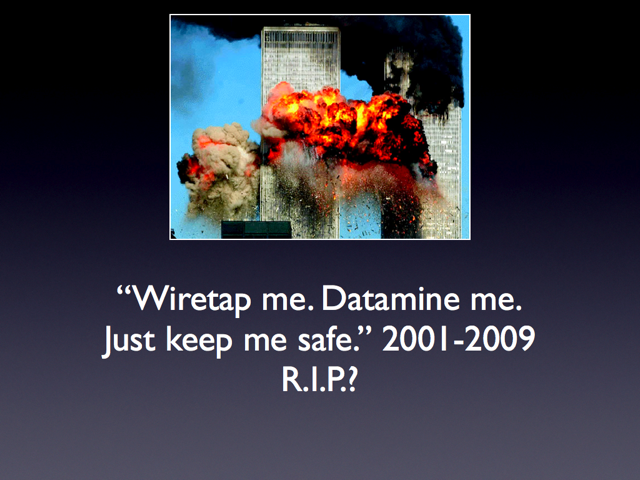
This, instead, has been the brand that has been dominant for the last eight years. Within our community, many of us have been appalled that there was no massive public outcry when it’s been revealed that our phones are all tapped in San Francisco, our emails read, our electronic transactions data-mined. Perhaps some people at the edges were activated and became members of organizations represented here. But the dominant meme since 9/11 states that Americans are apathetic about most aspects of their privacy and civil liberties, and are willing to subscribe to this notion: “I have nothing to hide from my government. So feel free to wiretap me, so long as you keep me safe.”
I don’t believe this is true; I believe this has been sold to us by political forces actively attempting to impose authoritarian politics (because it makes their jobs easier), and the simplest way to do so was to say that if you weren’t happy to be wiretapped for the greater national good, then clearly, you must be hiding something.
This is fundamentally in opposition to the notion that Americans are not answerable to their government; rather, it’s the other way around. This 233-year-old political meme has been reversed in the last eight, and in that time, the ball on electronic civil liberties has been moved backwards greatly, with little apparent political cost to those who did so.
However, this proves an important point: the ball can be moved. If one group of political actors can tilt the playing field against us, then it’s also possible for us to collectively tilt the playing field in our favor. After eight years, can we begin to lay the “keep us safe at any cost” meme to rest?
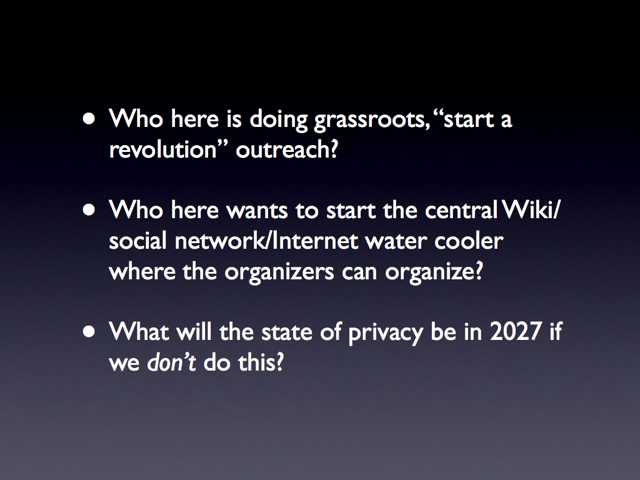
So these are my three questions to the CFP community:
Which organizations already have a public outreach program in place, promoting a more public profile for CFP-style debate?
I’m sure this is already happening, but it’s not obvious what we’re collectively doing. So who here is willing to become the central clearinghouse for this information, so we can work more effectively?
No offense is meant to the people who have been working on this issue for the past 18 years, but the definition of our issues as relegated to the fringe otaku is evidence that we have not had an effective grassroots outreach movement. So what do we think will be the state of privacy in the next 18 years if we do not work to redefine the public debate — and if we don’t, how much of our work over that time will be a constant uphill struggle to simply attempt to stay with the 2009 status quo? Aren’t there better ways to dedicate our effort?