Carter Emmart demos a 3D atlas of the universe
I wish they had given this guy 20 minutes instead of 7. Note to self: go to New York and spend some serious time at the Hayden Planetarium.
Carter Emmart demos a 3D atlas of the universe
I wish they had given this guy 20 minutes instead of 7. Note to self: go to New York and spend some serious time at the Hayden Planetarium.
NEW ORLEANS—Barely 24 hours after both market analysts and the technology industry were shocked by the announcement of a $7 billion merger between BP and the Apache Software Foundation, executives from both organizations are scrambling to explain a new contamination of the Gulf ecosystem, apparently by URLs, HTML tags, and other basic building blocks of the World Wide Web.
TAMU Professor of Oceanography John Kessler was the first to discover the bizarre contamination, posting to his blog this morning: “We were tracking a swarm of electric eels, when suddenly the entire population began rhythmically reversing polarity. Our underwater cameras revealed that they had accidentally strayed between two widely separated <blink> tags. Then a school of luminescent blowfish wandered into a CSS field and began changing size and colors. When several dolphins suddenly lined up and swam across the ocean floor, we knew we had a marquee on our hands.”
Web 2.0 researchers began arriving to aid marine scientists in shoreline Gulf territory by late evening, but aid efforts were halted when they discovered that AT&T coverage was nonexistent and none of their iPhones worked. Unable to tweet for emotional support and 75 miles from the nearest Starbucks, the best minds of the new media industry reverted to a state of nature, requiring environmental support groups to abandon brown pelicans in order to instruct them in the finer points of human survival. “It was really quite pathetic,” said Eve Lundstrom, a World Wildlife Fund volunteer from Minnesota. “After they were cut off from Facebook, they started questioning whether anything they did mattered if they couldn’t update their status. We found them trying to make lattes from seawater, and covering themselves in oil to resolve something they called ‘AntennaGate.’ When several of them stripped naked and swam straight out into the Gulf, we knew we had a real problem. The one we saved said they were looking for something called a fail whale.”
Sally Khudairi, Apache vice president of marketing, held a rapidly-called press conference on shore, within sight of a rapidly forming cluster of floating unmatched <div> tags. “Yes, we had begun integrating our technology into the reclamation efforts as of several weeks ago, and the servers we are using have worked perfectly for fifteen years. But for some reason, at the moment the Foundation signed the deal and entered into partnership with BP, all of our infrastructure suddenly began glitching. It was almost as if some sort of retroactive incompetence had been inflicted on the program code—which, of course, is impossible.
“Frankly, we have no idea how it is even possible for binary data to contaminate seawater as it has. But BP has promised that they will have a complete answer and solution to the problem in the next two weeks.”
Today’s announcement overshadowed continuing confusion stemming from the merger, about which both parties have been tight-lipped. The Apache Software Foundation gives away its software for free, and is generally believed to be financed by donations, so it is not known how they acquired the money for the all-cash deal, or how much they have left in reserve. BP issued this statement on an IRC channel in Finland early this morning: “We were as surprised as anyone when Apache approached us, and were unsure about the seriousness of their offer. But when they unzipped those dufflebags, and started piling bricks of cash and sacks of Krugerrands on the conference table, we stopped asking questions.”
Reaction to the announcement was highly negative, especially from the programming community which has contributed their time pro bono to Apache for years. “I’ve been living on nothing but off-brand Red Bull and 7-11 microwave burritos for nine years,” said one Linux programmer who identified himself only as Mar|<us. “It’s my code they’re using to work around an IE 6 bug with transitional XHTML 1.0, and what thanks have I gotten? A free pizza at the tweetup, and a LinkedIn blurb which hasn’t done shit for me in this economy.”
Apache has said nothing about the deal or why they made it, excepting a 4:42 AM EDT tweet from fundraising executive Serge Knystautas, which read in full: “‘Bout time you learned who really owns the web. Keep the Caymans transfers coming, boys. And fuck you, Stallman.” No further information has surfaced since, although speculation by Crunchgear blaming Apple and Steve Jobs personally for Apache’s apparent takeover of the Internet has been linked to by 14,482 blogs.
It is also unknown why the BP-Apache deal has apparently been subjected to a blackout moratorium on both Google’s and Yahoo’s search engines, both of which only show a single AP clipping posted on a Chinese language edition of the Epoch Times. A highly placed source within Google commented, in a quavering voice, “Man. You do not want to know what they threatened us with.”
When asked for comment at her press conference, Khudairi answered, “Klaatu barada nikto. Qapla’!”
At press time, reports are arriving from Austin that a viscous oily substance has begun leaking from the Ethernet ports on cable modems in homes and businesses throughout the city. Unconfirmed witnesses say that some wireless routers have begun spraying this substance in fine droplets in a 200-meter radius from the base station. Details are not available, but the phenomenon appears to be spreading outward to other cities in a drunken salesman pattern. Comcast issued a statement saying they were looking into the matter, but that this had absolutely nothing to do with BitTorrent throttling.
Old Spice Guy Remix
Michael Shermer: The pattern behind self-deception
It took me a long time to see the dolphin.
Repeal Of ‘Don’t Ask, Don’t Tell’ Paves Way For Gay Sex Right On Battlefield, Opponents Fantasize
This May, Sen. John McCain (R-AZ) promised voters he would do everything in his power to prevent gays from serving openly in the armed forces, and on Thursday, he told reporters that the role of the military is to defend American freedoms, not “the rights of, you know, those people some of us stay up all night thinking about as we toss and turn.”
“Imagine you’ve got a boat full of sailors out cruising the Gulf of Aden when all of a sudden they’re attacked. Some of the homosexuals lock themselves below deck and begin touching themselves,” said the 73-year-old senator and Vietnam War veteran, his breath quickening. “One of their names is Ricardo. Unbuttoning his pants, he throws his gunner’s mate down on the cot and penetrates him, his big, beautiful dick shimmering with power, his dog tags bouncing up and down as he’s pounding, and pounding, and pounding.”
Added McCain, “What I’m trying to say is: It all boils down to combat effectiveness.”
Antimatter deep underground may be key to predicting quakes
A massive particle detector located a mile underground has found bits of antimatter known as geo-neutrinos deep inside the Earth. The find proves the Earth derives most of its power from radioactivity and could help us predict volcanoes and earthquakes.
Your brain makes your eyes dumb
Fantastic optical illusion.
Macworld: iTuber brings YouTube to the desktop, with a few quirks
Xnet Communication’s iTuber provides drag-and-drop uploads and downloads, and other YouTube features, in an application that could use a bit more polish.
Hat tip to Brian Greenberg for this one: plug in a block of text into the I Write Like website, and it’ll tell you which great authors you emulate.
I happen to do a bunch of different writing, so I plugged in various writing samples.
For example, a chapter of the novel I’m working on: David Foster Wallace. Okay, nice start—one of the best writers in recent history, IMO. Of course, he was also horrifically manic depressive and hung himself in his garage a while back, so presumably the comparison only goes so far.1
For Macworld, TidBITS, or blog postings: Cory Doctorow. Call me a bit surprised by this one. It was no surprise that Brian writes like a guy who wrote Down and Out in the Magic Kingdom. But I think Doctorow’s prose is a lot more colorful than my nonfiction work tends to be, and certainly a lot more opinionated than my editors let me get away with.
So then I plugged in a swath of my nonfiction book, and the result was:
James frakking Joyce.
You’re kidding me, right?
1Plus, I don’t use footnotes.
We’ll pay you $6 to actually behead someone
BoingBoing has the original print ad for the Milgram experiments.
A little something I wrote a long time ago. Posting it here mainly so I don’t have to go looking for it again—Spotlight seems to have trouble finding it for some reason.
 |
 |
Greatest comic of all time unleashed worst overused design meme of all time
I find this highly disturbing.
This doesn’t work.
 |
Actually, this is a damn good idea.
 |
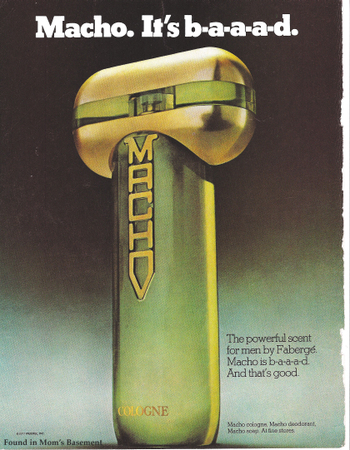
Really, is any comment needed?
|
Some things never change….
Image design 100 years out of date. Picture of girl playing with gun in bed 100 years out of date. Message that you need a gun because OMG what if someone tries to harm you? Timeless.
 |
U.S. public libraries: We lose them at our peril
LA Times essay, worth reading. Via Benton.
A Very Scary Light Show: Exploding H-Bombs In Space
Back in the summer of 1962, the U.S. blew up a hydrogen bomb in outer space, some 250 miles above the Pacific Ocean. It was a weapons test, but one that created a man-made light show that has never been equaled — and hopefully never will.
Drowning Doesn’t Look Like Drowning
The new captain jumped from the cockpit, fully dressed, and sprinted through the water. A former lifeguard, he kept his eyes on his victim as he headed straight for the owners who were swimming between their anchored sportfisher and the beach. “I think he thinks you’re drowning,” the husband said to his wife. They had been splashing each other and she had screamed but now they were just standing, neck-deep on the sand bar. “We’re fine, what is he doing?” she asked, a little annoyed. “We’re fine!” the husband yelled, waving him off, but his captain kept swimming hard. ”Move!” he barked as he sprinted between the stunned owners. Directly behind them, not ten feet away, their nine-year-old daughter was drowning.
Drowning is almost always a deceptively quiet event. The waving, splashing, and yelling that dramatic conditioning (television) prepares us to look for, is rarely seen in real life. The Instinctive Drowning Response – so named by Francesco A. Pia, Ph.D., is what people do to avoid actual or perceived suffocation in the water. And it does not look like most people expect.