Presidential debate: miscellany

I thought Romney started to lose his train of thought towards the end of the debate—a couple of times he seemed to launch into one of his old speeches to very different audiences, and then caught himself. I.e., “we’ve been endowed by our Creator” does not logically segue into a call for religious tolerance. There were several times throughout the debate when he wasn’t particularly smooth, but it seemed to get worse towards the end.

And why exactly was he bouncing up and down on his toes during his closing argument? He’s going kaboing kaboing kaboing the entire time, like there’s some soundtrack only he can hear.

As for Obama—same closing as his opening, which is to say that he started out decently and stayed decent, but there was certainly plenty of opportunities for improvement.

Last thing I don’t get: Lehrer was getting savaged on Twitter when the debate was live, and I just don’t see it. Sure, the two didn’t stick to the debate format. But when they went off script, they did continue making reasonably substantive points. Lehrer got the hell out of the way and let them talk. This might have been a fairly boring debate, but that’s because both candidates were wonky in their approach; I think Lehrer did a fine job of keeping them both talking, and I don’t see that enforcing time limits on questions would have improved on what was said.

Presidential debate: on compassion

Romney is doing a hard sell: “I feel your pain, and I’m going to do a better job than the president of making it easier for you.” One of the bizarre dynamics here is that he’s attempting to co-opt several strengths of the Democrats, while Obama (for reasons that escape me) is doing very little to argue against the underlying principles of the Republican position. (His attack against the negatives in the word “entitlements” is a welcome exception.)

This is part two of what Romney is selling that not only I’m not buying, but that I don’t think that most people will either.

I’m picking up this screen cap from Part 4 of the debate on YouTube: Romney has just said “Fourth” and is running through his reasons why Obamacare sucks. It’s at 1:31 of the segment.

It’s a headroll and a pursing of the lips, and it’s pompous as hell. It’s the facial expression of a guy thinking, “I can’t believe you’re so stupid that I have to explain this to you in the first place.” To be clear, I don’t think that he’s actually thinking that, but I think that it’s a bit of that personality coming through.

I never quite understood why W was the guy people wanted to have a beer with—a recovering alcoholic being about as appropriate for that as a Mormon (and it’s Obama who has his own brewer)—but conceding that people did think of him that way, then these are arguments he could make. Romney’s not the guy who innately sells “I care about the poor deeply and I’ll do more for them than the other guy will.”

For that matter, neither is Obama; the impression I’m getting tonight is that health care and the economy are interesting problems to solve, not things he cares about deeply. (I don’t believe that’s true. It’s just that he’s talking like a technocrat.) But Obama doesn’t have as strong a need to make the sale as Romney does.

Presidential debate: a digression on trust

One-third of the way through the debate, and my initial impression: everyone on Twitter (and from I hear, in general media) is frickin’ insane.

Someone else made the Etch-a-Sketch comment before I got to it (Chris Matthews? don’t know, quoting Twitter), but Romney goes beyond that: this is Pod Person territory in the first 30 minutes. I’m halfway expecting him to promise everyone a pony.

Here’s the thing: I’m watching Romney and I’m finding what he’s saying to be literally incredible—it’s completely at odds with everything else he’s said before. It’s not winning any points with me, but it’s not supposed to; there’s nothing he could say that would switch me to being a Romney supporter.

But that’s precisely the question. All of the people saying that he’s hit it out of the park are presuming that a) he’s pitching to the undecided voter, and b) that these people are tabula rasa waiting for Romney to create a first impression. I don’t buy that. They might be disinterested, and they might be uninformed, but they show up tonight with a standing level of trust or distrust in both Obama and Romney. And if they’ve never heard of either of these guys, then that standing level of trust is going to be their general impression of politicians.

So if you want to make the case that Romney’s argument is winning him votes, then you have to presume that the undecided, uninformed voter is going to spontaneously trust him here. And I don’t buy that that’s happening: because he’s a politician, because he’s wealthy beyond the dreams of most people, and at least in part because he’s talking out of an orifice that’s pointed in a completely different direction than it has been since 2008.

We tend to assumed that uninformed, undecided people are stupid and that they have no prior knowledge. Not true. And not buying that this is a Romney win in any way that matters. If Romney went into the debate with more generally positive numbers about how he’s viewed personally, I’d be saying something different.

The samaritan thief?

One downside of spending a lot of time gambling is that you spend a lot of time around gamblers. I don’t know why, but casinos turn perfectly normal people into the kind of folks you’d run into at the Mos Eisley Cantina.

So perhaps this story is about how I don’t trust people in Atlantic City.

I arrived in AC on a casino bus that dropped me off at Bally’s with a play voucher, so I camped out at a full pay Jacks or Better machine before heading off to my actual hotel. I was leaving $40 to the good an hour later, riding the PeopleMover to Pacific Avenue, when this happened. My thoughts in italics.

Guy behind me, in a thick East African accent: “Hey, were you just playing slots?”

Me, taking out headphones: “No, video poker.”

Guy: “<incomprehensible> leave phone?”

Me: “No.” The last time I saw my phone, it was sitting on my luggage, I might have dropped it….

Guy: “Someone said they found a phone. <I think, it’s still hard to tell the exact words>”

Me: “Shit.” Patting pockets—wallet, smokes, is that my iPod? The phone is lumpier. “Yeah, that was mine. Thanks.” <I start to board the walkway in the other direction.>

Guy: “No, man, here.” <reaches into back pocket, hands me my phone>

Me: “Hey, thanks. Can I give you something?” <big smile in reply>

I hand him twenty bucks. Phone still locked, no data exposed, I’m all good.

Then my brain turns on after he’s gone.

You find something in a casino, and you’re a decent human being, you turn it in at Security. Then the schlemiel who lost it can retrace his steps later.

How’d he know I lost a cell phone?

Scenario 1: guy sees me leave my phone, follows me out, maybe waiting just long enough so I offer him a reward. That’s a little scruffy, but hey, can’t blame him.

Scenario 2: guy sees me leave my phone, takes it, intends to leave with it, runs into me on the way out, and decides it’s faster to fence it back to me than to put it up on eBay. This is kinda seeming more likely.

I’m happy to have the phone back—I’m using it now to get online, and it’d cost me $40 this week just to get net access if I didn’t have it. Phone’s worth maybe $50-$100 (plus the chance to make free calls if you can break my code), and the replacement phone I’m looking at is $300. So at twenty bucks I got off cheap, and it was even Bally’s money.

But still, did I just hand twenty bucks to the guy who stole my phone? That bugs me.

I’m probably going to be noodling on this for a while.

jeffporten.com 7.0 beta

Trying out a new look for jeffporten.com, which makes this version 7.0. I suppose that to keep in touch with my Apple roots, the next two revs should be 7.1 and 7.5.

Aside from the look—which is trivial to change here on WordPress—there are three primary features I’m looking for:

  1. Centralization of where I’m putting all of my writing, including social networking services.

  2. Better control of CSS; the old theme was a pain in the butt.

  3. Better mobile templating. It’s pretty borked right now, and on the TODO list.

The excellent IFTTT service is dropping support for Twitter triggers, which means that I can’t use nifty rules to archive my tweets in ways that I like. So I’m going to attempt using my blog as my publication engine to Facebook and Twitter, so as to keep everything in one nice place (that I own, dammit).

Current rulesets: anything explicitly marked as Facebook or Twitter gets posted there. Illuminatus—my short posts with links or minor commentary—will be posted with full text to Facebook and no notice to Twitter. Conspiracy Theories—the “serious” writing—will post links to Facebook and Twitter.

It’s been a very long time since I checked in to see how many RSS readers I have, and how often people come here directly rather than following one of my social network links. Folks who follow me closely will see duplicate posts, and you’re the people I’d like to least annoy—so let me know what annoys you. At the very least, I’ll be make the links to the Conspiracy Theories and Illuminatus feeds (excluding the Facebook and Twitter material) more prominent. Any other annoyances, please let me know.

Thoughts on Twitter and Google+

I’ve been trying to figure out what the hell to make of Google+, and have assumed for a while that anything backed by Google would eventually find its breakout mechanism—but haven’t yet seen what that actually would be.

That is, Facebook, Twitter, and LinkedIn all have their happy little niches for how I use them. Facebook is where my personal networks mostly live, and is where I go to keep up with a far-flung network of friends and acquaintances whom I wouldn’t normally see in person. Facebook lends itself to a higher ratio of noise to signal than I’d generally prefer, but for that kind of community, extra noise is fine. You don’t shoot for “maximal efficiency” when you’re keeping in touch with friends.

Twitter, on the other hand, is mostly centered around my professional networks and the people I follow in my issue areas: writing, Mac stuff, Internet stuff, and progressive activism. Like Facebook, it’s where I go for news. Unlike Facebook, the shorter tweets and the limited link and discussion structure keeps it all much more management. Also, thank the gods, no Zynga.

LinkedIn: hell if I know. I put in enough effort to keep my network growing by looking up people I know. But I don’t actually use it. I keep hearing it’s a good place to pick up clients, but I’ll believe it when I see it.

Google+? The biggest problem is that it looks too much like Facebook, so when I signed up and set up my circles, what I saw was pretty much a subset of Facebook. I still don’t use it, and I’m still waiting for it to figure out how to draw me in.

I think that might be happening now, with Twitter’s recent boneheaded move to restrict its API usage. The Twitter API is what allows all sorts of third-party apps to do cool things with Twitter streams that aren’t built in, and also allow third-party services to work with your tweets. For example, I use IFTTT to do two things every time I tweet: stick a copy of what I’ve written into Evernote in my diary notebook, and email a copy of the tweet into an archive mailbox for safekeeping. IFTTT also scans my tweets for a #fb tag, and if it sees one, it cross-posts to Facebook for me.

According to an email from IFTTT today, thanks to the API changes, all of that is going away. I can still use the service to post to Twitter, but I can’t use it to get anything out of Twitter. Like Facebook before it, Twitter is henceforth going to be a black hole, emitting only officially approved Hawking radiation.

I think this might be an opening for Google+ (and I’m completely dumbfounded why Twitter is shoving its head so relentlessly up its ass). Interoperability is what turns social networks from a microblogging service into an operating system for the Internet—and even casual users make use of that OS functionality, even if they’re not aware they’re doing so.

Like I said, I haven’t done much on Google+, so I don’t know what they have and have not implemented on the back end. But here’s what will make me sit up and take notice.

  1. Excellent APIs. Give me very good ways of getting information into and out of Google+ in real time. For example, I now need a new “first place” to type up things that I then want to direct into Twitter and/or Facebook. If Google+ is that place, I’m going to start using it immediately. (I assume this is not the case, as if it were, IFTTT would have a recipe for it already.)

  2. An escape clause. One thing that really annoys me about Twitter is how hard it is to go backwards. My theory is, if I’ve ever written it, I want to keep it for posterity. And most of what I write on Twitter are snarky replies to other tweets. I can’t save that easily. Likewise on Facebook: there are ways to get my own timeline out of it, but if I’m in a comment thread on someone else’s wall, I can’t get back there. I understand all of the Big 3 have ways of downloading this stuff—bonus points to Google if they let me get back anything that I’ve created and shared, regardless of where I put it.

  3. Creative data formats. What really surprised me about Google+ was its adoption of “someone posts, then everyone comments.” There must be better and more useful ways of creating interactions. How about, instead of a separate events system, having posts in a date template where interactions can be comments, attendance, or other similar events? Turning messages more overtly into objects, and allowing other items in Google+ act on those objects, creates an ecosystem which is far more likely to leave competitors in the dust—especially if you provide mechanisms for the average user to do powerful things with this data.

But those are all lagniappes. The next winner of the social wars will be whomever makes it easiest to get stuff in from any number of places (computers, mobile, what-have-you), and equally easy to get stuff out. But the only competitors are the people who have critical mass—which rules out LinkedIn and App.net for the foreseeable future.

I thought this would be Twitter, but they’re fumbling the ball. Google has an iffy track record here, but hopefully has executives who realize that Google+ is badly in need of some oxygen. I’m not placing any bets as yet, but they’re the best set up to capitalize on this.

A short quiz for Pennsylvania Convention Center management

For the benefit of the management of the Pennsylvania Convention Center, a multiple-choice quiz. There are only two answers for each question, so this should be easy.


1. When an attendee at one of your conferences checks a bag at the “conference baggage check”, the baggage check should:

a. have no signage whatsoever, allowing the attendee to presume that you have the same closing time as most other conference centers, such as “sunset”, “10 PM”, or “never”

b. have a sign saying, “we close at precisely 6 PM, so please be here before then lest you be starred in a Kafkaesque passion play that we like to call ‘Samsonite and Delilah.'”


2. When that attendee arrives at the locked entrance to the convention center at 6:05 and is waving his arms to get the attention of the security guard, the guard should:

a) shake her head “no” from a distance of 50 feet, mouthing “we’re closed”

b) presume that the attendee has inferred as much from the locked door, and has some alternative reason for re-enacting Act III of Godspell on Broad Street


3. When the guard is finally enticed near the locked door, the conversation should be held:

a) through the glass, with lip-reading and pantomime

b) in any other fashion


4. When the attendee is finally allowed inside, the guard should:

a) allow the attendee to walk 1.5 city blocks inside the building to the empty and unmanned baggage claim

b) infer that perhaps there might be an issue requiring her continued assistance


5. When the attendee finds that guard and asks about his bag, a good reply is:

a) “You’ll just have to come back at 6:30 tomorrow.”

b) Choice a), followed by some additional action only after the attendee explains the concepts of toothpaste and a change of undies


6. The number of walkie-talkie messages and phone calls the guard should make for assistance should be:

a) 5

b) some integral number less than 5


7. When the second guard arrives, he should explain the situation with the words:

a) “They left”

b) Pretty much any other words in the English language


8. When asked “Who left?”, a good reply is:

a) “The people with the bags”

b) Pretty much any other words in the English language


9. The number of calls this guard should then make for assistance is:

a) 3

b) some lower number


10. When that guard walks away and leaves the attendee waiting for a return phone call, the amount of time he should be left waiting by himself with no apparent assistance is:

a) 25 minutes

b) some other amount of time


11. When that guard returns and repeats the same phone call, that conversation should:

a) give no indication that anything has changed in 30 minutes

b) provide some reassurance that the staff was not waiting for the attendee to give up and walk away without his undies


12. At this point, you would estimate that the attendee’s confidence that his luggage will safely be stored overnight if it cannot be found is:

a) excellent, given the efficiency and professionalism he has so far witnessed

b) some measurement lacking of that distinction


13. When the guard walks the attendee out the door, down the block, through the doors to the police office, past the police office, past the conference center security office behind the sliding glass windows that protect conference security from other conference center staff, around another hallway, and into an area marked “Food and Beverage Department”, that area should:

a) smell like rotting garbage left on a loading dock

b) probably not smell like rotting garbage left on a loading dock


14. When the attendee has been directed to yet another person behind sliding glass windows protecting her from conference center staff, and is directed to wait for another 30 minutes, thus providing the attendee, whom is a member of the press, sufficient time to sit down and write a scathing 1,200 word essay about your incompetence, this can be considered:

a) an excellent way to promote goodwill for the city of Philadelphia and Pennsylvania state management

b) potentially less than ideal


15. Has it occurred to you yet that the attendee would not mind waiting over an hour for his luggage, given his accidental tardiness, were it not for the fact that so far, no fewer than eight people have no clue where his luggage is?

a) no, this had not occurred to me

b) that is incredibly fucking obvious


16. How long after writing question 14 do you think that the attendee might be thinking, “Fuck my undies, I’d like to go home now”?

a) how long has it been since you wrote question 14?

b) about 30 minutes


17. The leftover pork fried rice left out in the room where the attendee is waiting should have how many gnats hovering around it?

a) gnats, plural?

b) oh, more than plural


18. . . .

a) uh, so how much longer has it been?

b) long enough that I’m considering coming back tomorrow with my wang flapping in the wind


19. After a total of 45 minutes, when the magic word “underwear” is said to the current person handling the baggage hunt, and this results in three phone calls in 90 seconds that appears to locate the bag, this can be considered:

a) good customer service

b) a return to Earth-Prime having spent 90 minutes in some alternate reality where one wonders what the fuck everyone was doing, or alternately, why my magic underwear appears to radiate a frequency coincident with GPS triangulation


20. When this person then walks the attendee back to the work area where he was until 6 PM, and indicates that the lockup room is next door, where the attendee would have seen his goddamned cherry-red wheelie luggage get rolled into the storage room had he waited another three minutes, and indicating that he must have passed the cherry-red wheelie luggage in the opposite direction while being forced to walk outdoors to the locked door in question 2, the appropriate response is:

a) ah, in the infinitely varied world in which we live, so many things occur so often that sometimes mere serendipity can rise to the level of irony, pointing out the gentle jesting of the universe at the expense of we poor mortals with our limited senses

b) you have got to be shitting me


21. When the attendee is left waiting in the same damned chair while everyone goes looking for the key, and while he is waiting, a mouse runs out from the chair oppos—

a) you have got to be shitting me

b) funny, that’s what I said


22. When the conference center staff returns and talks about the locked door being a “recore”, this is industry jargon for:

a) the Second Coming of Lord Jesus Himself riding a rampaging triceratops and swinging Jehovah’s scrotum overhead like a million-pound shithammer may get inside that door before 6:30 AM tomorrow, but you sure won’t

b) yes, that’s the impression I got as well


Postscript: the only criticism I have of the conference center staff is that they might have been a bit quicker on the draw, and have provided me a bit more information about what the hell was going on until I finally walked away without my undies. My overall impression is that I spent the entire evening dealing with polite, courteous people who have been crushed by a bureaucracy that would make Stalin weep in frustration.

Red and Blue: Politics 2012

Brian Greenberg and I used to have a regular colloquy on our blogs called “The Red and the Blue” where we’d debate some issue. That’s fallen off of late, but we’ve erupted into another 20,000-word extravaganza on Facebook recently.

I’m taking the liberty of cross-posting that discussion here for a couple of reasons: 1) I can never quite figure out what Facebook permissions are for linking to a discussion; 2) in case I’d like to read the damn thing in 2022, I trust my own blog more than I trust Facebook.

I’m editing out other comments from the debate (and making similar edits to Brian’s and my text), which is simply to keep in the spirit of Red and Blue. And also because I think I have Brian’s implied consent to do this, but I don’t know about anyone else.


Brian started the debate by linking to The Wrong Side Absolutely Must Not Win, with the comment “EXACTLY!” (Oh, so many words spilled following a one-word post….) My posts follow in normal text, Brian’s in blockquote:

Jeff, September 3, 10:49 AM

First, I agree with [the prior comment]. The Democrats are collectively moderate. The Republicans are collectively right wing batshit by the standards of the 1990s. The Democrats are squabbling idiots who bend over and grab their ankles when they are the minority party. The Republicans are masters of parlaying the filibuster, and the senatorial vote advantage of states with low populations, into shutting down the government when they don’t get their way.

So even before you start dealing with policy issues, it’s incorrect to say the parties are equivalent. I wish the Democrats were as effective as Republicans when in the minority.

Beyond that: last time I checked, the Democrats were in favor of insuring all Americans by 2014, and the Republicans are in favor of outlawing abortion entirely. Both of these are literally life-and-death issues, for either those who are uninsured, or for any woman of the age of 14 and up. No hyperbole necessary.

Personally, I also think that electing Romney—who would be the wealthiest president in 200 years—continues a trend towards plutocracy and oligarchy that has been even more dangerously powerful since Citizens United. So I think I’m justified in using hyperbolic terms about those views, but let’s be clear: just because it’s a matter of debate whether these are important issues, does not negate the fact that other political choices concerning health care, war, foreign policy, and the environment involve stakes that are too fucking high to heed an idiotic call for moderate language regardless of the topic.

Brian, September 4, 12:54 AM

You… could not paint a better picture of exactly what the article is pointing out if you tried. *My* side cares about “life and death” issues like Supreme Court justices and healthcare, *Their* side cares about things that don’t matter, like money and profits. *Their* side wants to kill sick people and teenage girls, *My* side wants to save the environment and end all war. And then, the icing on the proverbial cake: “No hyperbole necessary… [unless] I’m justified in using hyperbolic terms” – you know, because *MY* side’s issues are so important/substantial and *THEIR* side’s issues are so dangerous/undemocratic.

It’s as if the author of the article wrote your comments for you. Seriously…

Jeff, September 4, 3:39 AM

Brian… I can’t believe you’re not getting this. Let me try again.

Someone who is absolutely convinced of their pro-life position thinks that I’m in favor of drowning babies in a bathtub. That’s not an argument about moral equivalence, they think that anyone who is pro-choice is literally in favor of murdering babies.

There is no “moderate” or “polite” way to oppose that, any more than you would moderately or politely disagree with someone who was in favor of euthanizing the elderly or deporting anyone who isn’t white.

I completely agree with an argument against hyperbole—i.e., you can attack Obama for being too liberal without calling him a socialist. When I say that he’s moderate, I’m making a historically accurate, factual statement about definitional terminology in American politics. But if you want to make an argument that he’s too liberal, you can do so. Call him a socialist, though, and you’re being a hyperbolic idiot.

It is also a factual statement that wherever abortion is outlawed, more pregnant women die trying to terminate their pregnancies. I’m not saying that pro-life people don’t care about women in general. I’m saying that a minority of them—the absolutists who believe I’m in favor of drowning babies—think that it’s more important to prevent what they believe is a genocidal act against defenseless children.

However, the majority of them are ignorant of the fact that they’re in favor of a policy that causes women to die.

And the remainder just don’t give a fuck, in the same way that many people don’t give a fuck about the homeless, or the uninsured, or people starving and dying in poor countries, or children dying of malaria, or what have you.

That’s not most people. Most people are simply ignorant. The difference is that they’re willfully ignorant about actual pain and suffering. Some of these people would accuse me of being willfully ignorant of hellfire and damnation, and care about it just as much, and think that I’m just as wrong. The difference is that I’m talking about reality and not a sociopathic illusory fantasyland.

Yes, I do believe that my understanding of history, politics, and culture allows me to make a factual argument about sociopathic behaviors. I regard many Republicans as having the moral equivalence of a sixth-century village burning witches at the stake.

I’m making a factual argument to that effect, which you’re dismissing because I’m not allowing for some common ground? Please. That just shows that you’re not listening. There are many political issues where common ground exists. But when there isn’t, or when your political opponent advocates a position that will damn you, personally, to a shorter and more painful lifespan, it’s not hyperbolic to call it what it is.

Brian, September 5, 11:31 PM

To quote another prominent Republican, there you go again…

*Their* side believes that you’re in favor of “murdering babies,” but *my* side believes that they are in favor of “causing women to die.” *Their* side is being hyperbolic, but *my* side is reaching a conclusion based on a factual statement.

*Their* side believes I’m “willfully ignorant of hellfire and damnation” and *my* side believes they’re “willfully ignorant about actual pain and suffering.” *Their* side is being hyperbolic, but *my* side is talking about “reality.”

*My* side understands history, politics and culture. *Their* side isn’t listening.

For what it’s worth, I don’t believe that Mitt Romney, Paul Ryan, Barack Obama, Joe Biden or anyone in Congress from either party is in favor of murder and death or is willfully ignorant of pain and/or suffering. These are the kind of people that shoot up movie theaters, not the kind of people that run for and hold public office. The fact that they disagree with you (and me) on whether abortion is murder does not mean they favor killing young women. And when you say that it does, you are being as hyperbolic as the article I posted satirizes you for being.

Brian, September 5, 11:45 PM

@[prior poster] – first things first. Please don’t say *YOUR* side. I don’t have a side. I’m a registered Republican who has voted for Bill Clinton, George W. Bush and Barack Obama. My vote goes to the person I think would make the best president at the time he is running. And the fact that so many people have pre-ordained who they’re going to vote for before they even know who’s running drives me absolutely nuts every four years.

As to what you wrote, yes, justices have lifetime appointments. The one that George W. Bush nominated was the swing vote on Obama’s healthcare reform. You implied that Republican nominees to the court would have uniformly bad consequences and Democratic nominees to the court would have uniformly good consequences.

As I said to Jeff, the fact that one side disagrees with you on the issue of abortion does not make then more or less “bad” than the other side. (And, by the way, the fact that some (including me) disagree with you on the importance of potential court nominees with regard to choosing a candidate doesn’t make them “bad” either). The point is that both sides paint the other as dangerous/evil/harbingers of doom because of who they may nominate to the court. The point is that we can no longer say, “I disagree with Mitt Romney’s position on abortion, but I agree with his position on taxes (or whatever…).” The point is that “he” becomes “they” and “they” become dangerous/evil/etc. because “they” disagree with *YOU.*

Jeff, September 6, 2:03 PM

Brian—thank you, at least, for giving me the thread that explains this better. Attempt #3:

From the point of view of someone who believes that human life begins at conception, I am ABSOLUTELY in favor of murdering babies. Our argument is precisely over when a series of dividing cells magically moves from “cellular material” to “embryo” to “legally human.”

Someone who believes that human life begins when the sperm hits the egg looks at my point of view and sees LITERALLY no difference between the pro-abortion position, and drowning a 3-month-old baby in a bathtub. For them to then say that I am murdering babies, participating in genocide, or an evil monster is not hyperbolic or vitriolic—provided, of course, that you would agree with them that all of these terms apply to someone who supports the drowning of millions of babies in bathtubs.

THIS is the point I’m making. You’re drawing a line around some kinds of speech and saying, “This is hyperbolic, vitriolic, and has no place in our discussion.” I’ve been saying, “no, if something is LITERALLY TRUE, then by definition it can’t be hyperbolic.”

I’ll be the first to say that there’s a immediate step from “pro-choice” and “murdering babies” if you accept the above precepts. (Of course, I think the precepts are ridiculous.) The connection from “pro-life” to “women will die” is two or three steps, but those steps are repeatedly demonstrable and tightly coupled, so I think it’s justifiable—more than that, it’s one of the primary reasons I’m pro-choice.

Your argument appears to me to be, “If I hear obviously hyperbolic speech, I am going to believe it’s not factually accurate and dismiss it.” This draws lines and creates “polite, allowable political debate”, but more importantly, it also means that you dismiss anything that is hyperbolic by your terms. This has the effect of saying, “your political concerns are unimportant.” I can’t speak for [another poster], but such attitudes tend to get me fairly honked off.

Where you and [someone else] are both right is that there are many political areas where the connection from action to effect are many more steps, and are not tightly coupled. For example: I’m not going to call Paul Ryan a tyrant for being in favor of a 0% capital gains tax—although I can make a many-steps, loosely-coupled historical argument connecting low taxation to plutocracy, and plutocracy to tyranny. IMO, it’s perfectly reasonable to say that Ryan is a plutocrat or an oligarch, following the shorter path to the middle, but I’d say “tyrant” is somewhat hyperbolic. For that, I need to point to the Patriot Act and the neoconservative theory of executive power, where there is clearly a tightly-coupled path that makes the tyrant label stick (to both Bush and Obama, but that’s another post).

Jeff, September 6, 2:18 PM

Point 2: not much to add to the Supreme Court argument, except to say that since 1787 an appointment has been one of the best ways to make sure that your political philosophies were going to make a difference for decades. I disagree with Janet that a Court appointment has been politicized since Bork; it’s more accurate to say that that pendulum has been swinging for two centuries, and Bork was the beginning of this one.

Point 3: re “I don’t have a side.” I’ll gently call that horseshit. You have a side that traverses the gap between the two parties, so you don’t identify with either party exclusively; I think Janet and I both get that. But anyone who’s known you for a long while can come up with a guess about Brian’s opinion which is probably 80-90% likely to be correct, ergo, you have a side.

Pointing this out because saying, “I don’t have a side but you clearly do” is another way of saying, “I’ve come to all of my opinions through reason and you are parroting what you’ve heard.” According to what the psychologists say, ALL of us believe that we’ve reasoned our politics and ALL of us are wrong about that, a hell of a lot more often than we think.

Main difference between us is that your politics gives you reason to consider both candidates in most races. My politics mean I settle for the Democrat and never have to consider the Republican. That wasn’t always true: I voted GOP in PHL and PA races, back when GOP-PA meant something very different. I’ll consider green or socialist candidates when I have reason to. I’d prefer a social democratic party on the European model. But you’re being reductive when you think that Janet or I do less evaluation of a candidate than you do, even when it’s a foregone conclusion that we’re pulling the D lever as the least worst option.

Brian, September 8, 2 PM

I’m not sure if your rhetoric is so well rehearsed that you’ve stopped noticing the inconsistencies, or if you’re just hoping that it’s so eloquent that *I* won’t notice them. Either way, if one is to assume, for the sake of argument, that abortion = murder, then every single abortion results in a murder. With the same assumption, it does not follow that every person who wants an abortion in a state where it’s illegal will die. In fact, those who are anti-abortion would probably point out to you that the pregnant woman has several choices other than the illegal, unsupervised abortions that tend to cause the increased death rate you’re referring to – she can have the baby and put it up for adoption, for instance. Also, she can choose not to have unprotected sex in the first place if she isn’t prepared to be a mother. So, if anything, the “connection” between the position and the position holder’s definition of “murder” is much stronger on the pro-life side than on the pro-choice side.

But all of that is besides the point. The point, stated so well in the article I linked to and slammed home in stark reality by 95% of what you’ve written so far, is that most folks can’t stop defending their opinion as “righteous” and the opposite opinion as evil (or, in this case, murderous). I don’t believe for a second that you’re in favor of murdering babies, any more than I believe there are Republicans in high office that are in favor of murdering pregnant women. The issue is complex and will likely never be resolved fully, but the hyperbole can, and very much should, stop. The reason my argument appears to you as dismissive is because you consider anyone who recognizes merit to the other side of the argument as dismissing your own. That’s a pretty good definition of hyperbole in this context.

Brian, September 8, 2 PM

re: Point #3 – if you’re going to define “travers[ing] the gap between the two parties” as a side, then yes – everyone has a side. My “side” is the “middle” side. But that’s a pretty strained definition of the word.

Also, if I “consider both candidates in most races,” and you “settle for the Democrat and never consider the Republican,” then yes – you do less evaluation of a candidate than I do. In fact, if you’ve decided that you’re in favor of a candidate before you even know his/her name, then I’d suggest you’re doing *NO* evaluation of the candidate – you’re just reviewing the positions of him/her and his/her opponent in an attempt to prove your foregone conclusion – that the Democrat is right and the Republican is wrong. That’s not evaluation, that’s marketing.

Jeff, September 8, 5 PM

I rarely feel the need to rehearse my arguments, so I suppose you could easily argue either that my arguments are all unrehearsed and hence original, or that my mindset is so fixed that I stopped thinking originally in 1989.

Re the argument you posed, however: where you see inconsistencies, I see horribly sloppy thinking—or if you prefer, the kind of ignorance that I slammed in my earlier posts. Let N be the number of abortions where it is legal. N(1) is the number of abortions that are performed where it is illegal. It is true that N(1) < N. It is also true than N(1) is the kind of back-alley affair that led me to wear the clothes hanger pro-choice button in the 1980s.

Let N(2) be the subset of N(1) where the life of the woman is threatened or ended. The pro-life community wants to pretend that N(1) and N(2) are both zero—millions of data points exist to prove this is false. Personally, I believe that any nonzero number here is unacceptable, in much the same way that I’d be opposed to back-alley castrations.

Likewise, anyone who can formulate the concept that “a woman can choose not to have unprotected sex” is simply ignorant. I trust I don’t need to go into details.

So I think the real answer to your question is this: if someone is in favor of a policy that inescapably leads to a negative outcome, can someone say that they are therefore in favor of that outcome? I.e., pro-life inescapably leads to nonzero deaths of women attempting to have abortions, the invasion of Iraq inescapably leads to thousands of civilian casualties, etc. etc. I would say “yes, absolutely” if the person in charge of the policy is either cynically uncaring of the negative outcome, or “yes, with some slight wiggle room” if the person is willfully ignorant of same. The only possible “no” comes from “such an outcome could not be predicted at the time of the policy”—and even then holds the moral obligation for the person to reconsider the policy in the face of new facts.

This, incidentally, holds for beliefs anywhere on the political spectrum. I’m pro-gun control because I believe the lack of it inescapably leads to gun violence. There’s any number of research studies and data points that disagree with me. I don’t like having to reconsider the opinion—and I’ll admit that it’s very easy to say “any idiot can see that I’m right”—but I don’t approach that idea with nearly the certainty that I have about my pro-choice position.

Jeff, September 8, 6 PM

Point #2: unsurprisingly, I completely disagree that I’m ignoring the other side’s point of view—in fact, my ability to both state and argue for it implies the opposite. Pro-life is easy: if you believe that human life begins at conception (usually because of the infusion of the soul at that moment), then being pro-life is simply the corollary. Likewise, I grant moral points to the tiny sliver of my opposition who cares about both the “unborn child” (their words) and the lives of the women where abortion is outlawed.

It’s the majority of the pro-life community who are willfully ignorant and have no policy prescriptions to prevent back-alley slaughter that I state are in favor of murder. For the same reason, I say that people in favor of cutting off welfare after N months are in favor of an increase in crime or child starvation—the only way you can be in favor of one and not the other is if you’re willfully ignorant.

Likewise, if you can point out the outcomes of my beliefs and say that I’m willfully ignorant, I’ll reconsider them. For example, I’m strongly in favor of no-review welfare and easy access to government credit, to prevent things like crime and child starvation. The outcomes of that are an increase in fraud and government expenditure. I’m wholly okay with that. Show me different outcomes, and you’re damn straight I’ll reconsider my beliefs.

In my opinion, the reason I almost never have to reconsider my beliefs is because the opposing sides almost never make a factual argument against them. If you disagree with this statement, please feel free to begin one.

Finally: I think I’ve made a strong argument why my opinions are (mostly) rational, and the reasons why I’ll reconsider them. The problem with your attack on hyperbole is precisely because it creates a safe harbor for anything you deem hyperbolic. There are any number of philosophical arguments dating back centuries that ascribe the word “evil” to people whose policies result in back-alley abortions or wholesale civilian deaths. You seemingly dismiss all of them. I agree with a small subset of these—and have a regular mix of philosophical podcasts and audiobooks in my daily diet precisely to present myself with opposing ways of thinking.

When I want to listen to someone who disagrees with me who might present a factual argument, I generally listen to a Democrat. Or to a conservative who eschews the Republican label, such as you or Steve. Self-identified Republicans used to be worthwhile, but too many of them today start with precepts such as “Christ” or “global warming is a hoax”, which invalidates any reasoning that might follow.

Jeff, September 8, 6 PM

Point #3: again, your argument is far too reductive. You presume that the only valid decision point is which lever to pull. That’s ridiculous.

First, I’m generally deciding whether to vote Democratic or for a third-party candidate, so there’s the same level decision. Since this process includes considerations of game theory as well as straight voting procedure (i.e., will my vote for a leftist candidate cause the right-wing candidate to win), I’d argue that this is a deeper consideration than yours is, presuming that your votes don’t require secondary levels of consideration.

Second, I’m also deciding whether to volunteer for the candidates in advance of the race, or alternately whether to work with nonprofits and political organizations that may affect the race.

Finally, given how much I travel, there’s a “zeroth” consideration concerning where to vote. By default I’ll be voting in Pennsylvania this election, but I’m considering establishing residency in Nevada instead. Arguably, I’d say that even though my vote for Obama is almost certain, I’m putting far more effort into my exercise of the franchise than anyone who’s simply deciding between Romney and Obama.

Likewise, I’d argue that my politics require far more consideration of the parties than yours does. You’re a self-identified moderate, which means you’re catered to by both sides. I’m self-identified as “leftist”—I haven’t had a president campaign on my issues since 1936. That means I need to evaluate every candidate, then add in the game theory. If a libertarian streak occurred in the Republican party that was “Thomas Paine-libertarian” (as opposed to the Cato-libertarian that’s currently dominant), absolutely, I’d start giving that party a fair hearing. I don’t dismiss the Republicans out of hand; rather, it generally takes less than 60 seconds for nearly all Republicans to dismiss themselves by citing Christ or ignoring science, evidence, or some other segment of reality. When Christie runs in 2016, I expect that I’ll oppose him for different reasons, such as his record as DA or his opposition to gay marriage—but at least that will require more than 60 seconds of education.

Brian, September 8, 10:45 PM

Yeah, OK – we’re done here. I’ve given you several factual agruments, and you’ve ignored every single one of them, choosing instead to throw around words like “game theory,” quoting faux-algebra in an attempt to prove that abortion laws (and those who support them?!?) actually kill innocent women, and trying to convince me that your vote is somehow harder to decide than mine because you operate on some higher political plane than I do (including the idea that you might change states to influence the election more?).

You are clearly more intrigued by the argument itself than the substance of the argument and, frankly, I’m not. So at this point, we simply agree to disagree.

Jeff, September 8, 11:13 PM

Brian—I’m still waiting for the factual arguments. You’re attacking my rhetoric, and I’m explaining it. I’m resorting to philosophical concepts and algebraic terms in order to make myself more precise.

Yes, we’ve gotten caught up in a dozen side-topics, which is how these things usually go—I didn’t feel the need to discuss my voting strategies until you painted me as a knee-jerk thoughtless automaton. But I’d rather you didn’t disengage, because at this point your strongest argument against the initial point—the theory that politics might actually engage some life-and-death issues and should be discussed on those terms—has been that your tummy goes all wobbly when people get upset about it.

CS50: Forced to say something nice about Harvard

I’m usually pretty happy with my mad geek skills, but most of what I know about programming is self-taught. Someone thought it would be a good idea to put me in front of a teletype terminal in 1976, and I’ve been hooked since then. But back when I was actually learning stuff for a living, I majored in American Civilization and Communications instead of playing with computers.

Unfortunately, there are lots of gaps that come from this kind of educational process, so I sat down and took Harvard’s Intro to Computer Science over iTunes U last week—and I have to say, whoa. This is an amazing class. David Malan is both an excellent teacher and an interesting presence on stage, and goes through the concepts with skill and humor. I ended up learning a lot about C, and while I was able to whiz through most of the web-based technologies at 2x speed, I picked up quite a bit of useful information there as well.

Also, the demonstration of a Huffman tree is possibly the most beautiful intellectual theory I’ve seen in a very long time.

Malan’s class is currently the #2 class in iTunes U, so fire up iTunes and find it there (in the iTunes store under the iTunes U tab; the class is a free download), or use Harvard’s own web presence at cs50.tv. The class is geared for an audience with no programming experience; starting with C will throw you into the deep end, but that’s part of why I’m so impressed with Malan and the materials that Harvard has published to help you through it.

The SEAL report is setting off my spider-bullshit senses

I’m not in the least surprised to hear that the SEAL team had orders to kill, not capture Osama bin Laden. But I’m also not going to believe it just yet.

According to the AP, the new SEAL memoir says that the Obama administration lied about whether the team was given capture orders. The memoir also says that no one on the SEAL team is an Obama supporter, alongside several other tidbits quoted by the AP that would make good fodder as GOP talking points.

Here’s where I have questions: I consider it somewhat convenient that this kind of information would hit the airwaves in the pre-election window. In fairness, though, the AP reports that the book was originally pegged to a 9/11 publication date, which strikes me as an excellent, although tasteless, marketing ploy.

It’s remarkably unclear from the piece whether the AP has an advance copy of the book, or whether they’re quoting a Dutton press release. It states, “The Associated Press purchased a copy of the book Tuesday.” But the book isn’t available until 9/1, and advance press copies aren’t typically for sale—so are they working with an advance copy? Had they said nothing, I’d assume they were, as I’d assume that the AP would be on the gratis list. But since it’s also news that the DoD is only now getting their advance copies, this is a bit odd.

This might be a bit too inside-baseball, but the difference is this: give the AP an advance copy, and you’ve got 330 pages of book that could conceivably generate a headline. Give them and others a press release only, and then you’ve got a much better chance of dictating what headlines are going to make the news. People marketing the book won’t much care either way, as both will sell copies. People caring about framing the political message are definitely going to prefer the latter.

In any case, what’s really confusing me is this: I’m one of the people who are happy to hear that Obama might have ordered bin Laden’s capture, because I believe bin Laden was a criminal. But this puts me into a remarkably small focus group of Americans—so there is damned little to gain politically by the Obama administration to appeal to me, especially since just about everyone in that cohort is going to lean Democratic for many other reasons.

Sounds to me like we’re about to hear a shitstorm of attacks on the Obama administration for lying to appeal to people like me. Which the Obama administration doesn’t normally care about doing. And that’s the biggest reason why this headline is striking me as bullshit.

Thoughts on Syria

This just in on Google news:

Syrian Government Denies Blame for Houla Massacre

The Syrian government has denied its troops massacred at least 92 people, about one-third of them children, Friday in the town of Houla…. The Houla massacre marked the deadliest single attack since Syria’s anti-government uprising began about 15 months ago.

The single strongest argument I’ve heard in favor of military intervention came from an anti-Syrian government spokesman on the BBC: “We all know that NATO or the global community will intervene after another 20 or 30,000 people have been killed. So why wait when we all see what’s coming?”

I’m personally conflicted on the use of military intervention for humanitarian purposes. From where I sit, it was easy (and correct) to oppose the invasion of Iraq, and difficult (and correct) to oppose the invasion of Afghanistan without more clearly defined goals, methods, and exit strategies. It’s much more difficult to come up with a cogent foreign policy view that combines appropriate use of military force and political measures when considering Rwanda, Bosnia, Libya, and Syria. Points to the Obama administration for apparently getting it right in Libya, but in the absence of an Obama doctrine it’s not entirely clear whether the new Libya meets our long-term foreign policy goals, or what the difference is between Libya and Syria.

Two things, though, seem obvious:

  1. The absence of a clear humanitarian intervention strategy has a lot to do with how the global community should view both the U.S. and NATO, just as we’d be concerned about any nation that possessed a million-ton shithammer they could use against us without a clearly stated policy on its use. Based purely on numbers alone, the United States has a military designed to fight a world war single-handed, and the absence of its use can be just as telling as where we decide to use it.

  2. As they say, nature abhors a vacuum, but the political corollary is that a filled vacuum is resistant to creating effective measures. We’ve collectively delegated the enforcement of human rights law to the United Nations, which is also stripped of any enforcement capabilities. I’m not alone in glancing at some of the whack-jobs in the General Assembly and thinking that I’m glad that the United Nations doesn’t have a standing or allocated army… but after 70 years it’s also clear that human rights enforcement is toothless and ineffectual.

I can’t say that I can see a way out of this bind. But it does seem to me that if our foreign policy goal is to starve terrorist organizations of the will to hate Western nations, the use of money and power for clear humanitarian goals—and the absence of a policy of American hegemony promulgated by neoconservatives—would go a long way in that direction.

Jeff’s iPhone organizing strategy

I’ve just finished reading Tonya’s TidBITS article with tips on how to find iOS apps on an iPhone or iPod touch, and it inspired me to write up my own strategy.

Voila, my home screen. Or to put it more accurately, my display of secondmost important apps (with a few exceptions). The most important apps are in the Dock at the bottom, where I’ve put folders to make up for the fact that the Dock only has four spaces.
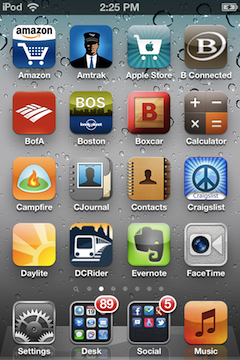
How to make a folder in the Dock: you can’t. But you can make a folder on any homescreen and drag it to the Dock.

Right now I have two folders there: Desk and Social. Desk roughly corresponds to “apps that do stuff I’d do on my Mac”: Mail, Safari, time logging, etc. Social is Twitter, Facebook, and a half-dozen others, and gets marquee treatment on the iPod because it’s my primary way of checking into such things. Music and Settings get their own places because I’m in and out of there all the time—and Apple, please please please give us a brightness slider shortcut in iOS 6? Kthx.

Above the fold: the apps I want quickest access to, and/or the apps where I want to see their badge icons at all times—and OmniFocus, I’m looking at you, kid. Apps get moved on and off the homescreen regularly based on how often I’m using them. For example, I’m giving Evernote another kick in the tires, so it’ll probably replace Voice Memos on the homescreen for a while.

You may have noted from the number of dots that I have quite a few pages in my Springboard. So let’s see what those look like….

Hmmm. Those aren’t organized at all! It’s almost as if Jeff has…

Yup. Alphabetical order. iOS makes this a pain in the butt; on my Android, there’s a one-click “alphabetical ordering” feature. But if it’s not on the homescreen, I don’t file it, folder it, or move it. Alphabetical by name so it’s easy to find. Every few months I take off the apps I’ve stopped using.

Let’s look at the last screen.We come to the end of the alphabetized list (and thank you, Zynga, for making that so easy to notice). Then there’s a blank placeholder app…

A what? How the hell did you do that?

…one sec, I’ll come back to that. After that are all of the apps I’m currently “testing”. I.e., these were downloaded for an article I’m writing, or are on my “check this out someday” list. If I decide to keep it, I alphabetize it. If it might be really useful, I’ll give it a shot on my homescreen.

As for the “blank” app, it’s a Safari bookmark. Open Safari, go to the URL about:blank (yes, Virginia, that is a URL), then tap the bookmark icon and save it to your homescreen. Give it a name of “.” or something else small and unobtrusive. Voila, blank app. Accidentally tap it, and you’ll just get a blank webpage, useful as a flashlight.

Blank apps are also very useful for an iOS annoyance. Move or delete an app on a full screen, and you’ll get 15 apps and a blank space like the puzzle on System 7. Worse: install a new app, and it might be randomly slotted here instead of on the last screen. Fill in the gap with another blank icon, and you’re good to go.

I sometimes have two homescreens (i.e.: 16 spaces on the primary homescreen, then swipe left for the next 16 apps and folders) before I go to the alphabetical list, but the folders layout I’m using now seems to work better.

Open letter to PZ Myers

So, Jessica Ahlquist recently received a letter charmingly threatening to rape her and her little sister for the sin of being atheist, because apparently rape is more in keeping with Christian values than not believing in Jesus.

PZ Myers wrote about this, which I’ll excerpt:

I don’t even understand the connections

[T]his letter is full of sexual slander and rape threats. WHY? This is not a sexual issue. She’s a minor; the last thing you should be talking about is having sex with her.

I’m just trying to wrap my mind around how those people think.

That’s not the way to think about this. Ahlquist is being threatened because she’s atheist. But the specific threat is violence for a different reason: the misogynist scumbag, and those of his ilk, simply did the math. “She’s female, 17, and small. I can beat some sense into her. In fact, someone needs to.”

The author—and I hesitate to call him a “man”, “person”, or anything else denoting humanity—would never use the same thought process for a man or woman who could visibly beat his ass into the ground. But he probably presumes that most women don’t fall into this category. Given his penchant for anonymous threats, well, let’s call that unproven.

Avoid Earthbound idiocy by putting an Internet in orbit

Two copyright-related news items just crossed my transom, which together remind me how foolish it is that we’re still pursuing technological and legal restraints on copyright infringement — which will only serve to generally screw up the Internet in new and exciting ways.

The first came by way of a tweet from Roger Ebert, pointing me to a story I missed about the new copyright infringement alert system. In brief, here’s how it “works”:

1) Copyright holders will continue to pay large sums of money to third-party companies hawking technological solutions.

2) These companies will monitor, or attempt to monitor, every P2P connection in existence in order to see whom is connecting to what.

3) If your IP address is displayed as connecting to one of these P2P clouds, you get a warning note from your ISP. After six strikes, undisclosed bad things happen.

The reason I put “works” in quotes earlier is that it’s trivially easy not to get caught. For example:

1) Use a BitTorrent client with an automated blacklist feature, and it will automatically refuse to connect to the IP addresses of any computer identified as doing copyright monitoring. (There’s a bit of an arms race going on here, and the blacklists aren’t always going to be 100% accurate, but they’re consistently pretty damned close.)

2) Use an open wifi hotspot.

3) Use any number of methods to spoof or block your IP address. Some of these are easy, some of these are difficult… but you can bet your socks that the more this feature is required, the more likely it will be that new P2P methods will spring up that do this automatically.

4) Or just ignore the whole thing. ISP involvement in this system is voluntary, and there’s no requirement that anything will happen to you after you get that sixth strike. It’s pretty much an open question how much heat the ISPs will want to bring down upon themselves, since any robo-cutoff system is almost certainly going to include grandmas who have no idea what they’re talking about.

In short, this system is geared towards that slice of the Internet-using market that is technically skilled enough to run BitTorrent, but not technically skilled enough to avoid getting caught. This is a very small slice of the torrenting market, and makes me wonder about the business opportunity to set up a turnkey safe torrent system as a consulting service. As always, torrents are completely legal, because there’s any amount of non-infringing data that can be downloaded over a P2P service.

The second bit of news relates to how impossible it will be to keep up with future technological advancements that make blocking impossible. For those of you already not up to date: the old argument that torrent sites were illegal hinged upon the idea that they hosted torrent files which in and of themselves proved that the site in question was engaging in copyright infringement. Torrent sites argued that the files themselves contained no copyrighted data, which presumably got them off the legal hook, but this argument didn’t fly in court.

So now, The Pirate Bay has switched to hosting its entire site using only “magnet” links that automatically link a torrent application to a P2P cloud. As with a torrent file, the link has a one-to-one correlation with whatever is being downloaded, but linking to a site is always legal; if this changes, then you can pretty much say goodbye to Google and any other search service.

The side effect of this change: The Pirate Bay’s entire database of 4,185,622 torrents is now a database that fits in 90 megabytes, which means you can store it on any one of the roughly 18 billion USB sticks that have been manufactured in the last decade. This also means that hosting the entire Pirate Bay is utterly trivial, and to generally prove this idea, The Pirate Bay is moving forward with a plan to host copies of its site in frickin’ low Earth orbit.

This sort of ties in with last December’s announcement that some groups are moving forward with the idea of setting up a “darknet” Internet which would be hosted on a private set of satellites. IMO, this particular idea is nutty as a fruitcake — satellites are a fairly expensive proposition — but the idea of creating a parallel Internet which is unmonitored and uncensored is completely doable. The process by which you and I connect to the same Internet is managed by the DNS system, and it’s perfectly possible to create two parallel Internet networks by deliberately creating separate DNS networks to manage them. This is generally seen as a Very Bad Thing — one of the major knocks on SOPA and PIPA is that it would essentially create these forks by breaking DNS — but a deliberate DNS fork is created every time a company sets up an intranet.

The same technology can be used to create a communications network that has content which skirts around national and international enforcement mechanisms. The primary vulnerabilities of such a secondary network would literally be based on military attack or police action that physically destroy servers or their connections, hence the plans for satellite bandwidth and orbital server hosting. These plans up the ante for what any nation or private entity would have to do in order to bring them down.

Personally, it seems to me that the technologies discussed in these plans are fairly dystopian, and I’d prefer to believe that after generational lag time is taken into account, it’s not going to be too long before Western governments understand that the legal framework forcing the existence of these secondary Internets is itself the problem. But the very fact that such things are possible with existing technology — and potentially necessary given our general moves to equate copyright infringement with terrorism — should demonstrate that the move to prevent piracy with laws and technology is a lost cause, as it has been for roughly five hundred years.

Bizarre apparent allergies

Photic sneeze response n.: the urge to sneeze upon exposure to a bright light.

Phobic sneeze response n.: the urge to sneeze upon exposure to a fearful situation.

Pholic sneeze response n.: the urge to sneeze when examining one’s own bald spot in a mirror.

Phoric sneeze response n.: the urge to sneeze after erroneously telling someone your name is Richard.

Phowic sneeze response n.: the urge to sneeze after erroneously telling someone your name is Richard, if your name is actually Elmer.

Phoic sneeze response n.: the urge to sneeze when eating Vietnamese soup.

Phrolic sneeze response n.: the urge to sneeze immediately after gamboling.

One protest I’m not down with

Oh, please. Really?

Two major business reform groups have planned protests of Apple Stores in six cities, urging the company to ensure the safety of workers who manufacture its devices. On Thursday morning, representatives of Change.org and SumOfUs will deliver petitions signed by hundreds of thousands of people, many of them Apple fans and iPhone owners, and carry signs and leaflets protesting the company.

I’m all in favor of nearly every take-to-the-street protest, including for causes I don’t support, but this is just silly:

  • Nearly anyone who uses any electronics or computers manufactured in the last ten years or longer has exploited a Chinese worker. Apple is taking the lion’s share of the heat for goings-on at FoxConn only because it’s the most media-friendly way to frame the story.
  • When FoxConn holds an open hire, this is what it looks like. FoxConn conditions are horrid by American standards, and better than many alternatives in China.
  • Meanwhile, anyone who votes Republican is probably supporting stripping away the rights that got us to the 8-hour day, 40-hour workweek, weekend, and overtime standard that we have today. Vote GOP if you want American semi-skilled workers to lead lives more like the Chinese.
  • Finally, if you use any electronics, then you’re also supporting a hellacious industry in the Congo that we require to get us those rare earth minerals they’re built with.

There are legitimate ways to pressure China and the DRC to improve the working conditions of all its workers, not just the ones who build photogenic products under decidedly nonphotogenic conditions. Apple may have a role in this. But pretty much the only people who have the moral standing to protest in front of an Apple store are the Amish.

The importance of inequality

Krugman posts some numbers on inequality. I’m interested in what he says about the rise of the 1% in terms of zero-sum game theory: namely, that the rise of the 1% has been enough that it genuinely has choked off gains for the rest of the economy. (And masked losses for the middle-class and lower during boom times.)

But the bigger question in my mind is historical: radical political movements and revolutionary fervor tend to start in nations where a comfortable middle-class, or an upwardly-mobile lower class, are suddenly cut off from future avenues of prosperity. It’s not the downtrodden who become radicalized; constant societal beat-downs also tamp down the ability to visualize something better. It’s when a large community is promised something better and has it taken away that folks form the Weathermen.

It’s been 50 years since we had that kind of political movement in the US. We tend to have less radical political movements than many other countries, which is generally attributed to societal and political safety valves, such as the dominant two-party system providing a moderating effect on the extremes of both parties. I think it’s fairly clear that these safety valves are breaking down.

Add to that the gasoline that’s being added to the fire by overzealous law enforcement. For some reason, Tea Party activists can bring guns to their rallies, but when populists break out the bongo drums, the police break out the econosized pepper spray. The use of violence against demonstrators who perceive themselves as law-abiding (regardless of whether they actually are) is the fastest way to make protesters think, “hey, maybe there’s something to this violence thing.”

Personally, the only thing that surprised me about Occupy Wall Street is how long it took to show up. I’m expecting to see more of the same throughout 2012–with the really interesting fireworks starting in 2013 after Obama is re-elected, if they still feel like they’re not being listened to. And the tinder won’t be set alight by the protesters: look for the opening salvos to be fired by law enforcement and federal agencies, who won’t realize that they’re attempting to put out smoldering coals with Molotov cocktails.

Warning: I may be a dangerous person

So I’m sitting at SFO waiting for my flight, using the public wifi, and cleaning out my downloads folder, when I came across this document I snagged earlier today: FBI Bureau of Justice Assistance: Potential Indicators of Terrorist Activities Related to Internet Café.

Hmm. I wonder if reading an FBI document at an airport counts as suspicious activity. Or if the fact that my monitor currently has “Warning: I may be a dangerous person” written across it in a large font while I compose this post might be an issue. (Which I post to a blog named The Vast Jeff Wing Conspiracy….)

In any case… seems like 13 out of 15 listed potentially suspicious techniques are things that I might do, especially if I happen to be researching terrorism at the time. Or troubleshooting a client’s AOL email, which is also considered suspicious.

In any case, if you’re curious about what the FBI considers potentially suspicious at places like electronic stores, airports, and hotels, the list is here. I think I’m going to put off downloading the rest of them until I get home.

Three obvious truths about Mitt Romney

Much hay is being made on recent Romney gaffes, at the risk of overwhelming the true stories being told here. The following seems transparently obvious to me, but since few other people are saying the same things, perhaps they’re worth enumerating.

Romney talks about the poor because no one believes they are. Ask nearly any American, and very few of them believe they are “poor” or “very poor”. Just about every American calls themselves middle-class of one stripe or another, and that includes the guy who hasn’t had a job for two years, and the guy who makes $200,000 but has friends and colleagues who make millions. Of the people who do self-identify as poor, only a handful pay attention to politics. Appealing to the middle-class at the expense of the poor is a standing American meme, and it’s been 50 years since there was any mainstream political discussion of this.

Romney genuinely doesn’t get it, and that’s part of why people can’t stand him. You can tell a lot about how a person thinks by the words they use. This isn’t “gotcha” journalism, this is basic psychology.

The chattering class instantly dismissed discussion of whether W was a sociopath when analysis showed that he became very fluent with words when talking about punishment and retribution, but only made “putting food on your family” flubs when it came to expressions of empathy. This dismissal occurred because some things that are true are still considered impolite in political society. You unconsciously pick up on people’s speech patterns and cadences all the time when you’re building your mental model of what these people are like; it’s part of the 90% of communication that we all use without words. It’s also the hardest thing about ourselves to fake; cover up all you like when you want to present a facade, but your microexpressions and speech hesitations are going to show your true self.

There’s a storyline about Romney that he’s made too much money to understand what it’s like to not have any. This is persistent because it’s true. A man who can spontaneously offer to make a $10,000 bet, or refer to a $370,000 income as “not much”, has simply moved to a realm where money means something different to him than it does to the people he wants to vote for him. This in and of itself is not a problem — Americans don’t hate rich people — but the dissonance it causes when he tries to pretend otherwise is exactly why he comes across as phony.

No one cares about sociopathy in politics because the GOP is built on it. The core of Republican philosophy is “pull yourself up by your own bootstraps”, and is encapsulated in Herman Cain’s “if you aren’t rich, it’s your own fault”. Republican voters love to hear this, because it tells them two stories about themselves that they want to hear: that they’re personally responsible for their own success, and that the American Dream means that they don’t need to responsible for others in general, just members of their own tribes.

This philosophy completely ignores the obvious truth: bad things happen to good people, and these bad things can seriously affect one’s financial health. In an economic downturn, the proportion of people who get shafted goes up, and by definition many of these people are not responsible for having a giant target painted on their asses.

This is why Obama is going to win in a cakewalk in 2012, although few people seem to understand this yet. The bad economy isn’t going to pull voters away from him, because the GOP is pitching their standard message of “I got mine, fuck you.” Meanwhile, huge swathes of swing voters who once had theirs are now wondering whether they’re personally going to be screwed by a “fuck them” philosophy. They’re going to swing back to the GOP when they’re financially safe enough to do so, or when the GOP figures out that its message is so poorly timed. (And when the GOP stops nominating candidates that make Dukakis look like Mr. Charisma.) Obama’s message is “I’ll do my best to have your back.” That’s the sale pitch to have in 2012.