Google saves me from a life of crime

I live in a house that backs onto a park, which connects to a white-collar complex, which in turn faces the road that goes to the Starbucks, the Metro, and the grocery store. (Which my father bought for two zuzim, had gadya, had gadya.) The complex is private property, but it’s 2/3rds of a mile to Starbucks according to satellite mapping when takin’ it to the streets, versus a half-mile cutting through the park and the complex. Easy call.

Even then, my shortcut takes several cutbacks and u-turns, and it was 95 frickin’ degrees in DC yesterday, so I did some exploring to see if I could find a better way.

I wandered around to various other entrances to the complex, meandering through a few parking lots.  Noted that these parking lots had trees and shade, which is already a bonus over my usual route. Found a break in the hedges and fences that surround the place—apparently to protect the houses behind it, including mine, from the dangerous white collar workers. Walked around a tree, wandered up a short path, and found a fence with a gate—directly in front of my house.

The gate, of course, was locked.  With a particular brand of padlock.  Which, as was documented last year in various places on the Internet, I could learn to pick with about a half-hour’s practice, using tools that I probably carry around anyway. (Innocuous tools, mind you. Nothing shady or even techie.)
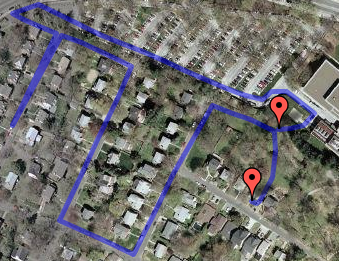
walkabout.pngNext up was the long walk around the locked gate in the fence, to get home and simultaneously see if I had any better options. That trip was 3/4ths of a mile to get me from point A to point A plus a smidge, as illustrated in the accompanying photo. This just annoyed the heck out of me.

(If you’re wondering, yes, there is a huge difference between teaching myself how to pick a lock, and just climbing over the fence right then and there. One is a clever hack. The other is doing something you clearly aren’t supposed to. This goes without question.)

On that long walk home, I’m calculating a few things in my head:

  1. The time and effort it would take to learn how to pop that lock, and in a short enough period of time such that no one would notice me repeatedly opening and closing the locked gate.
  2. The extent of the risk if I’m caught, which has its own categories:
    1. I could be stopped by a rent-a-cop, and forbidden to be on the campus private property again, in which case my walk rises from 0.5 miles to 0.65 miles.
    2. I could be stopped by a real cop and tagged with a misdemeanor; I’m not sure what law I’m breaking, as I can easily walk around the fence, but I’m guessing that “opening locks that don’t belong to you” is on the books somewhere.
    3. I could be tagged for something much worse, since I wouldn’t be a bit surprised if, in post-9/11 DC, what I’m describing here counts as an act of enemy combatant terrorist trespass. (And if you think I’m kidding, I’m fairly sure I committed a felony yesterday while troubleshooting a client’s network. No, I’m not going to tell you about that.)

By the time I got home, I was absolutely convinced that the next order of business was to look for the HOWTOs on popping locks with innocuous household objects. I had a clever hack, and it was going to save me time on a daily basis; that’s my favorite kind.  But just for the heck of it, and partially to prove to myself exactly how clever my clever hack would be, I pulled up the maps to get the exact distances I was saving.

My current, annoying route:

legal.png

My new, timesaving, perhaps illegal route:

illegal.png

According to satellite mapping, total distance saved:

(wait for it)

16 feet, 10.7 inches.

Okay. So perhaps not quite so clever.
We become our parents

I’ve been fascinated recently by ways in which I’m unavoidably taking on character traits of my parents. This is doubly true of traits I’m getting from my mother, as she died five years ago—every time I pick up a new Mom habit, it’s like she planted a tiny nurture time bomb back in the Carter administration that was just waiting to go off.

So no big deal that I now sneeze after every meal, like she did; I figure there’s some bizarre genetic explanation for that, similar to why I sneeze every time I walk into bright sunlight. But somewhat disturbing that, after decades of teasing her for her inexplicable love of the smell of gasoline, I now find myself unconsciously taking deep shnuffs every time I’m walking past one.

Today another one snuck up on me. One of Mom’s favorite songs was “Puff the Magic Dragon,” which she loved but always found to be incredibly melancholy. Play it on the radio and there would usually be tears on her face by the time it ended. Me, I’ve always liked it, but it wasn’t particularly stirring.

Then it popped up 30 minutes ago on my iTunes shuffle, and brought me to such a complete emotional full stop that I had to stop to write this and clear my head before I could get back to work.

Thanks, Mom. I’m not thrilled with the being short thing, and I’m not looking forward to the diabetes, but this one I can live with. I just have to be careful where I am when it starts playing.

Liking gasoline, though, that still freaks me out.

Talkin’ bout the weather

Does anyone else think there’s something extremely bizarre about today’s DC forecast?

Scattered showers and thunderstorms. Some storms could be severe, with large hail, gusty winds, and frequent lightning. Partly cloudy, with a high near 86.

At least the hail should melt quickly.

Big day

Every couple of years, I make a note of June 10th only because it’s exactly halfway to my birthday. Usually, this causes about 15 seconds of thinking “huh, time flies”.

Today, however, the evil subconscious demon in my head who’s good at math said, “Hey, you’re exactly halfway to 75.” He even just made me look at the clock and say, “As of about three hours ago.”

Damned evil demons….

Petty people suck

Everyone once in a while, you meet someone who casually, in the space of a few moments, is able to make you despise humanity and hope that someday the cockroaches will create a more civil society.

The scene: Costco just before closing, in a cattle call line for the cafeteria. For those of you who haven’t had the pleasure, the food is cheap, good, plentiful and 90% pizza grease; before you can have any, though, you have to stand in a long line with people whose shopping carts contain the gross annual exports of Shandong province. These carts are like trucks at the tollbooth, making it extremely hard to judge which line is longer. You’ll almost certainly be wrong, so the right strategy is to pick one and try not to be in a hurry.

I’m standing in a line that ends in two different registers, longish when I get there. It’s much shorter when some guy arrives behind me, cherubic tyke in tow, and we have the following conversation:

Some guy: Which line are you in?costcoguy.jpg

Me: I’m in the line.

Some guy: It looks like there are two lines here.

Me: There was a single line when I got here.

Some guy: Well (indicating the yellow stripe painted on the floor, on which I am standing), there are two lines.

Me: I thought the social purpose of lines was to allow the people who are waiting the longest to be served first. Do you intend to get in front of me? Because the only reason you could ask me which line I’m in, is so you’d have a chance to get lucky.

Some guy: No, you should just pick one.

Me: I have. (turning back around, still standing on the yellow line)

Thanks to the magic of camphones, I can share with you the picture of the man who does so much, in his breathtakingly efficient and negligent way, to ensure that existence remains nasty and brutish, if not short. Should you see him on the Beltway, I have not the slightest doubt that he’s the type to cut you off in traffic, so drive defensively.

Jeffsurf

I got 9 out of 10 on the toughest word game on the web. Warning: they don’t tell you which ones you got wrong.

Argentine ducks have disturbingly huge schlongs.

Another very cool alarm clock, if somewhat over-engineered. (Shockwave video with sound)

New Terminator trilogy in the works, debuting in 2009 without the Governator.

Internet Explorer 7 is an accidental, yet effective simulation of peripheral neuropathy.

If I lived in NYC, I’d be going to see this tomorrow.

Perhaps I’m just being harsh, but I think anyone who really needs this software should be ordered to slowly back away from the ramen before he hurts himself.

Brilliant television: Salvador Dali on What’s My Line?.

Don’t bother to vote: AIR has already predicted the results of the 2008 presidential election.

I find it absolutely terrifying that, 25 years later, I still have the blue maze memorized.

I’m not sure if I’m more disturbed by this photo due to its combination of nudity and Linux, or because it turns out Tux is an outie. (NSFW… no, SFW… aw, hell, it really depends on where you work.)

Jeffsurf, the children’s hour

Hey, teachers! Here’s something you can do to kids you don’t particularly like.

Or you can make them fly a plane: kid’s birthday money stolen by the TSA.

Apparently, all the literate children move to Virginia. An Amazon contest shows three DC suburbs in Virginia in the top five purchases of Harry Potter 7; at press time, DC itself and the Maryland suburbs are absent or far behind. No, I don’t have a theory on what this means.

Useful and cheap

big-gulp-extreme-3.jpgOkay, so it looks very silly, and when full it weighs about five pounds. But after long stretches of seeing $20 thermoses at Starbucks, I was happy to find this $4 bigmug at 7-11. Posting about it because I was somewhat amazed to discover that ice left in it overnight was still frozen the next day.
Hold this, sippy cup.

An open letter to John B. Catoe, Jr.

(Posting this on the very slight chance that a public display of pique will make me feel better.)

John B. Catoe, Jr.
General Manager, WMATA
600 Fifth Street, NW
Washington, DC 20001

Dear Mr. Catoe,

I am writing to inquire about the code of etiquette, if any, to request that the last T2 bus of night actually stop at the T2 bus stop on River and Goldsboro Rds.

At 10:30 this evening (after I had waited approximately a half-hour), the bus drove past my stop in the center lane; clearly, in advance of his arrival, he had determined that he had no intention of stopping. As I was waiting at the stop using a laptop computer, I presume I was reasonably well-lit. Therefore I deduce that simply being at the stop, with my own point-source of personal illumination, at the scheduled time of arrival, is not enough to actually request a Metrobus to stop.

What did I neglect to bring? An airhorn? Magnesium flares? Perhaps a system of radio communication to trigger some sort of “please stop” alarm near the driver’s seat? (I have Bluetooth and Wifi, if that helps.)

Having missed the bus, and being woefully unprepared by not charging my cell phone prior to using Metro, I was unable to call for a cab and proceeded to walk approximately three miles home. (More precisely, according to Google, 2 miles and 4,394 feet.) Personally, I’m in decent shape and enjoy a long walk of over an hour on a nice night (70 °F and partly cloudy, thank you for asking), although I suspect that not all of your customers can say the same.

The unfortunate part is that the first 1 mile, 253 feet of that walk was along River Road; which, as you may know, is an unlit highway with no pedestrian sidewalks, multiple blind curves, and a great deal of traffic. As it happened, there were plenty of oncoming vehicles moving at high speeds to illuminate my path, but perhaps you understand why I saw this as a mixed blessing. I have made a mental note to carry with me, the next time I plan on using Metrobus, an orange reflective safety jacket in the event I should similarly displease your drivers, or otherwise fail to signal my intention to make use of your services.

Your advice on this matter is greatly appreciated. I am very embarrassed by my faux pas.

Sincerely,
Jeff Porten

cc: Elizabeth M. Hewlett
Chair, Maryland, WMATA Board of Directors
1101 Mercantile Lane, Suite 240
Largo, MD 20774

Jim Graham
Second Vice Chairman, Washington DC, Board of Directors
1350 Pennsylvania Ave., NW, Suite 105
Washington, DC 20004

Ron Shaffer, “Dr. Gridlock”
The Washington Post
1150 15 St. NW
Washington, DC 20071

Scalzi, live and in person

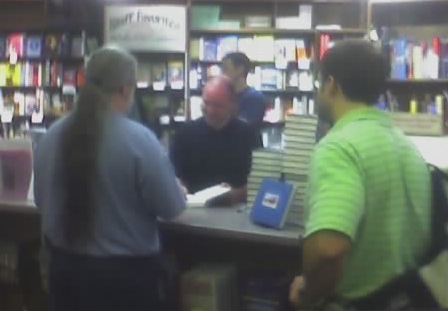
Liveblogging from the John Scalzi appearance pimping his book The Last Colony. Aside from being a helluva writer, he’s also an engaging speaker. Unfortunately, you can only catch him live in Richmond as this is the tail end of his tour, but the fine folks at Google have immortalized his speech there.

Also, based on the number of attractive, literate women standing in the book-signing line, I’m definitely recommitted to finishing my novel one of these years.

05-08-07_2021.jpg

Jeffsurf

Best sports-related geek humor ever.

This might alter the perception that polar bears are cute and cuddly.

Fascinating video from NPR [1] about social space in Second Life. Most fascinating to me: gender rules apply, even though the avatar’s gender has no connection to actual gender. (Makes me wonder if this is way to determine if the person you’re talking to is who s/he says s/he is.)

[1] Who knew NPR did video? Or as the Rocky Horror audience script puts it, “what the f*** is a radio picture?”

Spinal Tap reunites (for the 26th time in 25 years) for a global warming benefit; Marty DeBergi (aka Rob Reiner) debuts a 15 minute where-are-they-now video.

Here’s how you can own your very own integer, just like the people who make DVDs.

Fun with Internet phone numbers

or, How to Blatantly Steal Ideas from the iPhone

It will come as no surprise to anyone that I’ve got a minor case of geeklust for the iPhone. It might be a surprise that I’m not expecting to be an early adopter. For one thing, I can’t have one yet, and there’s nothing like delayed gratification to kill off the geek libido. For another, there’s a very long list of specifications that makes me drool quite a bit more over the Nokia N95, at least the next time I feel like dropping nearly a grand on a phone.

But this post isn’t about that. It’s about one feature of the iPhone that I wanted immediately when I saw it demoed: visual voicemail.

My relationship with voice communications is rather strained, especially for a guy who’s had around a dozen cell phones and two dozen phone numbers (including a 500 and 700 number, if anyone remembers those services). I’m horrible about keeping up with voice messages. I hate having to skip through 12 messages to get to the one I know I need. And it drives me nuts that I have yet one more nonfungible bucket collecting important messages, when 95% of everything else is routed to my email.

Enter GrandCentral, currently in public beta. Sign up with them and they give you a free phone number in an area code of your choosing. Then plug in all of your other phone numbers. When someone calls your GrandCentral number, all of your phones simultaneously ring. That by itself is fairly nifty, but since I’ve been a cell-phone only guy for ten years, I’m interested in their other services.

You can record incoming calls. You can drop someone into voicemail and listen to the message live, then pick up if you decide you want to talk to them. You can switch a call from one phone to another (i.e., off a landline and onto your cell). And you can get all of your voice messages stored on a website that’s accessible with mechanisms similar to visual voicemail.

But hey, that’s not all. Hook up GrandCentral with a free Gizmo Project account, and you can have your calls ring through to your computer. Or you could use Skype’s SkypeIn service. The difference is that SkypeIn is $38 a year, but Gizmo will give you a 775 area code for free. (Gizmo charges $35 if you want to pick your area code like you can with Skype.) And unlike SkypeIn, Gizmo 775 calls show up on the recipient’s caller ID. Last time I checked, SkypeOut calls instead provide the rather disturbing 1-000-012-3456 as your phone number.

I’ve been doing my experimenting with this at 2 AM, so I haven’t yet run many tests on voice quality. (Except for the guy in Italy whom I dialed up by mistake. Sorry about that.) But so far it’s been peachy keen enough for me to recommend it, and I’ve been giving out my GrandCentral number for the last week. The most fun I’ve had so far: in order to run a ring test, I used SkypeOut to call GrandCentral to ring through to my cell phone and Gizmo accounts simultaneously. I was somewhat amazed when it worked perfectly, although I was careful not to say anything, lest I created an echo that ripped a hole in the space-time continuum.

What I’m looking forward to doing is switching my calls over to Gizmo when I’m communing with my laptop. This puts incoming caller ID onscreen, and I can use my MacBook’s audio to take the call. This also means fewer cell minutes burned, and I can shut off the phone to save battery power. Finally, I’ve rigged my cell phone to stop using T-Mobile’s voicemail, so anyone calling my old number will still get fed into my GrandCentral visual voicemail system.

(Check with your cellular provider before you do this; they charge different rates for forwarded minutes and regular minutes. I discovered this years ago when AT&T billed me $300 for usage over my regular plan, which was unlimited minutes. I spent hours on the phone asking customer service reps how I exceeded an infinite number.)

So, for those of you who have my phone number already, drop me a line to get my new numbers. You can still reach me on the cell number you have, but I’ll prefer to take calls on the new GrandCentral number. (And of course, hang onto my cell in case GrandCentral goes kablooey.) You only need the 775 number if you want to know it’s me when that number pops up on your caller ID; call me there and you’re quite likely to miss me.

For those of you who don’t have my number, check out this nifty widget.

Red and Blue: An Inconvenient Truth

This post replies to Brian Greenberg’s review of An Inconvenient Truth.

I think we can also agree that this is true: “It is difficult to make a man believe that a problem has been solved when his salary depends on him working to solve it.”

I’d be willing to bet a very large sum of money, at attractive odds, that there is not a single environmentalist working today who is afraid of being put out of work by an effective solution to global warming. The problem is simply too huge, and even given massive public investment in reversing the trends, there’s at least another decade or two of work to be done. (And of course, any activist who draws a salary from his cause will always be able to find new employment on a different problem later, should he be lucky enough to obsolesce himself.)

He needs to be dramatic as well, even to the point of twisting the facts to do it. This, I believe, is what ultimately sunk him in his 2000 election bid, and it’s presence here is palpable.

Ugh. No, I’m not going to debate 2000 with you (again). But there has been tons of media analysis that basically established that in 2000, nearly every instance of “Al Gore exaggerates” was actually attributable to what the media reported he said, and not what he said. Compared to the sweetheart coverage of GWB’s malapropisms, the effect was really quite stunning.

First, there are the truly inexplicable asides about the hardships he has endured in his life.

Agreed that I didn’t much care for this, but I suspect this was done for movie production values rather than to sell the argument.

I had to laugh at the various scenes of Al Gore “studying” global warming data on his laptop. A closer look at the machine clearly shows that he’s working in whatever the Mac’s equivalent of PowerPoint is, and he’s editing slides, not studying data. Setting aside the fact that he says he’s given this slide show over 1,000 times, so the slides are probably already set, I’d be willing to bet a large sum of money on the fact that Gore didn’t create any of these slides himself.

Ooooo, how much money? Because I’d win that bet. Gore uses Keynote (the Apple branded competitor to PowerPoint), and is fairly famous for authoring both his presentations and the words that appear in books under his name. It might not be 100%, but it’s not ghost-written either.

Furthermore, the slides are updated on a regular basis (there are reports of people seeing him working on it on the plane), and people who have seen him live in consecutive appearances report that whole sections can be dropped or amended, to suit the current state of research, the audience, and the length of the speech.

Everything else becomes a function of how many of us there are, and since no one is advocating for killing off 7 billion people, we almost have to look at ways to adapt to this new reality, rather than ways to stop/reverse it.

Not entirely true. For one thing, we’ve known about population growth for nearly 100 years, and there have been movements to slow it for that entire time (the most legitimate of which is Zero Population Growth). But it makes a huge difference now that large swaths of the developing world are industrializing. It’s not just a function of raw numbers. (And there are interesting philosophical debates going on about the implications of having a population of nine billion; twice as many mouths to feed, but also twice as many Einsteins, Borlaugs, and Gores to address it.)

Two examples caught my eye: Holland and the World Trade Center memorial site…. These are ironic because both sites are currently below sea level, and both have been protected by technology that was invented decades ago.

Yes, but both would be in pretty bad shape if changes in sea level started fluctuating rapidly, yes? One might also point out Venice, which despite centuries of engineering to fight back the sea, is still losing.

his criticism about our rejection of the Kyoto treaty, despite the fact that the economic impact on the US was so severe that the Senate rejected it by a vote of 99-0

You are seriously misrepresenting both the Treaty and the reasons for that Senate vote. Suffice to say that there are any number of people and websites who will explain to you their proposals for reaching Kyoto Protocol levels with a net economic gain for the United States.

Think of it this way: pollution is waste. Green re-engineering lowers waste. In what other area do otherwise intelligent analysts think that maintaining current levels of waste is cheaper and better?

The current strategy seems to be purely political – disparaging everyone who disagrees with anything Gore says, rather than discussing reasonable alternatives (or even, heaven forbid, market opportunities) for how to deal with the issue.

This is pretty much the diametric opposite of the message of the environmental groups that I’m familiar with. It is, however, repeated so frequently on Fox News and other media that I’m not surprised you believe this.

I’ve compared global warming to Y2K before, and I remain convinced they are similar.

That would be nice, but it’s not the case. A better example is nuclear waste products, and coming up with a storage system that will be safe for 100,000 years. Y2K required a large investment of time and money, but the “waste product” that it fixed was not cumulative. Global warming precursors, on the other hand, are very much cumulative and subject to tipping point behaviors.

According to Wikipedia, Y2K cost $300 billion. The numbers I’ve heard for reversing carbon load can go much higher; I recall one proposal for atmospheric scrubbers that would go for $1 trillion. (The design was such that individuals and businesses could buy their own; the system was many small-scale and cheap devices.) Likewise, just turning on the scrubber, or insert your solution here, requires a period of time (usually decades) before the reversal is evident.

My personal expectation is the opposite: the United States (and to a much lesser extent, the rest of the wealthy nations of the world) will continue to ignore this problem until it has reached crisis proportions at home, which will be after adverse effects hit billions of people in poorer nations. Americans have a tremendous capacity to not pay attention to such things, until it comes time to ship a billion dollars in tsunami relief. New Orleans was an opportunity for Americans to grasp that Mother Nature is still a very dangerous bitch—but thanks to the cheerleading for oil and coal from the Bush administration, and the near-complete abdication of responsibility by the Democrats, that window was shut.

Until food, water, and climate security hit us where we live, we’re not going to care, and billions will pay the price for that. Many already are. It will be interesting to see if the first, inevitable examples of political terrorism by ethnic groups threatened by genocide through lack of access to potable water will be seen as a military or political problem. I’m not hopeful on that score.

Jeffsurf

Garrison Keillor on the chosen president:

An ancient Republican dropped by my house on Monday to sun himself on my porch and announce over coffee that he is now an independent. The problem is that his party has become the Calvinist party and he is Episcopalian. In his church, faith and doubt sit side by side: It’s fear that we must cast out. But in the Republican Party, fear is the fuel that runs the car.

Kryptonite is real. Or at least, white kryptonite is real, but it doesn’t appear to have the ability to destroy all plant life.

Ohio 2004 election results were hosted on RNC-linked servers, with opportunities in the chain to tamper with the tallies.

This alarm clock could be the most amazing thing I’ve ever seen. And you can actually buy one.

eFax customer service representatives fail the Turing test. (This page is a must-view for the illustration.)

QOTD

Bill Moyers on Democracy Now:

I almost didn’t come back to PBS; I really wanted to be a correspondent on The Daily Show, but I wasn’t funny enough.

I’m looking forward to tonight’s broadcast of Moyers’ first Journal on PBS: Buying the War.