Wow. Check out the time-lapse movie, showing this slab growing at one meter per day.
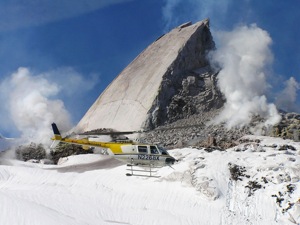
Wow. Check out the time-lapse movie, showing this slab growing at one meter per day.
Some bitching and MacGyvering from on the road….
Bitching: it is absolutely stunning how many people, when exiting an Amtrak bathroom, do not close the fracking door behind them. If you happen to be sitting near the bathroom, this is a Very Bad Thing.
MacGyvering: in a pinch, toothpaste can be used to adhere a 3×5 card on a bathroom door when you need a makeshift sign. Plus, it’s minty fresh where minty is very useful.
You too can have a career in the exciting financial services industry.

Ars Technica with an excellent overview of NSA programs. Be sure to follow the links to the story about Mark Klein, the AT&T whistleblower, and Klein’s statement to the press.
Meanwhile, I received an email today from Skype telling me that all phone calls made via Skype from anywhere in the US and Canada to any phone number in either country are now free for the rest of 2006. (They were previously about two eurocents a minute.) Since Skype phone calls are encrypted, this may or may not be related to what’s going on in the NSA revelations, but it’s very interesting. Notably, since Skype calls can be made from public wifi points, this bypasses both wiretapping and casual attempts at an IP trace. And it will probably lead me to buy less cell phone minutes. How many millions of others will do the same?
Only downsides that I can think of are that my laptop is not available while walking around (but PocketPC PDAs are, and are Skype compatible), and that SkypeOut calls don’t provide a caller ID, which strikes me as marginally unprofessional for business calls.
These are minor knocks, and it might move millions of phone calls into encrypted channels. I’m trying to wrap my head around how huge this might be.
Addendum: Apparently, reporters at ABC News are being individually targeted to find out who they are calling.
I’m in a debate elsewhere on the utility of Total Information Awareness-type programs, which reminded me to post this Ars Technica article on the same topic from last year.
The problem is not that such large-scale industrial fishing invariably catches a few dolphins along with the tuna, but that between 99.999 and 100 percent of what you’re going to get is dolphin.
Still working on a bunch of CFP follow-up posts. In the meantime, I appreciate how Loews L’Enfant went out of their way to make us feel welcome:

By way of Daring Fireball, a fascinating story in the New Yorker detailing a 419 scam and the mind of the scammed, a psychotherapist.
I dare you. Read this article about light moving backwards that travels faster than the speed of light, and exits a fiber optic cable before it fully enters it, without actually having your brain turn to oatmeal.
According to Engadget Mobile, T-Mobile and Verizon Wireless cell phone records are not being provided to the NSA. Obviously, if you’re calling a US landline, they can pick it up on the other end.
The jury is still out on whether a pen trace on Skype phone calls is possible, but as far as I’ve heard they’re currently outside the NSA dragnet. On the other hand, Skype is still the only consumer-level phone system that provides end-to-end 128-bit encryption transparently to its users, so the call itself cannot be tapped if you’re calling to another Skype user — again, if you’re calling a landline, you’re exposed on the other side.
Gary McKinnon is an idiot. Or he’s the most dangerous hacker who has ever penetrated US military systems.
Evidence for idiocy comes from Slashdot’s discussion of McKinnon’s failed attempt in a British court to block his extradition to the United States.
Evidence for danger comes from this BBC report that the US claims he caused $700,000 in damages hacking military and government computers.
A few thoughts, off the cuff:
No question, we’re talking grade-A idiot. For one thing, he was looking for hidden UFO data. For another, he was spelunking about in US military systems and got caught using off-the-shelf monitoring tools, rather than hacker tools that might at least have given him a shot at covering his tracks.
But is he dangerous? And more importantly, is there anything we should be taking away from this story?
For one thing, if McKinnon’s claims are true that he accessed some of these systems and found that they had no password protection, that’s something we need to be looking at very strongly. I don’t think it excuses his actions (neither does his stupidity, for that matter), but there’s not a great deal of difference between what McKinnon did to NASA and what you’re doing to jeffporten.com right now. That is, the difference isn’t “hacking”, but rather that I want you here, and the NASA computer is more obscure than my site. But still findable, and still on the Internet.
Here’s an example. Let’s say you’re using a computer with nmap installed, and you type in the following command:
nmap -sS 209.124.50.132
What you will get back is a list of protocols on which my website is willing to talk to you. Now let’s say you do this instead:
nmap -sS 143.84.24.*
and you’re stupid enough to do this from somewhere other than someone else’s Wifi access point. What you’ll get back is a list of people in dark suits with badges who are suddenly interested in what you’re doing. Because now you’re mapping a block of sites that includes the Army Research Laboratory, whose scary warning I blogged a while back.
Note that I have not actually run that command and I don’t think you should either. You’ll end up scanning 256 computers that are most likely all military, and for all I know some of them are not supposed to be accessed by guys without uniforms. But all of them are on the Internet, and all you’ve done so far is walk up to all of them and say, “Hi! What services are you running?”
So let’s say you’ve done this, and somebody over in the Double Secret Probation Security Department decides to figure out if you’re an idiot or a true threat. He gets a team to trace your traffic. But you used several of nmap’s standard obfuscation techniques (which I’m not going to document for you; they’re easy enough to find), so it takes them a week to figure out which logs apply to you. Then they have a map of IP addresses from which Internet providers you used, so they ask an FBI type to go knocking on ISP doors and connect those to physical addresses.
Then they set up a surveillance team and nail your ass.
No, I’m not running off on some paranoid fantasy. I’m just working some numbers from the Bureau of Labor Statistics, and doing a few sums in my head, and the figure I come up with is that what took you about five seconds to do, cost about $25K for the US government to nail you for, just in terms of salaries for the people involved. Probably higher since my numbers presume that these computer techies and FBI types don’t have any supervisors and prosecution is done pro bono.
That’s why I’m, well, skeptical when I see numbers like “$700,000 [in] damage to military and NASA systems”. I remember seeing reports of attacks on military computers from the 1990s, designed to scare the hell out of Congress, where the exact line of code I listed earlier would have been counted as 16,777,216 separate attacks on military networks. Under extremely vague statutes in force today, opening your laptop in the wrong part of Washington DC, and accidentally handshaking with an open government Wifi base station, could constitute a terrorist attack.
Which is not to say that I think this is a secret government plot to throw all computer users in Gitmo. Every server I run is attacked on the order of 1,000 times a day by automated attacks, and I’m guessing that any government system gets hit far worse. Most folks fly way beneath the radar even if they are terminally stupid, and I presume that McKinnon did something to set off an alarm bell or two.
But if he is right, and he did find services that were inadequately protected, then it would be awfully nice if the process of prosecuting him also exposed these problems and caused them to be fixed. Because it’s axiomatic that if he found them, he wasn’t the first nor the last. Somehow, I don’t expect that kind of open trial is going to take place.
And I gotta say… the worst hack in US military history came from a UFO nut in London, working alone, and cost only $700K to fix? Man, that’s the most reassuring news I’ve heard in years.
So, on Monday I paraphrased Mort Halperin as saying that “all of the [Bush] administration’s statements concerning which information is targeted [for wiretapping] were specifically about this particular initiative [monitoring overseas calls]; … most expert observers believe that there is at least one more program, and possibly more, whose scope has not yet been revealed.”
What a difference three days makes. Boom, brand new program that doesn’t discriminate too much about whether you’re a US citizen or inside US borders.
I have little interest in the metaphysical debate over whether the Fourth Amendment covers the use of government computers, rather than government humans, listening in on your calls. I have little interest because I’m damn sure it should. The claim that computer monitoring is somehow not an unreasonable search into your papers is as ludicrous as if James Buchanan had claimed ponytapping was Constitutional because he used slaves instead of white people.
What I’d instead like to draw your attention to is this quote from Reuters:
“The privacy of ordinary Americans is fiercely protected in all our activities,” Bush told reporters at a hastily called session aimed at damage control. “We’re not mining or trolling through the personal lives of millions of innocent Americans.”
And that’s highly interesting, because it’s a lie. Not an evasion, not a spin, not a misreading, but a damned lie. Specifically, the phrase “we’re not mining.” It’s a shame he didn’t stick with “trolling,” because one could argue that they’re not literally using giant fishnets or trying to pick up women in bars.
But mining, well, that’s exactly what you have to do with the largest database in the world, and it’s pretty much the exact definition of “using the data to analyze calling patterns in an effort to detect terrorist activity.”
So, to recap — we have this program over here that monitors the actual content of phone calls on overseas lines, which is revealed by media investigation, and which Bush claims (without providing evidence) is strictly limited in focus. Then we have that program over there that monitors pen traces of domestic calls, which is also revealed by media investigation, and which is arguably what Bush claimed he was not doing when he was exposed the first time.
When that hits the news, he simply lies about it.
That’s the problem with circumventing the rule of law; once you’ve decided you’re above it, there just aren’t any limits. Or, to quote Al Gore, “Can it be true that any president really has such powers under our Constitution? If the answer is ‘yes’ then under the theory by which these acts are committed, are there any acts that can on their face be prohibited? If the President has the inherent authority to eavesdrop, imprison citizens on his own declaration, kidnap and torture, then what can’t he do?”
These surveillance programs ran simultaneously. To state that there are others which we don’t know about is a given; that’s the point of intelligence agencies. The sole question about the others is their scope. Considering the scope of the programs we do know about, I don’t see any conceptual line being drawn as “information about Americans that the government has no right to know.”
So — an open question to anyone in the “nothing to hide” community who’s stopping by this week. Where’s your line? How do your Fourth Amendment rights protect you? If you’re not disturbed about your phone calls, how about your emails? Private documents? What doesn’t the government have the right to know about you?
I’ve recently had to resurrect a line when discussing Zacarias Moussaoui that I originally used when discussing Timothy McVeigh — that is, I’m morally opposed to the death penalty, but you wouldn’t catch me with a sign protesting the night this particular guy got the hot shot.
So I was pleasantly surprised last week, wandering by a CNN broadcast at the CFP hotel, to see that our national drive for blood revenge took a brief recess. As I’ve discussed before, much of our military action since 9/11 has been as much (or more) driven by a need to “get the bastards” as by a real understanding of what needed to be done to protect ourselves in the future, or to bring the right bastards to justice. I assumed that Moussaoui, as the only 9/11-related case to be brought to trial, was toast.
And that’s the tricky thing about justice — it just gets so messy when you involve judges and juries and the need to make a coherent argument. Especially when your prosecutors taint the evidence. But thanks to Mark Kleiman for pointing out an interesting blowback effect from our war on terror and its concomitant war on legality.
As Michael Isikoff notes in the linked video, Moussaoui isn’t the only guy we have in custody, but he’s the only guy who’ll be going to trial. And that’s because our trial system doesn’t allow for waterboarding, genital electrocution, or imprisonment without trial. By our own definitions, it’s impossible to bring the rest of the 9/11 conspirators to justice, because we ourselves have violated our standards for justice.
Kleiman shows he has a great sense of humor by suggesting that we can send these people to the International Criminal Court for trial for war crimes. Anyone care to lay me the odds of that happening before 2009?
| I loved all of the movie mash-ups at this Photoshop contest, but I’m afraid that you definitely have to be the type of person who owns a copy of Schoolhouse Rock to understand why this is my favorite. |  |
I find it hard to believe that it’s still necessary to make the argument that “nuclear weapons are bad”, but apparently half the country still hasn’t gotten the memo. Worthwhile reading is this Harper’s essay discussing why a nuclear earth penetrator is neither clean nor efffective.
[A] 400-ton explosion would have to occur a full 600 meters underground in order to be “contained.” These guidelines also stipulate a carefully sealed burial shaft to contain the blast, not a maw. Even the B61-11, at its current, inadequate impact speeds, does not burrow a clean rabbit-hole in the ground but rather kicks up a crater like a meteorite; any faster-moving penetrator would do so to a still greater degree.
Even supposing that the missile’s point of entry were miraculously neat, a nuclear blast at the depths a real missile could attain would invariably breach the surface of the earth, expelling a hot fallout cloud in what is known as a “base surge.” Base surges are more dangerous than traditional fallout clouds because they are more toxic, containing irradiated particles of dirt and rock. They also spread more quickly, sweeping across the surface of the earth in every direction, outward rather than upward. Bunkers are usually built in urban areas, so many thousands of deaths would be a virtual certainty. Even a 1-kiloton bunker buster–a relative firecracker, with a tiny fraction of the explosive power of the high-yield RNEP–detonated at fifty feet underground could eject about 1,000,000 cubic meters of radioactive soil.
My coverage of the Computers, Freedom, and Privacy conference has just been published at TidBITS. The conference was chock-full of information and I’ve got more to say about it, which had to be cut from the article to keep this issue from becoming 30,000 words long, or from taking on more of a political tone than is usually the case. I’m still catching up on a pile of work from last week, so feel free to keep checking the CFP topic here to see my new articles as I post them.
Thanks go out to Adam Engst and the rest of the TidBITS crew for asking me to cover the conference, and to the Association for Computing Machinery for putting it on in the first place. As I say in the article, if you’re in the least bit interested in these topics, by all means come to Montreal next year.
Another shout-out goes to my buddy Brian Greenberg, who surely is shocked as hell to read this. The reason? Because Brian was the audience I had in mind when writing the article; he’s my standing skeptical sounding board on issues related to privacy and whether the current administration is living up to Orwell’s 1984, and I consciously wrote my piece with the hope of convincing Brian — and others like him — why these topics are important.
I’m sure he’ll tell me if I succeeded. Hope you do too.
Fascinating science reporting can be found in Sleep Retardant Properties of My Ex-Girlfriend, which proves once again that CMU researchers have a sense of humor, and really need one:
I spoke to Hermina and explained my study and its results, as well as the importance of getting sufficient sleep. I concluded by explaining that, due to her sleep-retardant properties, I could not continue to sleep with her, an act she termed “breaking up”.
When Tom, who I mentioned earlier in the paper, discovered that Hermina and I had broken up, he expressed interest anew in sleeping with her. I attempted to warn him about Hermina’s sleep-retardant properties. In response, he referred to me as an “idiot”. This clearly demonstrates his lack of understanding of the value of sleep.
My favorite search terms that brought people here, in order of Google PageRank:
1. flying hoverboards (5/10,900)
2. pookaliscious (6/80)
3. atlantic city slots players on september 11 2001 (8/348,000)
4. jeffrey wing war of world (10/16,500,000)
5. jewish deli montana (20/212,000)
6. bryan greenberg said (28/998,000)
7. coolest website (31/17,800,000)
8. perry como gettysburg (not in the top 100 out of 174,000)
9. sick canary (not in the top 100 out of 828,000)
10. sign of the coming apocalypse (not in the top 100 out of 5,260,000)
And oddly enough, for the popular search for “jeff is an idiot”, I’ve dropped from first place to not even in the top 100.
Most frivolous use of 200 iPods, ever.
I had expected to post more this week while I was at CFP, because, well, I am an utter blinkin’ moron. This is the busiest conference I’ve attended in a long time, and that is saying something.
Rest assured, I have much to say on the topic, but I’m going to hold off on commenting more here until my article gets published in TidBITS. When it is, I’ll continue here with the sort of editorial commentary that really isn’t appropriate over there.
But as a teaser, I’ll mention that after hearing from DHS about their plans to keep us safe, this is looking like an awfully fine time to move to Canada.