Does the President have a death wish?

Has anyone else noticed that W has been a bit… morbid in his recent comments?

First came the unveiling of his Texas gubernatorial portrait, where he commented to the great amusement of his audience, “I’d like to welcome everyone to my hanging.”

Then, he vowed that taxes would be raised “over my dead body.” (Actually, he vowed the exact opposite, but who needs diction from a manly President?)

These would be curiosities, excepting one other article in the Washington Post 1/8/02 edition, where he’s quoted as saying, “All in all, [2001 has] been a fabulous year for Laura and me.”

Great year, huh? I’m surprised that Bush is so willing to admit that his political fortunes were improved last year, as they obviously were. But I’m bothered worse by something else.

The post-September 11th world is one in which there are a lot of things we can’t say without getting official attention from the authorities, and joking about the death of the President is definitely one of them. Likewise, anyone saying how wonderful 2001 was would be, at the very least, deserving of avoidance at parties. Yet the President can still say anything he damn well pleases.

Perhaps he considers that a perk of high approval ratings. But I would love to see what the “red states” who voted for him would say if there were wider distribution of his comments. Of course, criticizing the President is still unpatriotic, and is not one of the things polite people say.

Jeffporten.com rides again.

And in case you’re wondering where we’ve been, remember this moral: it’s not a good idea to use an email address in your own domain as the MAIL-FROM authenticator address.

If you have no idea what I’m talking about, consider yourself lucky.

Long story short, I had been hosting this site on a server at an old client site, and had accidently set things up so it would be very difficult to put things back together when that server went away.

Interesting side note to this story: my domain is hosted at Network Solutions. After a few months of getting conflicting information about what I’d need to fax to them to prove that I actually own this place, I was able to do this over the phone—with no identification whatsoever—when I called up to pay my $35 for the year. Reset my password, gave out my account ID, and basically gave me complete control.

Needless to say, if I weren’t me, I could be doing big mischief on a site in my name right now. Moral of this story: if you own a domain, keep it renewed well in advance.

Denaturalized Citizens

Let’s cut to the chase. Residents of Washington, DC, the nation’s capital, are enslaved by the national electorate and denied their basic human rights as American citizens.

For those of you who don’t know it, Washingtonians have no representation in Congress. For the privilege of living here, we give up our right to two voices in the Senate and one in the House. That puts us in the category of people who live in Guam and American Samoa. However, unlike all other American possessions, we also pay full federal taxes. That puts us in a category by ourselves.

Ironically, we can all hop on the Metro and go see the original documents that purport to give all Americans these basic rights. We can also see the original clause in the Constitution that takes them away from us. It’s somewhere near the Three-Fifths Compromise that said that black people weren’t worth as much as white people. One of these two transgressions has been reversed.

Now, if you don’t live here and you have a basic knowledge of urban politics, when you think of DC government, you’re going to think of Marion Barry, our infamous crack-using former mayor. For those of you who don’t know the man, he was our mayor for a while, then he was busted by the feds and sent to prison, and then he got out and we re-elected him. I’ve heard otherwise intelligent people say that this proves that DC doesn’t deserve to have representation in Congress.

Excuse me? What other American citizens lose their right to vote based on bad choices? If that were the case, there’d be no Senators from either Carolina.

Now, you might think that not having representation in Congress is no big deal — after all, how often does the federal government affect your life personally? That’s because you don’t live in Washington. Congress has subcommittees of people from all over the country who have the power to revoke any laws our own City Council passes. We once legalized marijuana for medical reasons — blown to hell. We’d like to have the power which every state enjoys to tax the two million people who work here but don’t live here — forget it.

If you’ve flown to Washington recently, you might have noted that “Washington National Airport” is now “Reagan National Airport”. This was passed by a Congress who decided to honor Ronald Reagan — the man who despised the federal government and championed local rights — by forcing us to change the name. The local governing board, appointed by elected officials, was unanimously against it. Documents showed that the airport was named after George Washington the president and not the city, so we swapped one presidential honoree for another. The result of this opposition? Welcome to Reagan National Airport.

Now Bob Barr, Representative from the DC suburb of the state of Georgia, wants to kill $60 million in desperately needed public transportation funds if the local transit authority doesn’t rename the airport stop after Reagan as well. He’s been blocked for now, but DC residents expect that it’s only a matter of time.

So — why don’t we have representation? The Supreme Court has upheld our situation as constitutional, because — well, it’s spelled out right there in the Constitution. Can’t argue with that. But the real issue is political. DC is incorrigably, hopelessly, capital-D Democratic. Give us statehood, and you’ll have three more Democrats riding the members-only elevators of Congress.

Personally, I’m not sure why the obvious solution isn’t in play. As you learned in ninth grade civics, DC was made up out of a totally unlivable block of malarial swampland that Maryland and Virginia had no use for. Virginia wised up to the fact that this had become some primo property and forced us to give it back a long time ago, so now every square inch of the District of Columbia is formerly Maryland.

So — why not vote for Maryland Senators? I’m sure we’d be properly balanced out by the gun-toting neofascists of western Maryland. There’d be another Democratic House member, but the GOP can make up for that by the fact that they utterly control Congressional redistricting this year.

Here’s the kicker. We need Congressional action on this one, and recent reports say that Congress throws out all mail that comes in from folks outside their districts. Washingtonians live outside everyone’s district. But maybe you don’t.

Letter from Honolulu, DC

Those of us who thought that the bruising election battle of 2000 might lead the Washington press corps to be a bit more critical of our new president are going through a rude awakening.

Remember during the transition when a broad scope of authority was given to Dick Cheney? Ah, those halcyon days of December. The story of the moment was that Bush was too much of an intellectual lightweight to have the full burdens of the presidency thrust upon him, so Uncle Dick and his wiser, older compadres were coming in to run the show.

Then the honeymoon began. According to the new storyline, President George W. Bush is now the healer that President-elect Bush wanted to be. After all, he invited Edward Kennedy, of all people, to the White House to watch a movie. He showed up at Democratic gatherings. He invited the Congressional Black Caucus in for a sit-down. Truly, this is a man who must be willing to work with Democrats, if he can stand to be in the same room with them.

So now that Bush has a properly “presidential” storyline, Cheney no longer has to be the grown-up. In a front-page article by Dana Milbank in today’s Washington Post, Uncle Dick now has “unprecedented power in the White House.” He has “integrated the vice presidential staff seamlessly with the presidential staff.” His chief of staff will be invited to every meeting that Bush’s chief will be attending.

Just a few scant weeks ago, this would have raised serious questions—at least in passing—about GWB’s ability to handle the scope of the presidency himself. Now, it’s a measure of his openness and willingness to have two heads in the White House. Why, one might ask? Because Cheney is somehow the first vice president since 1929 to have no presidential aspirations himself.

Consider me a heretic, but I would have thought that the first qualification of the vice president would be a willingness to assume the top office. Cheney gets a magical twofer: he has risen above the petty politics that consume the rest of us in Washington, and so long as he has the power and authority of the presidency, he’s magnanimously willing to forego the title. (The article is quick to say that Bush will always get final say, although if all of the heavy lifting is being done by Cheney, one wonders what criteria Bush might use to override him.)

Meanwhile, Bush rides the wave of bipartisanship, even as Ashcroft, Norton, and Thompson get busy in their Cabinet posts. The last president who crossed the partisan line was, of course, our last president, who set up the Nader wing by using Dick Morris’ “triangulation” policy and made his second term seem more like a moderate Republican’s than a Democrat’s. Welfare was ended “as we knew it”, largely by ending it entirely. Clinton was rewarded for his political centrism by the kindness and deference extended to him by the Republican party during the impeachment.

So forgive me if I want to see some Clinton-style centrism from Bush before I get all mushy over his bipartisanship. There have been some concrete actions here—notably the incredible Republican conversion to supporting Americorps as part of Bush’s religious funding proposals—but that has to be measured against his immediate gutting of global women’s health programs. (US funds weren’t being used for abortion anyway; Bush’s cut of aid shuts down funding to anyone who might provide family planning or referrals for abortion.) A similar standard in his religious funding system would prevent any faith at all from appearing in a government funded program—which assuredly is not what he has in mind.

This also just in from the new bipartisan Bush administration: HHS Secretary Tommy Thompson believes that the best way to prevent HIV infection is to find a cure for AIDS (Washington Post, 2/3/2001, A15). On the Christmas list for HHS: 1) a dictionary including the definition of “prevention;” 2) a press release about a magical new substance called “latex” which does prevent HIV transmission; and 3) a list of all of the sexually active teenagers who’ll be infected with HIV while the Bush administration putzes about looking for a cure, still years off.

George W. Bush: Dot-Com Failure

Back after a long hiatus, just in time to point out the first travesty of the new Bush administration.

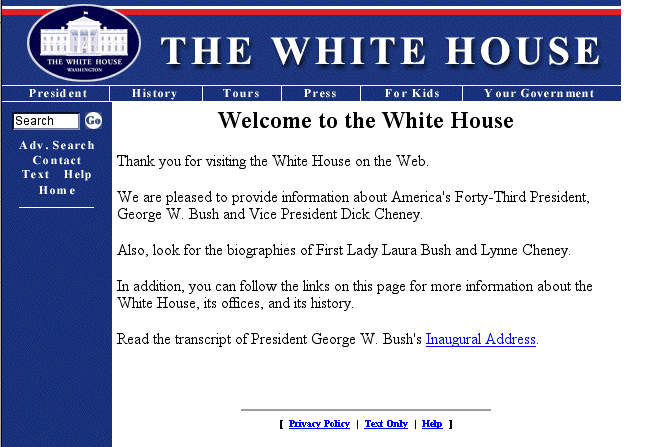
On the left, the most recent redesign of the Clinton White House web site. In the middle, for purposes of fairness, the original Clinton web site, from the prehistoric era of 1994. On the right, the current design of the Bush White House web site. Click on the thumbnails for a full-size version.

The Clinton thumbnails take you to the government archive of the sites. The Bush thumbnails take you to a snapshot of the whitehouse.gov site made on 1/21/01. Why? Because the archives will never change; hopefully, whitehouse.gov will.

The first Clinton site is pretty amateurish by today’s standards, but it was nearly state of the art then. The recent Clinton site is top-notch. Well-designed, lots of information, good navigation tools. So why did the Bush administration ditch it for something that looks like it popped out of a shareware web editor?

I can understand the new folks wanting the rip up the old carpets, but this is showing the bare floorboards until they get around to it. I can understand not wanting to use an existing framework for content, when on day two of the Bush presidency there just isn’t much to say. But surely they can do better than this? Or is communicating with the public just not as important as getting contributions for the inaugural celebration?

Before you think that Bush didn’t want to use the Clinton HTML, check out the new privacy policy, then look at the old one. And if you think I’m just talking about esthetics, think again.

Yes, I know, in a few weeks it’ll probably be better. But does anyone think the site would look this bad today if the Supreme Court had ruled for Al Gore?

4 AM at Charles de Gaulle

The wake-up call comes at 4 AM. I find myself in my Cocoon cubicle at Charles de Gaulle Airport: a square the length of the double bed, a PVC prefab with a desk, shower, and toilet. I checked in here 15 hours ago after missing a plane for the first time in my life, and needing sleep after an overnight bus ride from London the night before, over the Channel by ferry from 12 to 2 AM.

My check-out time is 5 AM. The sign on the front door informed me that these rooms do not meet the minimum standards of the French government for a hotel, although they are the cheapest rooms in Paris with a private shower. Therefore, no stay can last more than 16 hours. I silently congratulate the bureaucrat who thought of that; it ensures a middle-of-the-night move if you decide to hop from room to room more than once.

The room is totally sealed; aside from the satellite photo of France on the wall, I could be anywhere on Earth. Or not—this design is perfect for the space station. I fell asleep the night before imagining I was returning home at warp speed, beating the plane I missed.

I sleep through my alarms, the phone and the television. At 4:58 AM, I shower, and check out at 5:17.

5 AM at Charles de Gaulle

The seats are littered with sleeping travelers too poor or unaware that a private bed is available nearby for 250 FRF. Their luggage is lashed to the trolleys that are free here and $2 everywhere in the States. Their bags and clothes give them the air of refugees rather than travelers, as if their flights will not leave for several weeks.

There is only one restaurant open, where I buy a cappuccino for 14 francs. It is covered with cocoa powder; after I dissolve it past the foamed milk with a plastic spoon, the beverage is entirely tasteless, palatable only because it is hot. I look for a sign informing me that this drink does not meet minimum French requirements for a coffee, and therefore must be consumed in 16 minutes.

Two television screens list a score of flights throughout Europe, Africa, and Asia. There is no other information, other than the news that the 8:10 to Cairo has been cancelled. I wonder if all flights to Cairo are cursed.

The airport is unnaturally quiet. Everyone, myself included, smokes Marlboros; Mediums for me, Lights at the next table, Reds everywhere else. The wick on my Zippo will not catch, so I need to bum lights from people around me; they are always offered, but with that odd French air that robs the gesture of all courtesy. I get a light from a woman wearing a jeweled Mickey Mouse stickpin.

The epitome of a French vagrant asks for a cigarette. I give him my last one and open a fresh pack. Fifteen minutes later, he asks someone else for another. I note that those people were not sitting here when he asked me for one. He has the same look as the homeless in the States who are ready to regale of you of their years in the Nam and their hard luck tales since. I wonder if the same wars are used here for such stories.

The only nonsmokers here are a Dutch family; the father wears a brown leather jacket and is the widest man I have seen since leaving the States. Paris is designed for the slim, and I wonder if he has had difficulty.

6 AM at Charles de Gaulle

In the past ten minutes, the noise level has gone from zero to bothersome. I am too sleep deprived to shut it out. There is an Asian tongue at the next table; the rest is French. It is a relief to not hear English for the first time after a week in France. I have seen two other Americans—our demeanor always betrays our nationality—but we are each traveling alone.

A black man clears my table with no regard as to whether I am finished. My tinfoil ashtray is replaced with glass. He communicates with me through hand signals that I cannot order from him, that I should go to the bar. I surmise he communicates with every customer through hand signals.

The appearance of my laptop computer, worth about $5,000 here, has drawn me some attention. I am suddenly less annoyed by the noise and crowds.

Ten flights are boarding. The flight to Cairo is still the only one cancelled.

Two tables away, a Frenchman in a gray woolen jacket and ugly tie opens the first pack of non-Marlboros I have seen. They are Philip Morrises.

Three stewardesses in matching burgundy at the next table are talking animatedly; with the arrival of the business crowds, this is the jolliest I have ever seen a public space at 6:30 AM. One of the woman wears a small piece of paper under her right lip, as if she cut herself shaving.

A man to my right sits with five duffel bags, two rucksacks, and a canteloupe-colored baseball cap; the chair next to him holds a maroon purse and a black feather boa. I am relieved to see companions join him.

The café is still the only one open. I purchase an orange juice and go for a walk. The juice is expensive and surprisingly good. I have done some shopping and am carrying far more baggage than I usually do; encumbrance plus fatigue causes me to take ten minutes to negotiate the tables out of the cafe. This is my fourth trip to Paris, and I feel like the high school kid I was the first time I was here.

Nine flights are still boarding, but it is now too late for the 6:45 AM to Manchester. The flashing red words in French give the impression from a distance that nine catastrophes have occurred out on the runway.

7 AM at Charles de Gaulle

The only woman behind the TWA counter is wiping it down. At home I would assume this was the ticketing agent, cleaning her desk before beginning the day. Here, I am not sure. I do not approach her, and cannot tell whether I am saving myself or her the embarrassment.

As of the end of December, I will have flown 40,000 miles this year on TWA. Yesterday, I noted that as of January, I will never be stranded again; the frequent flyer upgrades also give me the class of ticket that can be transferred to other airlines. This morning, I would like to use the toilet, but I have nowhere to put my bags; I am not yet eligible for the TWA business lounge, if there is one here. The airline industry provides its services to those least likely to need them.

I find another café where the coffee is better; in ordering my petit dejeuner I attempt to specify a croissant as my bread, and receive it as an extra. A Pepsi here costs nearly four dollars, and I wonder what I will be charged. The orange juice is from concentrate, but the jam is some of the best I’ve tasted.

Charles de Gaulle is built as a torus, around a central fountain. The fountain was placid an hour ago, but someone has recently turned on the jets. When sunlight hits the fountain, reflecting off the water and the silver aerial tubes that carry moving walkways, it can be quite beautiful. Now, though, it is still dark, and the fountain barely distracts from the Logan’s Run design of the airport interior.

I have been struck with Traveler’s Paranoia: my duffel contains a week’s worth of dirty clothes, and my gifts are not expensive, yet I am guarding my bags as if they contain uncut diamonds.

I take a picture of a snowman decoration to illustrate this article, and a man at the next table looks up at the flash, then glares at me. I want to say, “I am a writer; this is for my work.” I want to be anything but another ignorant American, snapping pictures of everything.

The direct flight from Washington has just arrived. I am homesick enough to be angry with everyone on the flight who has left the city where I am trying to go, where I will not be for another sixteen hours.

The 9:20 flight to Philadelphia, where I was born, has also been cancelled. After my uncharitable thoughts about Cairo, it is rather disturbing. It is now too late to board the flights to Copenhagen and London Heathrow.

I wonder if it is too early for a beer.

At the next table, a woman wearing Nikes is reading a newspaper with a headline about the Egypt Air 990 crash. I do not read French, but I understand the word “kamikaze” in the headline, and the blurry picture of a plane on the cover. It is odd pleasure reading before boarding a flight. I hope my pilots have families waiting for them back home.

8 AM at Charles de Gaulle

I spend 20 minutes in a fruitless search for a power outlet. Boarding an airplane without a fully charged battery always makes me feel faintly queasy. I have 10 hours of music and five hours of South Park episodes on my PowerBook, yet I keep forgetting to buy extra batteries.

The business center here is located behind a mirrored glass wall, with no indication of operating hours or services. It could be the airport offices. I want to check my e-mail, as if there is anything there that will not keep until I get home.

I decide to risk the airport lavatory, crowding into the stall with all of my baggage. For the fourth time this week, I have a sudden urge to go to Euro Disney; part of the Disney unreality is the sanitized bathrooms that make you feel like you are the first person to use them. The foot pedal flushes the toilet for 90 seconds, vigorously enough that I crowd myself and my bags against the lav door to prevent being splashed.

The woman at the TWA ticketing counter—not the same woman who was wiping it down this morning—tells me that the check-in will open in 20 minutes. Nothing better to do, so I am the first in line.


Y2Kvetch

Just a small disaster was all they wanted. A few hundred people incinerated in a fiery plane crash. Traffic gridlock in a few urban areas, maybe with a few road rage shootings thrown in. Maybe ten thousand people or so going hungry for a couple of days.

Instead, the 1/1/2000 changeover occurred with nary a whimper — until the inevitable complaining started. Now, the Great Myth of Y2K Doomsday has been rapidly replaced with Y2Kvetching. Nothing went wrong, so maybe we really didn’t need to spend those billions of dollars, after all?

The switch could have been easily predicted — and to the best of my knowledge, wasn’t — by anybody who understands the basic difference between computer programmers and your standard, run-of-the-mill human being. Computer programmers attempt to make their software mathematically elegant; software that merely works is frequently laudable — in parlance, a good “hack” — but it’s not quite as good as software that is logically bulletproof. In the real world, nothing is ever that good, so the average person doesn’t know what the hell we’re talking about.

In my neighborhood in Washington, DC, there are five different bus routes that run up and down Wisconsin Avenue; they all begin in the same spot, but they diverge in Georgetown and continue on to different destinations. In real-world terms, this works just fine. To a computer programmer, this is a pretty kludgy system. (A kludge is a system that works, usually because it’s overly complicated, or as in the Y2K scenario, based upon a limited set of inputs.) Most techies, if we were programming the bus system, would just put one big bus on Wisconsin Avenue, then run different bus lines from the endpoints.

Y2K, in a nutshell, was a bunch of computer analysts looking at a kludgy system as saying, “you know, this just isn’t bulletproof, and we don’t know where the problems might be.” And since there’s not a damn thing that isn’t computer-reliant somewhere, the worst-case scenarios were easy to envision.

So — was all of this blown way out of proportion? The obvious answer is no, but some people would have you believe that everything went so smoothly that the whole thing was a scam cooked up by those of us who would profit by it. Logically, then, these people wanted to see a few disasters, just to prove that all of that money was spent to good purpose. As Germany, Italy, and China seem to have come through unscathed, these people now have their Schadenfreude dressed up with no place to go.

The reality, of course, is different. I guarantee you that some people, somewhere, have had a very bad week, as they tripped up on Y2K issues that they didn’t find in time; more companies and governments will find their own bugs in the next twelve months. They’ll all bend over backwards to prevent anyone from finding out it’s Y2K-related, though — as the first new paradigm of 2000 is that anyone who has a Y2K mosquito bite is a grade-A moron.

U.S. Senate 2, World 0

For the past fifty years, the United States has been at the forefront of major international activity to improve the lot of the world in arenas of human rights and armed conflict. Although our actions and motives were frequently obfuscated in the name of the Cold War, most Americans believe that we’ve done much more good than harm on the world stage. At the very least, this is how we wish to see ourselves.

During the 106th Congress, two major steps backward have been taken. First, we first worked to weaken, then refused to sign, the International Criminal Court treaty, despite the fact that it was American initiative — dating back to the Nuremberg trials — that largely brought the ICC to its present state. We are now in the company of such great nations as Iraq, North Korea, and Libya as nonsignators.

Now, this week, the U.S. Senate rejected the Comprehensive Test Ban Treaty. England, France, Germany, China, and Russia — normally not bedfellows — called on us to ratify it. The vote was nineteen votes shy, not even close.

Special consideration goes to Senators John Chafee, James Jeffords, Gordon Smith, and Arlen Specter, for breaking party ranks to vote for the treaty. Awards for Shame to John McCain for taking a break from principle and integrity, and Robert Byrd for voting “present,” the lone Democrat to do so.

Both parties claim that they wish to continue abiding by the terms of the treaty. We have no plans to test nuclear weapons, or to undertake any other actions that would violate the treaty that we have not signed. Congressional testimony against the treaty states that we have no need to do so until the year 2030 (discounting the possibility that other technologies may preclude the need for testing by then). By defeating the treaty, we have given up the ability to ask other nations not to develop and test nuclear weapons, and the creation of international monitoring bodies to prevent nations from covertly doing so.

Are we so willing to trade our security for the sovereign power to do things we don’t want to do?

Treaties from 1966, Senators from 1955

October 13, 1999 Update

This morning’s Washington Post has two articles above the fold on the front page: negotiations in the Senate to postpone the vote on the CTBT rather than have it voted down, and the military coup in Pakistan.

Pakistan, for those of us joining us late, became a member of the nuclear “club” last year, and with India is felt to have the highest potential for actually getting involved in a nuclear shooting war. The two nations are involved in active conflict over the disputed Kashmir region, and the flight time for nuclear missiles between the two capitals is measured in minutes. This means that during false warnings about launches, each military has a reaction time of about 15 seconds before they decide whether to retaliate.

Partisan politics are important, but the Senate is literally risking the future of the world on their meaningless squabbles. Contact your Senator today and tell him or her that you want the CTBT passed. The phone number for your Senator can be found here.

October 5, 1999

Readers will be excused if they’ve mistaken recent news reports about the 1966 Comprehensive Test Ban Treaty as a retrospective. A treaty signed by the United States over thirty years ago, and still not ratified by the Senate, just seems too far-fetched to contemplate.

Welcome to Washington.

I won’t make a comprehensive case for the Comprehensive treaty here, as that’s been done before me by several former members of the Joint Chiefs of Staff, military strategists (both inside and outside the U.S. military), and the Secretary of Defense—whom, lest we forget, was formerly known as the Republican Senator from Maine.

However, the need for this treaty is so blindingly obvious, only the willfully blind would miss it. If you believe in the support and maintenance of international law as a means of preventing international conflict, the CTBT is a good idea as it ensures that fewer nations will have access to nuclear weaponry, within the framework of recognized international organizations. Fewer nukes, fewer triggers, and a safer world.

On the other hand, if you distrust international organizations and you prefer the U.S. to maintain its military superiority ad infinitum, the CTBT removes one of the sole remaining threats to the United States mainland. Nuclear weapons are a much cheaper method than conventional armaments to catch up with the world’s great military powers; why then are we delaying the creation of an international system that would prevent other nations from catching up?

The Republican argument against the treaty, and forgive me if I paraphrase: “This is a bad treaty because it might sometimes be broken, and it might sometimes be imperfectly enforced.” Oddly enough, that’s not what you hear them saying when they’re talking about drug laws, but I digress. The alternate argument boils down to the usual vague fears that signing any international treaty somehow hobbles the mighty American colossus. Far better, I suppose, to live in chaos with the rule of “might makes right?”

The CTBT comes up for vote on October 12. A two-thirds majority is needed, and we’re still several votes shy. Contact your Senators and tell them that you care whether you live in a saner world.

Welcome to jeffporten.com!

Welcome to either a fascinating resource demonstrating a cross-section of the work that I do, or an act of monumental ego.

After nearly a decade as an activist, and six years working in the Washington, DC area as an Internet consultant, web site designer, database expert, conferencing entrepreneur, published author, and professional dilettante — it’s become extremely difficult to explain just what I do.

The greatest difficulty is continuing to find the thread that links these various pursuits together. The best thing about having varied interests and involvements is the moment when you can bring disconnected people from different worlds together for their common interests and goals, especially when they only then discover that they have common interests.

In my work and my personal life (if you can separate the two), I am blessed with colleagues and friends who are intensely committed, extremely skilled, astonishingly talented, and all-around decent people — most of whom will never meet each other. I hope that by publishing what I do, and writing about the people I work with, more of you will.

And I don’t mind having another soapbox to stand on. Watch this space for essays, rants, raves, and other amusements.

Happy New Year to those of you celebrating 5760.

The Twentysomething Guide to Creative Self-Employment

Yeah, I wrote a book. Back when I actually was twentysomething.

This book can alternately be called “Jeff’s diary, 1993-1995”, or “how to start a business with no experience whatsoever”, which is pretty much how I did it.

It’s long out of print, but you can buy a used copy cheap from Amazon or Barnes & Noble. And when I say cheap, I mean silly cheap.

  • The White House:
    POTUS: “This has been a tough week. But we have seen the character of our country once more.”

: POTUS: “We have seen the character of our country once more.”” // wherein suspect is not Mirandized, US citizen on US soil.