US Announces Invasion of US

In a surprise move, the White House announced today that prior to the invasion of Iraq, American military forces will be directed towards another nation that is closer to home, and a far greater threat to national security. That nation: the United States of America.

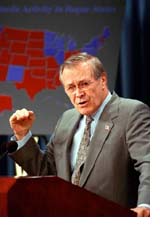
Secretary of Defense Donald Rumsfeld released the shift in policy at a hastily arranged press conference at Camp Pendleton, California, which stunned official Washington and left Democrats scrambling to avoid gibbering on live television.

“After reviewing our reasons for the invasion of Iraq,” said Secretary Rumsfeld, “we applied President Bush’s war on terrorism doctrine to other nations that we thought might pose a greater threat to homeland security.”

Rumsfeld laid out the reasoning behind the decision. “First, as we’ve said before, there are known Al-Qaeda operatives working within United States territory, and actions taken by the current government have been insufficient to stop them. Second, this is a nation that has one of the largest arsenals of weapons of mass destruction on the planet, and has made clear that they intend to improve and increase this arsenal, possibly placing those weapons among their ‘Axis’ allies abroad.”

“Third,” he continued, “this country flouts the authority of the international community and shows no respect for international law. All they respect is raw, military force. We’re going to show them that we have that force, and the will to use it.”

Rumsfeld’s speech was interrupted by a cacophony of questions shouted from the press pool. In response to a shrieking CNN correspondent, Rumsfeld said, “Yes, we have compiled information on where Al-Qaeda is most likely to be, and we will be concentrating our forces where the enemy is located.”
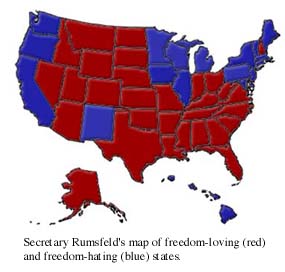
“We have divided the country into ‘red’ states and ‘blue’ states. Red states show little or no Al-Qaeda activity; blue states are far more dangerous.” Again stopped by the press, this time by a Washington Post correspondent standing on a chair and waving her arms, he added, “Well, we thought that the five-color threat assessment was too complex to present to the American people in this case, so we decided to simply divide the country into those people on the side of freedom, and those people who hate freedom.”

Rumsfeld said with a large, unruly grin, “We have a large base of contiguous states which are safe locations from which to start operations. Our early attention will be in the Northeast, where there are large populations over a small territory; this will make it simple to establish early air dominance and then move in and eradicate the terrorist factions.”

When asked for details about the nature of the military operation, Rumsfeld said, “I have that information. And you do not. That’s all there is to it.” The room fell entirely silent. Then he barked, “Wusses. I can’t believe you get paid for this. Our first target is complete containment of this region,” gesturing with a laser pointer at New York state and leaving smoldering tracks on the map.

“We will run an amphibious landing down the Hudson River from the east. Unfortunately, from the west the Great Lakes region is almost entirely blue state, so if we can’t move our forces through Ohio, we’ll be looking for support from Canada, the Uzbekistan of North America.”

[Contacted by reporters in Ottawa, Canadian Defense Minister John McCallum said, “We’ll be discussing the American request with Prime Minister Chrétien, and of course we want to provide all necessary assistance to our neighbors, but frankly we think they’ve lost their minds.” Then he looked around nervously and left the Peakes Building in a black, unmarked limousine.]

A Guardian reporter asked Rumsfeld mellifluously, “What do you think the reaction will be abroad to your declaring war on a democratic state?”

Rumsfeld responded, laughing, “Democratic state? The Zimbabweans hold more responsible elec…”, before he was cut off by Karl Rove whapping him in the back of the head with a copy of Roll Call.

Rumsfeld called an end to the press conference and started to leave the podium, when the New York Times asked, “When will you be providing more information about your plans?”

Rumsfeld glowered and growled, “It’s a safe bet that the Times will very shortly be getting an exclusive.”

eWeek on Apple OS names

From eWeek:

[Apple’s 2003 OS] Panther will mark the third significant upgrade to Mac OS X since its debut—and the fourth big cat from Apple. The initial Mac OS X release bore the internal code name Cheetah, and Mac OS X 10.1, which shipped in September 2001, was referred to internally as Puma although neither moniker was ever publicized. (Mac OS X 10.2 Server was code-named Tigger, sources said, another sobriquet that never saw the light of day.)

Menschenhawks

On this, the anniversary of the WTC and Pentagon attacks, I’d like to introduce you to my friend Brian.

I’ve known Brian for around 13 years now. He’s got a lovely wife and an adorable tyke and a baby on the way, and you can see pictures of them all at his website. He’s got a great head for business and an inexhaustible reservoir of good advice which he dispenses to his friends. If you look up the word mensch in a Yiddish-English dictionary, you’ll see his picture. (It means “truly decent guy”.)

Which is why I was struck by his essay about the WTC. You can read it for yourself, and I strongly recommend you do, as it lays out his background for what he has to say. This includes the following, which he thought as he visited Ground Zero for the first time:

Think what you will about the war against terrorism, the war in Afghanistan, or a war in Iraq. At that moment, staring at the burning rubble, it all seemed very clear. It didn’t need to be fair. It didn’t need discussion or debate. We were going to find “them” and destroy “them.” We were going to make sure this kind of thing would never, ever happen again. And we alone were going to determine when we were finished. Period. The rest of the world could help us or get the hell out of our way.

Brian implies, although he doesn’t actually say, that he’s moved on from this visceral reaction. But this crystallized for me the fear I’m feeling about the motivations of the administration, and of the people who are either supporting them or tacitly going along.

It takes a strong individual to face fear, anger, and the urge for revenge, and then move on and say that those were feelings of the moment. There’s no question that Americans are feeling much less secure than they did on September 10, 2001. Some people are downright petrified.

Part of it is fear of the unknown. The big medical news here is West Nile virus, which has killed several dozen people and has everyone nervously checking for mosquito bites. These are largely the same people who try to go to work when they have the flu, which kills around 10,000 Americans a year.

Likewise, the best way for you to not make it home tonight is to get in your car and drive somewhere, which prevented 41,821 people from ever getting home in 2000. Doing some quick math, that’s about one WTC attack per month. Around eight times as many die from cigarette smoking. Therefore, if we were blessed with Vulcan logic, our war on terrorism would be taking a back seat to other matters more likely to kill us.

But obviously, logic has nothing to do with this. If it did, people would always fly instead of drive. Risks are assessed based upon our feeling of control, and driving brings with it an illusory sense of control that you don’t get in the passenger cabin of a 747.

So now our leaders are fighting for their own sense of control, however illusory. We gained it first with our victory over the Taliban, if not Osama. We maintain it with airport security lines, threat assessment color coding, and ongoing statements from the administration that range from the vaguely reassuring to the vaguely terrifying, sometimes in the same sentence. Soon, unless there is a major sea change in the political tide, we’ll be going to war in Iraq to get our next hit off of that very addictive drug.

The reason we want to go kick some Iraqi ass is because all of us had our metaphorical moment at Ground Zero, and few of us have recovered. And if we go, we’ll win; if we doubted that for a second, perhaps we’d be less willing to go. The only question is whether Iraqi casualties will outnumber ours by 10 to 1 or 100 to 1.

The problem is that the true questions of security in the Age of Terrorism don’t get answered by the defeat of nations. No one can say whether defeating Iraq is better in the long run for our safety than not going there in the first place. Sure, Saddam’s a bad man who wants nukes, but we’ve known that since 1989. (Before which time, he was our ally against Iran.) The only thing that’s changed vis a vis our national security regarding Iraq in the past year is that there were rumors that he sorta had something to do with al-Qaeda. Those rumors have been repudiated, but here we are, getting ready to head back to the Persian Gulf and leave it a lot flatter than it is now.

If that someday makes it more likely that we’re targeted by terrorists, and decreases our security, the lines of cause and effect will be far too fuzzy to draw convincingly. If you don’t buy the idea that American actions have some effect on the emotions we arouse in others, no amount of this kind of evidence will ever convince you otherwise.

But if our goal is truly “to make sure this kind of thing would never, ever happen again”, rather than raw vengence or the need to just do something to make ourselves feel better at any cost, we need to start giving some serious thought to what we mean by security, and what we do to sustain it.

[This essay is part of The Red and the Blue discussion: 9/11 Anniversary, 2002.]

The Myth of Republican Competence

Joshua Micah Marshall, in the Washington Monthly, writes Confidence Men, subtitled “Why the myth of Republican competence persists, despite all the evidence to the contrary”:

“While no one bats a thousand in politics, it’s actually difficult to think of one thing the vice president has been responsible for that has not ended in muddle or disaster. Yet his reputation for competence has survived. The same applies to the Bush administration generally.”