More words from Sam Clemens

Something I would have posted for Independence Day, had I read it by then. From A Connecticut Yankee in King Arthur’s Court. For those of you who haven’t read it (shame on you!), the narrator is currently the second-in-command of King Arthur’s England, and is traveling with a noblewoman on a quest when this scene occurs.

I just finished Huckleberry Finn prior to reading this, and have read a few critiques calling it Twain’s best work, and perhaps the finest American novel of the 19th century. I’m not qualified to dispute that; but measured in terms of raw satire and love of country, Yankee stands head and shoulders above it.

In half an hour we came upon a group of ragged poor creatures who had assembled to mend the thing which was regarded as a road. They were as humble as animals to me; and when I proposed to breakfast with them, they were so flattered, so overwhelmed by this extraordinary condescension of mine that at first they were not able to believe that I was in earnest. My lady put up her scornful lip and withdrew to one side; she said in their hearing that she would as soon think of eating with the other cattle—a remark which embarrassed these poor devils merely because it referred to them, and not because it insulted or offended them, for it didn’t. And yet they were not slaves, not chattels. By a sarcasm of law and phrase they were freemen. Seven-tenths of the free population of the country were of just their class and degree: small “independent” farmers, artisans, etc.; which is to say, they were the nation, the actual Nation; they were about all of it that was useful, or worth saving, or really respect-worthy, and to subtract them would have been to subtract the Nation and leave behind some dregs, some refuse, in the shape of a king, nobility and gentry, idle, unproductive, acquainted mainly with the arts of wasting and destroying, and of no sort of use or value in any rationally constructed world. And yet, by ingenious contrivance, this gilded minority, instead of being in the tail of the procession where it belonged, was marching head up and banners flying, at the other end of it; had elected itself to be the Nation, and these innumerable clams had permitted it so long that they had come at last to accept it as a truth; and not only that, but to believe it right and as it should be. The priests had told their fathers and themselves that this ironical state of things was ordained of God; and so, not reflecting upon how unlike God it would be to amuse himself with sarcasms, and especially such poor transparent ones as this, they had dropped the matter there and become respectfully quiet.

The talk of these meek people had a strange enough sound in a formerly American ear. They were freemen, but they could not leave the estates of their lord or their bishop without his permission; they could not prepare their own bread, but must have their corn ground and their bread baked at his mill and his bakery, and pay roundly for the same; they could not sell a piece of their own property without paying him a handsome percentage of the proceeds, nor buy a piece of somebody else’s without remembering him in cash for the privilege; they had to harvest his grain for him gratis, and be ready to come at a moment’s notice, leaving their own crop to destruction by the threatened storm; they had to let him plant fruit trees in their fields, and then keep their indignation to themselves when his heedless fruit-gatherers trampled the grain around the trees; they had to smother their anger when his hunting parties galloped through their fields laying waste the result of their patient toil; they were not allowed to keep doves themselves, and when the swarms from my lord’s dovecote settled on their crops they must not lose their temper and kill a bird, for awful would the penalty be; when the harvest was at last gathered, then came the procession of robbers to levy their blackmail upon it: first the Church carted off its fat tenth, then the king’s commissioner took his twentieth, then my lord’s people made a mighty inroad upon the remainder; after which, the skinned freeman had liberty to bestow the remnant in his barn, in case it was worth the trouble; there were taxes, and taxes, and taxes, and more taxes, and taxes again, and yet other taxes—upon this free and independent pauper, but none upon his lord the baron or the bishop, none upon the wasteful nobility or the all-devouring Church; if the baron would sleep unvexed, the freeman must sit up all night after his day’s work and whip the ponds to keep the frogs quiet; if the freeman’s daughter—but no, that last infamy of monarchical government is unprintable; and finally, if the freeman, grown desperate with his tortures, found his life unendurable under such conditions, and sacrificed it and fled to death for mercy and refuge, the gentle Church condemned him to eternal fire, the gentle law buried him at midnight at the cross-roads with a stake through his back, and his master the baron or the bishop confiscated all his property and turned his widow and his orphans out of doors. […]

These poor ostensible freemen who were sharing their breakfast and their talk with me, were as full of humble reverence for their king and Church and nobility as their worst enemy could desire. There was something pitifully ludicrous about it. I asked them if they supposed a nation of people ever existed, who, with a free vote in every man’s hand, would elect that a single family and its descendants should reign over it forever, whether gifted or boobies, to the exclusion of all other families—including the voter’s; and would also elect that a certain hundred families should be raised to dizzy summits of rank, and clothed on with offensive transmissible glories and privileges to the exclusion of the rest of the nation’s families—including his own.

They all looked unhit, and said they didn’t know; that they had never thought about it before, and it hadn’t ever occurred to them that a nation could be so situated that every man could have a say in the government. I said I had seen one—and that it would last until it had an Established Church. Again they were all unhit—at first. But presently one man looked up and asked me to state that proposition again; and state it slowly, so it could soak into his understanding. I did it; and after a little he had the idea, and he brought his fist down and said he didn’t believe a nation where every man had a vote would voluntarily get down in the mud and dirt in any such way; and that to steal from a nation its will and preference must be a crime and the first of all crimes. […]

You see my kind of loyalty was loyalty to one’s country, not to its institutions or its office-holders. The country is the real thing, the substantial thing, the eternal thing; it is the thing to watch over, and care for, and be loyal to; institutions are extraneous, they are its mere clothing, and clothing can wear out, become ragged, cease to be comfortable, cease to protect the body from winter, disease, and death. To be loyal to rags, to shout for rags, to worship rags, to die for rags—that is a loyalty of unreason, it is pure animal; it belongs to monarchy, was invented by monarchy; let monarchy keep it. I was from Connecticut, whose Constitution declares “that all political power is inherent in the people, and all free governments are founded on their authority and instituted for their benefit; and that they have at all times an undeniable and indefeasible right to alter their form of government in such a manner as they may think expedient.”

Under that gospel, the citizen who thinks he sees that the commonwealth’s political clothes are worn out, and yet holds his peace and does not agitate for a new suit, is disloyal; he is a traitor. That he may be the only one who thinks he sees this decay, does not excuse him; it is his duty to agitate anyway, and it is the duty of the others to vote him down if they do not see the matter as he does.
jeff@themovies: The Island

Summertime, and lots of things are blowing up at the movies. The Island ranked as a decent entry in this genre, in that it at least passed Jeff’s Law of Internal Consistency, wherein once you get past the idea that the good guys have the ability to survive things that would pulp a normal human, the plot holes can only accommodate a small truck. It was also a kick to see Obi-Wan Kenobi and Neelix sharing the screen, sort of like watching Patriot Games a few weeks ago and enjoying the interplay between Han Solo, Mace Windu and Darth Vader.

Minor plot spoilers ahead, as if plot was the reason to see this movie.

The one thing about the spare parts of the future idea that bugged me: did anyone else notice that the only nonwhites who are interested in clones are football players? Apparently the future has no rich black people. Perhaps it would have been less noticeable if we had any time watching Michael Duncan Clarke interacting in the Brave New White World.

And does anyone really think you can suppress sex in an adult community of a few thousand people? Or would want to? Seems to me, you spike the food with birth control, socialize them like it’s the 1960s, and let them all go at it like bunnies.

Wil Shipley on business culture

QOTD:

You don’t adopt the mannerisms of big, successful companies when you’re small, because those mannerisms aren’t what made the companies successful. They’re actually symptoms of what is killing the company, because it’s become too big. It’s like if you meet an really old, really rich guy covered in liver spots and breathing with an oxygen tank, and you say, “I want to be rich, too, so I’m going to start walking with a cane and I’m going to act crotchety and I’m going to get liver disease.”

—Wil Shipley, Delicious Monster

Why Steve doesn’t come around anymore

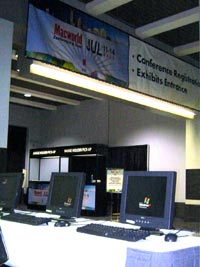
Caught this shot on Monday evening, before the conference really got into full swing. The computers here are owned by the Hynes Convention Center, and were set up to poll the attendees about their impressions.

My impression: guys, when you’re holding a Mac conference, take 30 seconds to change your screen savers, alright?

These was a rumor that Steve Jobs was in attendance and was wandering the show floor. This was accompanied by a story about a presenter who spotted him in the audience and got so flustered that he had to end his talk early. Honestly, I hope Steve’s got better things to do; if I can do the expo in 15 minutes, I can’t see what would make his visit worthwhile.

MacWorld Boston trip report

Best thing I can say about MacWorld: Boston’s a nice town to visit. I’m writing this in the shadow of an 1867 statue dedicated to “the relief of human suffering by the inhaling of ether”, so you know these guys know how to party.

MacWorld Boston is the red-headed stepchild compared to San Francisco (and increasingly the Worldwide Developer Conference), so most of the value of the conference came from meetings I had set up beforehand. Aside from that, the show floor was so sparse that I could walk it in 15 minutes, and I had finished everything I wanted to do on the floor by the end of day one. Day two I bought a few gizmos (an earclip flashlight, just because, and a BTI replacement battery for my laptop). Day three I didn’t even bother showing up, although I spent most of it in the Starbucks next door to the Hynes Center.

The good things I can say: all card-carrying geeks should make plans to see Andy Ihnatko speak sometime before they die. He’s a showman as well as a writer; what else can you say about a man who makes a robe out of discarded iPod banners for part of his presentation? His talk was fairly varied, but some high points included his two-cent heads up display (mirror reverse a PDF print preview, print to paper and place on car dashboard), and an amusing discussion of why the switch to Intel shouldn’t matter for most users.

I also enjoyed Ben Waldie’s talk on Automator; the crowd ranged from developers to complete newbies, and he seemed to make it interesting for all attendees. I’m looking forward to catching up with him at the Philadelphia AppleScript MUG at some point.

The real disappointment was the show floor. I really don’t have a strong enough need for high-volume DVD burners that I need to compare four vendors. There are really just so many iPod accessories that need to exist, but apparently some companies haven’t gotten that memo. And while I’m as crazy as the next person (here, anyway) about the newest bags I can use to shlep around my laptop, the biggest innovation I saw was the use of lavender ballistic nylon instead of Model T Black.

One group I will be keeping an eye on are the AppleSpecialists, a consortium of independent Apple resellers who are banding together to compete more effectively against the Apple stores. More than once I heard vendors expressing interest because it’s difficult at times to deal with the monolithic Apple corporate structure to get retail space. One of the members is MacUpgrades in my hometown, and I’ve been impressed enough with those guys for years to give high marks to the rest of the bunch.

Verdict: I’m glad I came, but the best parts of the trip were thanks to some of the people here. The show, not so much. Better to make plans for MWSF; I’ll be in Italy for the 2006 edition, but January, 2007 should be an eventful time to make my next appearance.

Happy 238th, John Q.

It’s been quite a few years since I’ve been to Boston, and I think this might be my first aimless day wandering around it. There’s an inherent charm here that I’m trying to determine whether it’s local, or if I’m just putting traveler’s gloss on what I’m seeing.

Certainly, the Public Gardens need no gloss. It’s beastly hot here today (i.e., what I’d be getting if I stayed in Washington), but the Gardens have plenty of shade and a steady breeze. The feel here reminds me of Hyde Park in London; it’s a bit more bedecked with benches and human amenities than is the British custom, but it has the same sense of calm. Washington has her fair share of parks, but the closest thing we have to a place like this is the Tidal Basin, which unfortunately is not in my part of town. And the Basin somehow doesn’t have the human scale that I’m seeing here.
Airheaded thinking

A few mundane thoughts that damn near everybody has in airports, but which I can’t help writing about while I’m airblogging.

We take this miracle a bit too much for granted. I’m flying to Boston; the neighboring gates were going to Tampa and Seoul. Boston, Tampa, Seoul. Those don’t seem to belong in the same sentence. The excitement experienced by the waiting passengers didn’t seem to correlate with the destination.

My neighbor across the aisle is a young teenager who barely looked out the window when we took off. This strikes me as unnatural for adults, let alone for children.

We are asked to fasten our seat belts whenever the sign is lit, or whenever we are seated. Therefore, we should fasten our seats belts when we are not seated because the sign is lit.

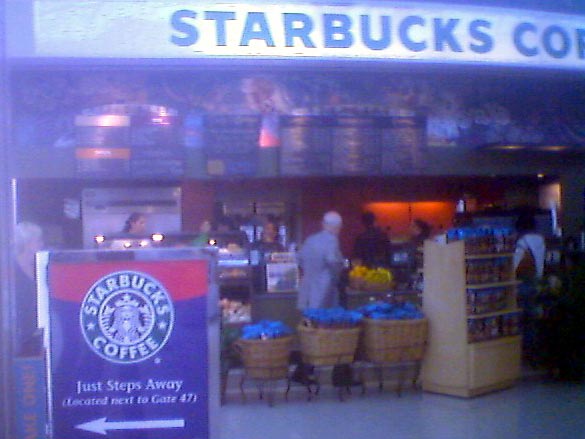
Note this sign at Dulles, directing you to a Starbucks. You approach it from the entrance to Terminal B, and if you follow the sign immediately and turn right, you will not look to your left and find there is another Starbucks immediately behind you. Luckily, I already had my venti coffee from the third Starbucks in the kiosk that was just past security.

Prior to takeoff, I was told to shut off my electronic devices, but I could still use my cell phone until they shut the doors. My electronic device is also a cell phone; if a cell phone is not dangerous, then clearly my smartphone is less so when not being used for a call. And yet it does not fall into the set of all electronic devices.

Further evidence that I am an idiot: I have six movies to watch on my laptop. I have the complete works of Mark Twain on my cell phone. And yet, when they told me to shut off my gizmos, I realized that I had brought nothing to read that was not battery-powered.

While I was in the bathroom, they handed out mints on the plane. The mints were strong enough that the actual cabin turned minty fresh; I could tell what the flight attendant was handing me without asking. And when they brought around the hot towels (a very nice touch on a no-frills fare), they had dropped some dry ice in water to give the tray the proper steaming presentation.

That’ll have to be jeffreyporten.com from now on

This is my first flight on Independence Air, and all in all I’m pleased with them so far. I respect any airline that allows its flight attendants to refer to a water landing as a “dip in the Atlantic”, and I’m even more impressed by the graphic that accompanied the plane evacuation instructions. Yes, that’s a broken-up plane outside the window, and they even put an “i” on the ruined tail rudder. That’s ballsy.

But their computer systems can use some work. I signed up for their frequent flier program when I bought my ticket, but it was rejected when I tried to use it. I figured it was a computer glitch, and went to gate to resolve it when I checked in.

Thirty minutes later, the gate agent is still having the same problem. Turned out that my FF account, like just about everything else in my life, was under the name “Jeff”, but I had ticketed myself with my passport-kosher legal name of “Jeffrey”. The only people who call me Jeffrey knew me when I was less than three feet tall. Problem number two was that the name on my frequent flier account is apparently engraved in stone and cannot be changed. So I was reticketed as Jeff and sent on my merry way.

Me: “So, when I come home, will TSA know that ‘Jeff’ on my ticket and ‘Jeffrey’ on my passport are the same person?”

Indy Air (paraphrasing): “Sure hope so, because we don’t.”

Paying the Reid Airport Tax

My Lord, did I screw up this trip.

So I’m standing in a TSA line imported straight from EuroDisney in August, when suddenly on the fifth repetition the canned announcement about prohibited items sinks into my cranium. I blame the early morning departure time. It was 11 AM; who is up at that ungodly hour?

But eventually I hear the word “lighter” and realize that I’ve got one of those. A rather nice one, with sentimental value. Credit where credit is due, I got no argument when I surrendered the lighter (easily replaceable) and kept the case (the important part).

But then came the metal detector, and my repeatedly setting it off, and my subsequent wanding. Obviously, my travel skills have atrophied, because this is what I was still wearing: left pocket, pack of cigarettes in foil, aspirin container (scraps of foil left on rim); right pocket, unidentified something in my wallet, and back it went into the X-ray; shirt pocket, an errant dime; right hand, class ring; waistline, belt buckle and cell phone belt clip with metal clasp.

That was after I had cleared myself of all metal. Steve Austin would have gotten through easier than I did. But eventually I made it, less one lighter. Those of you who feel smokers deserve all the hassles they get may commence experiencing schadenfreude now.

Upon arrival at Dulles Gate B, I headed off to the smoking lounge for a last hit before the flight, where I found dozens of travellers who had passed through security while retaining their deadly incendiary objects, and who shared them freely with me. A flight attendent told me, between puffs, that they had to be careful because TSA raided the lounge from time to time and confiscated the lighters.

To which I commented, “All of these people have committed a felony by getting those lighters this far. If they were serious about the law, they’d come in here and do mass arrests.” It’s nice to see that even TSA acknowledges that their security is just for show.

Bonus points to me for not actually referring to the cost of my lighter as the Reid tax while at the checkpoint—although seeing as how I’m writing this from the plane, perhaps a few points should be stricken off.

It’s improved a bit since then.

Laugh-out-loud funny passage from Mark Twain’s A Tramp Abroad:

RECIPE FOR GERMAN COFFEE

Take a barrel of water and bring it to a boil; rub a chicory berry against a coffee berry, then convey the former into the water. Continue the boiling and evaporation until the intensity of the flavor and aroma of the coffee and chicory has been diminished to a proper degree; then set aside to cool. Now unharness the remains of a once cow from the plow, insert them in a hydraulic press, and when you shall have acquired a teaspoon of that pale-blue juice which a German superstition regards as milk, modify the malignity of its strength in a bucket of tepid water and ring up the breakfast. Mix the beverage in a cold cup, partake with moderation, and keep a wet rag around your head to guard against over-excitement.

Independence, vigilance, and liberty

For Independence Day, a few thoughts on our government.

I agree with Brian’s assessment overall on how the O’Connor replacement will go, with a few addenda.

I will continue to give two hoots about John Bolton. I believe John Bolton’s policies will lead to the deaths of millions and the suffering of millions more in the 21st century, just as those same policies had that result in the 20th. Perhaps others have the luxury of seeing John Bolton solely as a political football. They probably sleep better than I do. But unlike them, I will not be distracted by whatever bright, shiny object hits the headlines in the weeks to come.

As for the Supreme Court, unless Bush’s nominee has publicly advocated the slaying of Jewish children to make Christmas eggnog (you know, in order to be fair and balanced over how we make our matzoh), he’s going to be confirmed.

If Bush’s first choice is not confirmed, his next choice will be. This choice will only be marginally less odious, but the Democrats will claim a huge victory. This is what counts as principled opposition in the time of, “Sure, he publicly proclaimed that the US will torture anyone we please, but at least he speaks Spanish.” The same thing will happen in the UN ambassadorship, or the next Supreme Court vacancy.

It’s time for the moderates and the left to wake up and smell the coffee. The forces of tolerance, of moderation, of separation of church and state, all lost along with the Democrats last November. That battle is over. The longer we spend picking over the carcasses, the less prepared we are for future engagements. The right has the presidency, the Congress, many state legislatures, and is closing in on the courts.

So here is what will happen after the Supreme Court is restored to nine justices. Over time, rulings will come down that favor the right. Everyone is watching the abortion decisions, but it’s going to go far beyond that. The conservatives are much happier making their gains quietly, because those wins are the ones that last. And they will make gains. This will set the boundaries for the next round of battles.

Here in America, I’m generally viewed as radical left. Forty years ago, I would have been considered an American moderate. Seventy years ago, with the fascists and the Hooverites on one side, and the communist revolutionaries on the other, I would have been as mainstream as they come.

But today, those same views are radical. Separation of church and state is radical. Belief that American power stems from knowledge and science and equality of education is radical. The idea that our values must be exercised to have meaning is radical. Or so my opponents would have you believe. And to be radical is to be marginalized.

This marginalization does not happen in a vacuum. It happens with the complacence and complicit behavior of the so-called moderates who pretend that these things are not occurring. I believe that many Americans do not want to go down the path that the right is taking us—and yet, we move down that road at a merry pace. Why? Because too many people feel the wind in their hair and put their hats on.

As for the Democrats and the active left: you—we—are failing miserably. The Democratic leadership will share a place in the history of political cowardice with Neville Chamberlain and James Buchanan. The left needs to learn how the modern political game is played, and stop operating under Marquis of Queensbury rules. Your work is for nothing if you do not effect change.

I am an American, and I am a patriot. For my political beliefs, it is common for me to be called a traitor, a supporter of terrorism, a heretic and anti-American. This is now an accepted part of the public debate, and it is allowed because my countrymen allow it to happen. Because the vast sleeping center does not stand up and say that this is not an American mode of discourse. And so long as they remain quiet, the political field will continue to shift, as the right pushes the spectrum further and it becomes necessary to become more conservative to remain safely moderate, where you risk offending no one and can pretend that politics do not matter.

Apathy and silence will be construed as the consent of the governed. History is littered with governments that became theocracies and fascist states by providing fear and anger to the ignorant. On this, the 229th anniversary of our independence, I am unable to understand how any loyal American can wish that to happen here. Or can allow it to happen through inaction.

Perhaps some of you think I am engaging in hyberbole. Perhaps I am. My question to those of you who do: how large does the risk to your nation have to be to get you to act?

But you must remember, my fellow-citizens, that eternal vigilance by the people is the price of liberty, and that you must pay the price if you wish to secure the blessing.—Andrew Jackson, Farewell Address, March 4, 1837

When in the Course of human events, it becomes necessary for one people to dissolve the political bands which have connected them with another, and to assume among the powers of the earth, the separate and equal station to which the Laws of Nature and of Nature’s God entitle them, a decent respect to the opinions of mankind requires that they should declare the causes which impel them to the separation.

We hold these truths to be self-evident, that all men are created equal, that they are endowed by their Creator with certain unalienable Rights, that among these are Life, Liberty and the pursuit of Happiness. —That to secure these rights, Governments are instituted among Men, deriving their just powers from the consent of the governed, —That whenever any Form of Government becomes destructive of these ends, it is the Right of the People to alter or to abolish it, and to institute new Government, laying its foundation on such principles and organizing its powers in such form, as to them shall seem most likely to effect their Safety and Happiness.—The Declaration of Independence of the Thirteen Colonies, In Congress, July 4, 1776

[This essay is part of The Red and the Blue discussion: Supreme Court/Independence Day.]

Not lovin’ it

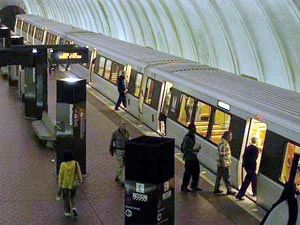
I was somewhat horrified this evening to see a Metro train pulling into the Woodley Park station, its entire exterior “wrapped” in a floor-to-ceiling advertisement for McDonald’s Fruit and Walnut Salad. Call this a bit of Washingtoniana that I didn’t realize was sacred until someone messed with it—it doesn’t rise to the level of the Washington Monument (no pun intended), but the brown exterior is as much a part of the DC experience as the Metro’s hexagonal tiles and Das Blinken Lights to tell us a train is coming.

So WMATA, hands off the trains. I know you’re hurting for cash and the Congress isn’t helping, but you’re the stewards of something important here. So I’m instituting a personal boycott on any company who advertises in this fashion. It’s not like I’m a regular Big Mac person, but this means I’ll be ending my three burrito-a-week habit at Chipotle for a while.

(Photo adapted from Wikipedia entry.)

And it’s got a built-in handle

Via Slashdot, a review of the first Macintosh. What I find fascinating about this is what the author felt the need to explain:

Few things are as abstract as the data and programs stored and used on a computer. The Mac takes that abstraction and presents it as something familiar…. Do you want to put a document in a folder? Pick it up with the mouse and put it in the folder. Do you want to throw something away? Pick it up and put it in the wastebasket. Abstractions take on real forms that we can understand and use without obscure commands or bizarre syntax.

Another important aspect of this user interface is the way in which the Macintosh makes commands available to the user. As I write this review with MacWrite, the top of my screen has an Apple symbol and six words (File, Edit, Search, Format, Font, and Style) written across the top. If I point at any of the items with the mouse and press the button, a menu of options appears on the screen. When I release the button, the menu disappears. All available commands appear in the menus….

A special disk-copy utility is now available that lets you copy an entire disk in just four swaps – not too shabby when you realize that this utility uses nearly 80 percent of the total RAM just to hold the data.