Serve your country as an arm of the ruling party

TPM notes legal and ethical conflicts in the latest partisan Bush use of the military:

[A]ctive duty personnel […] may not “Participate in partisan political management, campaigns, or conventions (unless attending a convention as a spectator when not in uniform).”

Now, we don’t know if these military personnel are appearing in uniform or not. And much of this probably turns on what constitutes a ‘political event’. But to my mind, an event organized by a Republican party official at the direction of the White House political office is by definition a political event. That’s just obvious, isn’t it?

Another question. We know how the White House political office knows who’s a Republican County Chairman. How do they know which active duty military officers in a given area want to make speeches supporting the administration current policies in Iraq? Think about that.

You know, it used to be when you thought about a political party that harnessed every action of government for partisan aim, and judged everyone through that lens, you were talking about Communists. I guess Karl Rove decided he admires Karl Marx after all.

Barred from discussion

Ah, I remember the good old days when everyone knew whom to despise. Only a few scant years later, and Bob Barr, darling of the impeach-Clinton set, needs a poison taster for his rubber chicken:

“Are we losing our lodestar, which is the Bill of Rights?” Barr beseeched the several hundred conservatives at the Omni Shoreham in Woodley Park. “Are we in danger of putting allegiance to party ahead of allegiance to principle?”

Barr answered in the affirmative. “Do we truly remain a society that believes that… every president must abide by the law of this country?” he posed. “I, as a conservative, say yes. I hope you as conservatives say yes.”

But nobody said anything in the deathly quiet audience. Barr merited only polite applause when he finished, and one man […] booed him loudly.

I was at the Omni Shoreham yesterday—wish I had known to drop by and be the plant in the audience.

More adoption of a Bush-friendly lexicon

Media Matters is tracking the adoption of Bush spin as a way of describing one of his policies:

Following the lead of Fox News and The Washington Times editorial page, an article by the Associated Press adopted a variation of the White House terminology “terrorist surveillance program” to describe the Bush administration’s domestic spying program.

Seems to me, if we’re going to call a surveillance program with a documented success rate of < 0.5%1 as “terrorist-related”, we could also call lightning a steady source of electrical power, and my past PowerBall wins as a steady source of income.

1Estimate based on published reports that “thousands” of people have been wiretapped, with approximately 10 terrorist-related connections successfully logged.

Going beyond the 2D monitor

I’ve been giving thought recently to ways I can make my computer time more productive through interesting monitor tricks. For example, take a look at this demo by Novell showing some screen gimmicks they’re releasing later this year.

Most of that, I already have. Well, except for the floppy window that bends in the wind when you move it around. I don’t have that. Can’t imagine why I’d want it, either. (What’s next, force-feedback trackpads?) But I can zoom in on any arbitrary point on the screen thanks to Universal Access. I can more or less zoom out to an arbitrarily large size by playing with some very cool Quartz screen effects. And thanks to some other open source software I’m running, I can set up as many of these screens as I like.

There’s no question that multiple monitors are a productivity boon, and it’s surprisingly useful to be able to zoom in and out of the standard desktop size. The other gizmo I’ve been playing with is a hack that lets me set a transparency on any window or set of windows I like. That’s the effect for which the jury is still out; my instinct is that there are ways I can use this (and there are one-off times when it’s essential), but it’s not a regular part of my desktop experience yet.

My overall impression is that these tools allow you to stretch the desktop metaphor to make it more useful—but that there are newer metaphors that would be even better. For example, 3D cube transitions are more than just eye candy; I find they help me make a mental adjustment to a new workspace.

Anyone else playing with some of these toys?

Jeff Porten, in a nutshell

Thanks for stopping by for a visit. I’m Jeff Porten; on various days of the week, I’m an Internet/Macintosh/business development consultant, database and web developer, writer, and entrepreneur.

Most of my consulting work these days is for the Association of Research Libraries and the Coalition for Networked Information. Over there we work with CommuniGate Pro, Apache, QuickDNS, and FileMaker Pro, all running on a fleet of Mac OS X Servers.

The rest of my client base is almost entirely small business and nonprofit, with a smattering of governmental. They are centered in Washington DC, but I keep a global footprint and work hours to match, with active and past projects in Europe, Asia, Africa, and South America. Australia, give me a call.

I am an incurable serial entrepreneur, so I usually have a half-dozen ideas that I am percolating, incubating, and procrastinating. The most active of these is Plenarcast, a startup that provides Internet broadcasts of conferences and events. That business is run on WebCrossing 5.0 on a BSD Unix system for the live site, and on Macintosh OS X for development purposes. I’ll announce my other ventures here if and when they’re ready for prime time; unfortunately, many of them go the way of DC3Wireless, the brilliant wireless Internet idea that was shelved when T-Mobile announced they were outspending us by 100,000 to 1.

I was recently the CTO of a business that provided grassroots communications to Congress for the members of various businesses and nonprofits. That business, unfortunately, became a dot-com flameout, but I have retained the rights to the entire system, so contact me if you think you can put it to use. That was built using 4D and WS4D, with mailing list services under LetterRip Pro and SIMS.

I wrote a book a few years ago, and keep meaning to write a few more.

The family business is a candy store catering to diabetics. We didn’t have the time to process web orders, so the retail storefront is now offline, but you can still visit our bricks and mortar. That site was running on WebStar, FileMaker Pro, SIMS, and a few other software widgets, last time it was up.

jeffporten.com Site Map

Welcome to jeffporten.com 5.0, inaugurated in February, 2006. I’ve moved the site to WordPress, and with new software comes some new features and reorganization, if you were used to the old site.

The Blogs Formerly Known As “Portentia” and “Jeff Wing Conspiracy” have been combined. Actually, pretty much everything is now a single feed on the home page; I’m going to use WordPress categories to subdivide what I’m writing about rather than send them out on different blogs.

If you’re here just for one particular topic (i.e., you want to read me on security issues, but don’t care about Macintosh software), then feel free to bookmark me by category rather than by my home page. I’ll be looking into whether I can similarly set up multiple RSS feeds by category.

Main sections of jp.com 5.0:

About Jeff Porten: more about me, including my consulting work, professional background, and nonprofit activism.

About this site: you’re here already.

Friends of Jeff: people I know, what they do, and why you should read their websites.

Portentia: essays and other long-form pieces I have posted to my website (as opposed to quick blurbs and blogging).

Software: shareware and freeware I’ve written, demos, and technique discussions.

Jeff Wing Factions (AKA blog categories):

Americana: American history, sociology and culture.

Beltway: Washington political issues, focusing on legislation and policy.

Free Agent Nation: ruminations on self-employment, entrepreneurship, writing, and blood donation.

Inside Draws: talk of odds, gamblers, very odd gamblers, and Hold ‘Em.

Mac Guru: important things to know about the Macintosh.

Media Diet: books I’m procrastinating, movies I want to see, TV I’ve missed. Commentary on specific media artifacts (as opposed to the media at large; see Vox Populi).

Nomadism: places I’ve been, places where I am, travel issues in general.

Photoblog: I see something that amuses me, I take its picture.

Preambling: Discussions relating to providing for the common defense, promoting the general welfare, and securing the blessings of liberty. With occasional footnotes about elbow room.

Quotable: a while ago, this was its own blog. Here mostly for legacy purposes.

Red and Blue: my ongoing debates with Brian Greenberg.

Technobabble and Ubergeek: science and technology issues. Computer stuff that isn’t Macintosh-related. Technobabble is meant for the layperson; Ubergeek goes into programming techniques and more technical detail.

Vox Populi: big picture issues relating to democracy, the media, communications, and politics.

Whimsy: if I thought it was funny, it’s here.

More PowerBall musings

The Multi-State Lottery Association has recently changed the odds for PowerBall, so I thought I’d update my earlier post. Summary of earlier statements: even though PowerBall, like most lotteries, is rigged to return fifty cents on the dollar, there is some jackpot size at which point it is theoretically a better than 100% return on a bet. (Presuming the ability to play an infinite number of times; in all tests of this kind, a small number of trials will show anomalous results. In PowerBall, that basically means that everyone’s lifetime play will be statistically anomalous.)

The new rules have made it even harder to win the big jackpot, and likewise for the smaller wins. The sole concession to the player is that the five-ball hit without the PowerBall has been increased to $200,000, so now it’s theoretically possible to win a million dollars without hitting the PowerBall draw (five out of five with a 5x PowerPlay multiplier).

In any case, if you play PowerBall without making the PowerPlay bet ($2 for a ticket versus $1), you are getting incorrect odds and hence contributing to the state when the jackpot is below $232,292,812. (Assuming cash payout in one lump sum; variations on the value of this prize in relation to the advertised jackpot not accounted for. There is also a bonus pool on the 5 ball win with no PowerBall when the jackpot increases more than $25m in any one game; also not included.)

The PowerPlay still improves the overall bet—a $2 bet increases the return on any non-jackpot win at least 2x, up to 5x. There used to be 380% return on this bet for any win; this has been lowered to 350%. Regardless, the jackpot needs to be “only” $189,520,398 to be an even game with this bet.

What I find interesting about this is that it shows the utter irrationality of PowerBall players. That is, the rule of design of most gambling is to provide selective reinforcement; provide the player with small wins on the road to taking the house edge. This is difficult when the house edge is as huge as it is with state lotteries, but you can still work this into the design. With PowerBall, every revision of the game makes it harder to win, therefore creating much larger jackpots at the expense of the small wins that the players used to receive.

In other words, people play PowerBall when they can win a sizeable fraction of a billion dollars, and they stay away when the win is “only” say, $30 million. This is actually mathematically correct, but I doubt most players apply the mathematics to this. From the player perspective, is a win of $15 million any less life-changing than a win of $100 million? Yet, that’s what draws people in.

Likewise, they don’t seem to mind a string of losses like most gamblers. In the current game, if you play every game (104 times a year), if you made even a small win more than twice a year, you’d be lucky. Back in 1999 or so I won enough in four drawings straight to pick up another ticket and a pack of smokes. That should happen now once every 17,300 years or so.

So my guess is that the PowerBall attracts even more strongly a sort of non-gambler gambler, which is to say that the people buying tickets aren’t really buying tickets to win per se, but they’re buying a ticket to dream about what they’d do with the money for the days until the drawing. This has been measured before, and also indicates that twice a week is about as often as you want to run a game of this kind. It also suggests that in ten years we’ll be seeing lotteries with billion-to-one odds against and regular demiannual prizes of a few hundred million. Which should be enough for a few tanks of gas.

If you have something to share with the class, George….

Just when I think I can’t be amazed at who’s running the show anymore:

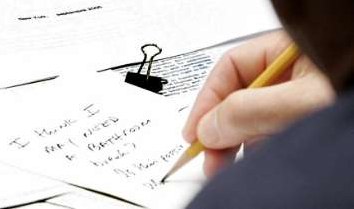
Excerpt from the Editor & Publisher story: “In what seems destined to become one of the most yakked about photos of the month, if not year, a Reuters photographer today seems to have captured President George W. Bush scribbling a note to Secretary of State Condoleezza Rice during a session at the United Nations. On the note is a message revolving around the need to take a ‘bathroom break.'” Original photo here.

Clearly I need more coffee

So I’m reading a manual for this network analysis software I’m testing, and I come across this passage: “You could think of a network packet analyzer as a measuring device used to examine what’s going on inside a network cable, just like a volunteer is used by an electrician to examine what’s going on inside an electric cable.”

Actually, if you read that twice, it says “voltmeter”. But I think volunteer works better.

A flood of anger, a drought of compassion

By way of my normally rational pal Brian, I am pointed to an essay by the less commonly rational Lileks as a shining example of some points that Brian had stated earlier.

Which leads me to think—it’s not the Democrats or the liberals that are experiencing blinding partisanship. It’s the Republicans who are allowing their partisan fervor to blind themselves to a level of incompetence that would lead them to spurn a local 7-11 that showed the same traits.

First, and let’s be clear here: it’s a straw man argument that the left is blaming George Bush for the hurricane itself. I have heard some people on the left say that there is some correlation between Katrina and Kyoto, which is clearly a load of horse droppings. The purpose of Kyoto is to prevent the Katrinas of 2025, so the sole connection one can draw between the 2005 version and the actions of the last five years is one of poetic justice. Or injustice, since those who profited from the spiking of Kyoto are profiting from the inundation of New Orleans.

Therefore, I’m not expecting to defend the entire political left from that small subset of us who are ignorant of science. If the Republicans wish to engage me on that score, please, feel free. Between intelligent design and your environmental policies—which will provide a direct causal culpability to future disasters—I’ve got an armory here and you’re stocked with snowballs.

Second, normally this is considered to be a topic that is worthless for debate, but I have to ask the governing right: what do you believe the government is for? As a denizen of Washington and a nominal traveler of the world, I’m exposed to more theoretical and practical forms of government than most, and just about everyone (except the anarchists) from Cato on up believes that a federal government takes on responsibility for the safety of her citizens. Yet all I’m hearing from the right is how those poor, deluded people in New Orleans shouldn’t have sat around waiting for Uncle Sugar to show up and save them.

A libertarian will tell you that a federal government should be vigorous in the face of a natural disaster. But apparently the Republican point of view is that “strong national security” means killing every person who might do us harm, but says nothing about actual safety. I can expect that from the Millennarians who support the idea of God’s wrath proceeding unabated over humans (and forgetting that this was why we started forming cities and governments 20,000 years ago in the first place), but it sounds odd coming from those who are not counting on Messianic Return to save us.

Third, let’s talk about anger. Brian and Lileks seem to buy thoroughly into the theory that those of us who are angry at Bush are enjoying playing the “blame game”. Lileks puts forth the theory, approvingly quoted by Brian, that in the event of the next terrorist attack, the left will swarm out with righteous anger to attack the president, and implies that we are just waiting for the opportunity.

Can I just say? That’s simply evil. Horrifying. Disgusting. Dehumanizing of everyone who doesn’t share your support of the administration. If you want one hint as to why political discourse has degraded to where it is, take a moment to determine why the above didn’t spent one moment resting in the rational thought centers of your brain, and know that the fault lies within yourselves. You will not be able to engage in debate with people you regard as animals, and clearly that’s how you think of us.

That being said, anger has its uses, and what strikes me is that the opposition seems to think that because we’re angry, therefore we must be incoherent. Whereas I note that there are damn good reasons to be angry, in politics as in life, and utter mismanagement of a disaster ranks among the first of these.

No, I cannot prove that the funding cuts to the levees directly led to their breach. It is possible that fully funded levees would also have been destroyed. However, it is true that cutting these funds increased the probability of such a disaster occurring, and so in the face of that same disaster it is rational to accrue some fault to the people who made those decisions.

No, I cannot demonstrate that Clinton’s FEMA would have been more effective at preventing (or at the very least, not causing) the post-disaster atrocities we have witnessed. All I can do is point to the near-unanimous statements that that FEMA was seen to be the best-organized and best-run such agency we’ve ever had. As opposed to this one, which cut the emergency communications lines of neighboring counties.

No, I cannot answer for the actions of state and local officials. It was the local sheriffs who turned away pedestrian refugees trying to flee the city, although initial reports are that federal troops and private security firms have done likewise. I too wonder where the buses were before the storm hit. That being said, I also recognize that municipal bus drivers are not emergency staff, and so in the event of a disaster it could be considered humanitarian to tell them to get the hell out of town.

But on that point—while we can argue the question of philosophical responsibility as long as we like, as a legal matter the issue is settled. Once the governor and the president declared New Orleans a disaster area, responsibility moved up the chain. The purpose of this is to create a single point of responsibility; in a disaster, you do not want federal, state, and local officials answering to different masters. Two people both trying to do good can do harm. So as stated in federal law, the sole source of command and responsibility was FEMA days before the levees broke.

But all of that is still being rational. Let’s do a little anger here.

This is not like other things. This is another 9/11, and it proves that four years to the day we have completely forgotten the lessons we should have taken from 9/11. The lesson that most people learned, apparently, is that people want to kill us and we have to go slaughter them first.

The lesson we should have learned is that living on Earth is dangerous, from both natural and manmade events, and that we have collectively formed communities, governments and nations to protect ourselves. Humans are not armed with fangs or claws or wings, and having solely our brains as our evolutionary means of defense, we use them. That the role of government at any level is to protect its citizens should be so self-evident as to not need debate.

This is the first time we’ve lost a city to natural disaster in a century. Our technological and financial resources are a dozen orders of magnitude more vast than those available to the governments of San Francisco 1906 and Chicago 1871. And yet we still left people to die in their own feces in government-created camps.

As I have said many times in the last four years, I am stunned by how willing my countrymen are to accept things in America that we have prided ourselves as being above. Many accept what takes place here because they believe that no other America could have done better, than whom we elect makes no difference, and that we cannot expect any differently.

In my view, this is treason.

Finally, for my Democratic and leftist friends: you need to get over one article of faith, the idea that eventually there will come a reckoning and the great mass of people who disagree with us will come to our side in a mighty wave. What this month should prove to you is that there is nothing so corrupt, no ineptitude so vast, no wholesale abdication of responsibility so calumnous, to cause this to occur. The frame of the supporters of the president is such that these events only cleave them to him more strongly.

Therefore: stop bitching. This frame exists due to twenty years of hard work by Norquist et al., and will remain until we undo it. Our point is that George Bush cannot keep us safe. This is how he was reelected, and this is where his failures are manifest. Use logic where possible, use emotion where necessary, and use passion to keep yourselves going. Choose your targets well, and don’t waste energy on those who refuse to listen; you can only defeat a framework when an individual chooses to leave it.

We have a message to take to the Christians, who can see the lack of charity from the government; to the poor, who can see their equals left to die and then blamed for it; to the traditional conservatives, who feel their government should be stronger in the face of disaster.

This is not anger, this is not partisan politics. This is about death and misery, and preventing future generations from repeating our failures. This is our failure, every American’s. We are Americans. We can do better.

And don’t forget the free swimming lessons

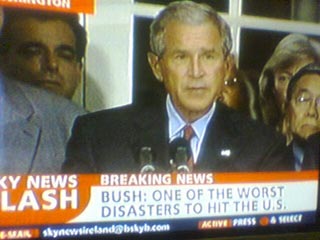
Barbara Bush, formerly known as “America’s favorite grandma”, about the Katrina victims as quoted in Editor and Publisher:

Almost everyone I’ve talked to says we’re going to move to Houston. What I’m hearing which is sort of scary is they all want to stay in Texas. Everyone is so overwhelmed by the hospitality. And so many of the people in the arena here, you know, were underprivileged anyway, so this–this [she chuckles slightly] is working very well for them.