None of my regular readers will be surprised to hear that I’m in favor of Barack Obama’s call to reform earmarked expenditures, rather than banishing them entirely. Using a Congressional vote as leverage to fund a pet program, and bring federal money home to your district, is as old as the Republic, and it’s a vitally important way of doing business. The problem is that it can mean sending money to private companies and causes, without much transparency, which doesn’t have a great deal of public interest bang for the buck.
Obama hasn’t announced his plan for doing this yet, but I’ll suggest a very simple method of reforming not only earmarks, but all legislation passed by Congress and signed into law. Our problem isn’t just earmarks: it’s also laws written by lobbyists, bought and paid for with private money. Or all-around bad laws tacked onto otherwise good bills.
The way this happens now is by making it too damn hard for the American people to keep track of what’s happening to American law. For example, let’s say you’re curious about the actual legislation that was passed in the recovery bill. Look that up online, and here’s the first thing you find:
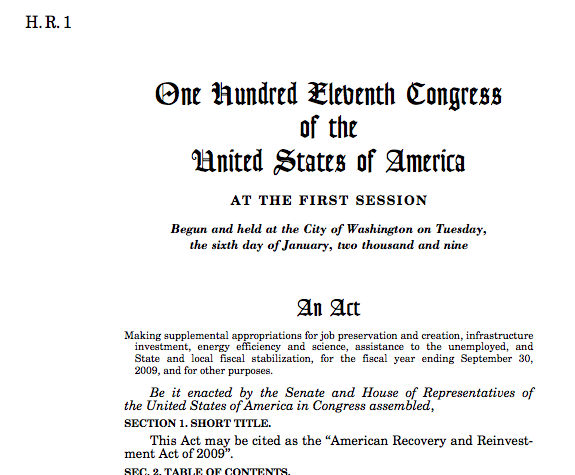
But that’s the HR1 version, not the Senate version, and it’s not immediately clear (to me, anyway) whether what you’re looking at is what passed in the House initially, or after the conference committee with the Senate over its version. Lawmakers love conference committees: it allows them to make major modifications to legislation after all the news reporting has been done on the House and Senate versions, and it’s where our system of governance runs with all the smoothness and commitment to justice as Zimbabwe’s.
If you prefer to track the changes made to legislation, you can use THOMAS, and you’ll get something like this:
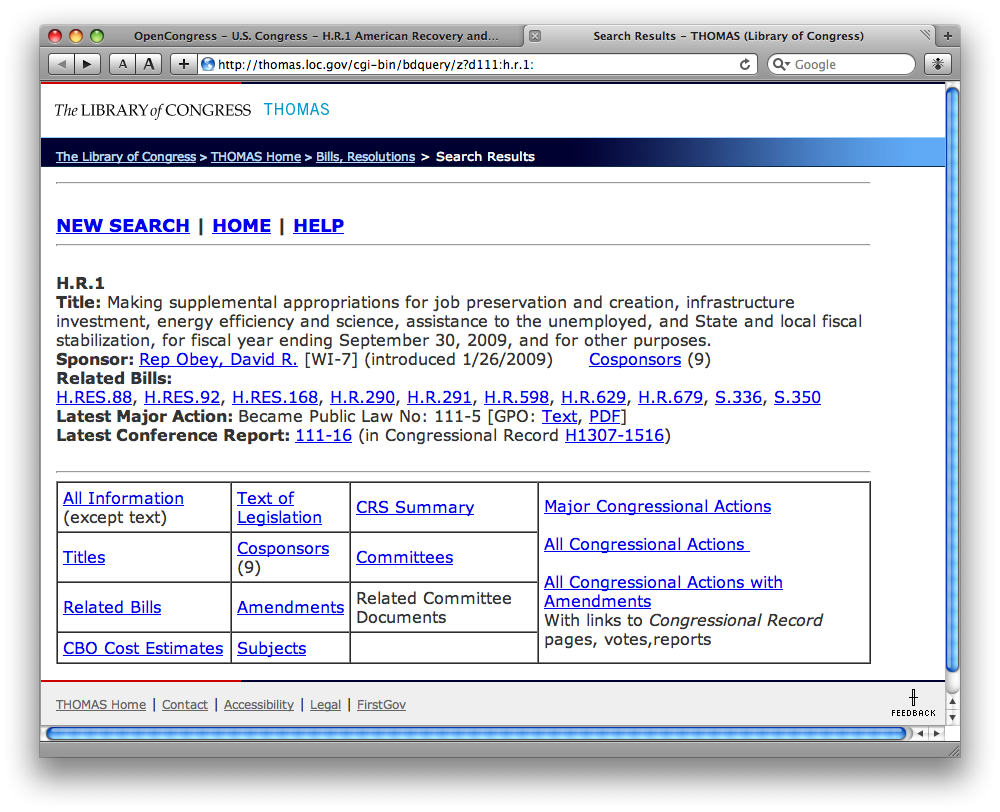
which leads to this:
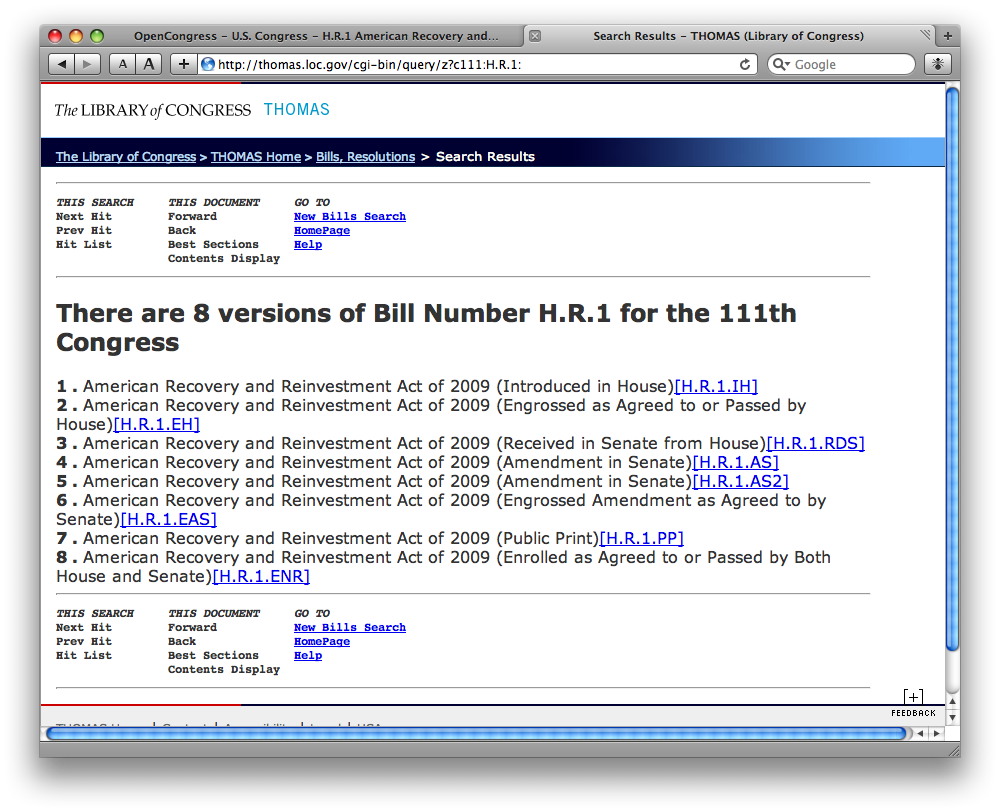
and finally, this:
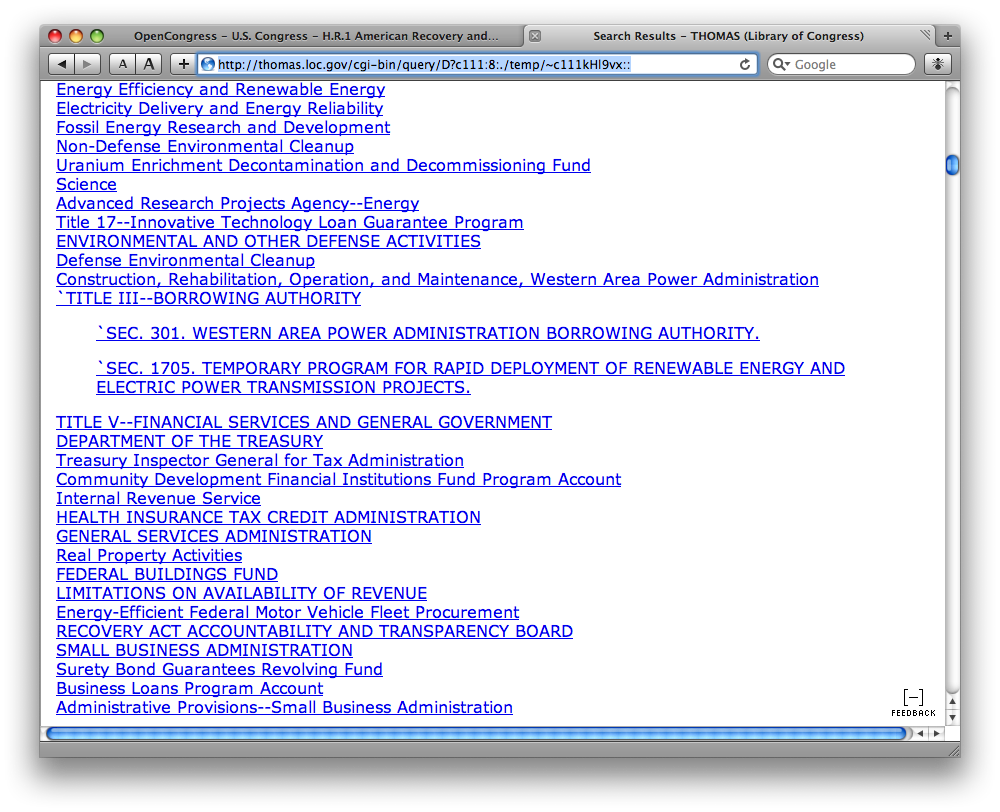
Call me crazy, but I’m thinking that not only will maybe five Americans read through all that, but that this system is designed to ensure that only five Americans will read through all that.
There’s a much better way to do this, and we already have one example. Instead of reading through the 407 pages of the HR1 PDF, you can read any of the information that’s being posted to recovery.gov, which generally purports to explain in plain English just what the hell is going on with all that legalese.
And, importantly, we know who wrote this bill: no matter what changes were added in Congress, the perceived author is Barack Obama. But that also means he takes the credit or blame for subsection dccxlviii, paragraph 322, where Congressman Waldo added three lines which builds the Prairie Canyon Lookout Point and Sniper Range in Keokuk.
How about this, instead? We normal Americans have had the ability, since 1989 or so, to create documents that use “tables” and “comments”. So let’s pass a law—the last indecipherable one—which requires all future legislation to look like this fictitious example:
| Text | Author | Intent |
| (A) 75 percent of the amounts available for each fiscal year shall be allocated to States based on the share of each State of households that participate in the supple- mental nutrition assistance program as reported to the Department of Agriculture for the most recent 12-month period for which data are available, adjusted by the Sec- retary (as of the date of enactment) for participation in disaster programs under section 5(h) of the Food and Nutri- tion Act of 2008 (7 U.S.C. 2014(h)); |
Rep. James Waldo, D-IA | Send nutritional aid to the states which need it. |
This would have the following very important impact:
- Every paragraph (or even line) of legislation has a direct lineage. This need not be a member of Congress. If Barack Obama wrote it, he can take credit. If a Congressional staffer wrote it and the member wishes, the staffer’s authorship can be retained. If a lobbyist wrote it, he can be listed. However, the member who introduced the amendment must be appended.
- If a lobbyist, or a very special friend, wrote it and a compliant member of Congress wants to cover up that fact, then he has to put in his own name instead. Someone always claims authorship. And if a lobbyist writes an entire bill wholesale, then either he or the member of Congress has to add that paragraph-by-paragraph statement of intent, each entry with someone’s name on it.
- Every paragraph has a plain-text explanation of what it’s supposed to do. This need not be comprehensive, literate, or even particularly accurate. However, if the law is passed and the Intent section is incomplete, wrong, or misleading, then everyone in that member’s district can damn well know about it by the next election.
And just like that, we’re done. Every earmark is a law. You want to reform earmarks? This does that; Representative Waldo can stand or fall based on the sum total of the money he steers to Keokuk, and it’ll be easily searchable for all to see.
Here are the best things about this proposal:
- It’s easy. Everyone who has a hand in writing legislation knows exactly what he’s trying to do when he writes it. All he has to do is write it down. In programming terms, this is simply a question of enforcing self-documenting code.
- It’s accountable. If someone deliberately tries to obfuscate the intent entry, his name is right next to it. Or if not his name, his boss’s—the one who has to stand for re-election.
- It’s political dynamite. Let’s say there’s a grassroots movement to pass this into law. You’re an entrenched lobbyist or member of Congress who wants to keep doing business as usual. Here’s my question: how exactly do you spin your argument in favor of collusion, opacity, and back-room dealing? I can’t imagine many elected officials of either party would love this bill—and I can’t see how they would oppose it.
This idea is all yours, Mr. Obama. Feel free to use it.
Heard on NPR today that Obama was one of the supporting Senators who has already implemented this partly — earmarks now require the name of the sponsoring member attached. Unfortunately, this is apparently metadata and not obvious when researching the bills through THOMAS or OpenCongress. Anyone who knows details, please inform me.
This is wiki-wiki wacko policy-making porno! You will rot in the deepest level of Hades for your sunshine socialism, sir. (jk)
Pingback: The Vast Jeff Wing Conspiracy » More on the astounding lack of legislative transparency