It’s finally over (continued)

I was called out today on my past errors, in Brian Greenberg’s eulogy for the Bush administration. Specifically, among Bush’s many other accomplishments which I did not anticipate, he refrained from large-scale invasions of more than two foreign powers, and he did not pardon himself or others for war crimes.

In both cases, not only do I freely admit to being wrong, but I also freely admit that I was hoping to be wrong. Unlike some who find it “disappointing” when they don’t find weapons of mass destruction, I’d rather have a less-than-perfect oracular record when that means that the world is a better place than I expected it to be.

Likewise, I’ll stipulate that I was glued to my news feed for the 72 hours prior to the Obama inauguration, watching for and expecting last minute abuses of presidential power. I can say that I am pleasantly surprised by Mr. Bush’s actions here as well.

I don’t have any good explanations for why Bush declined to be a greater failure in his last two months in office, but if I had to guess, I’d say he was just too damn tired. After the election, you just got the feeling that he was ready to go home, and the following two months were his prolonged Senior Week before graduation.

Brian points out all sorts of specific ways in which the United States currently differs from a 3,000-mile wide smoking nuclear crater, and suggests that each of these specifics are reasons to be grateful to 43 for not screwing up more.

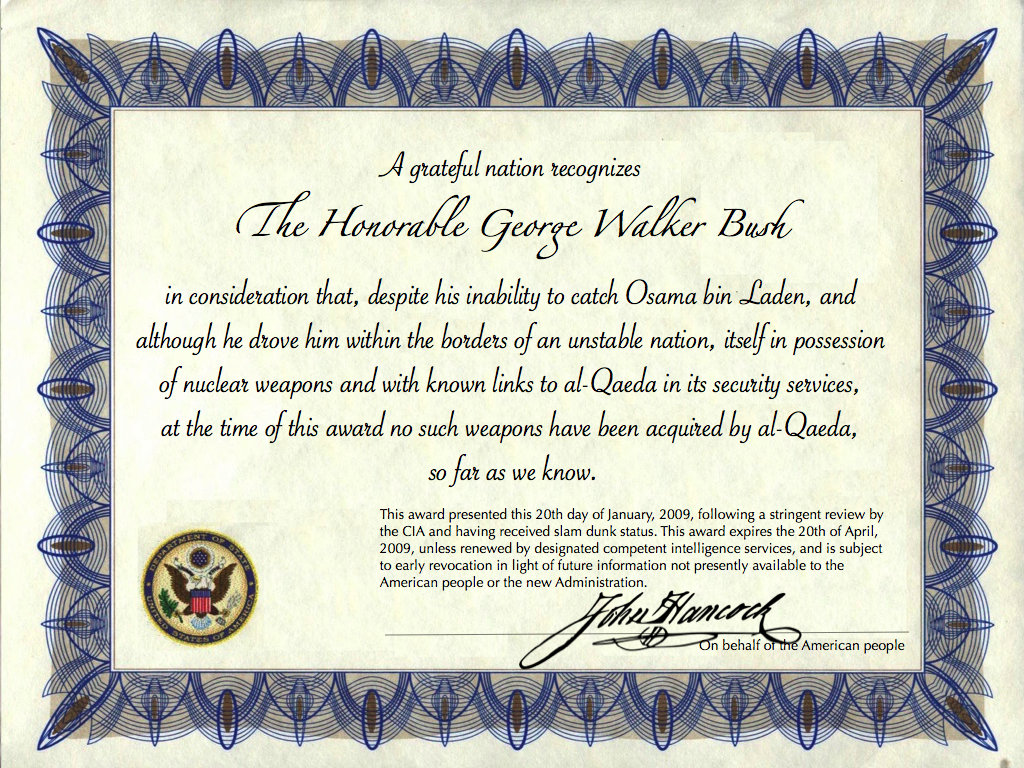
And there, well, I have to agree with him from a philosophical perspective. It is, in fact, possible to envision a Platonic dystopia in which George W. Bush was even more misfeasant than he was in reality—say, by using Syria to stage the Iraqi invasion—which logically implies that he is actually less than perfectly awful. At the same time, it’s hard to figure out what you’d put on that Certificate of Merit.
I find it amusing how often Bush defenders (and the man himself) raise the question of how he’ll be viewed by history as a way of deflecting present criticism and debate, as if history doesn’t count until suitably large numbers of decades have passed. Unfortunately, history already has very clear opinions: Of presidents who entered into temporarily popular, but extended and unsuccessful wars. Of presidents who suspended Constitutional rights for some people, especially of a particular racial group. Of presidents who presided over great shocks in the nation’s economy after implementing their own brand of economic policy.

If you know history, it is not difficult to guess how history will view Mr. Bush. And it is not difficult to guess where he will end up—like other failed presidents, he himself will be the answer to the trivia question, remembered rarely, and generally thought of only when the next list is drawn up comparing Tyler to Buchanan to Harding to Bush.

Or perhaps, like Hoover, he’ll be remembered mainly in contrast to the president who succeeded him.

Avoiding Bush’s last great mistake

It’s already been an interesting year on the torture front, starting with both Bush and Cheney discussing their direct involvement with “enhanced interrogation” techniques, through to yesterday’s decision by the top judge at Gitmo that, well, “enhanced interrogation” is an enhanced way of saying the word “torture.”

Personally, I think it’s pretty damned odd. For seven years, the only official discussion of high-level involvement in America’s movement to the dark side has come through clenched teeth. What little has been said to the public has been sculpted to give two simultaneous and contradictory messages about our top leadership: they’re badasses whom you don’t want to mess with, and they’re completely uninvolved with this war crime stuff. But now, in the waning week of the Bush II presidency, it’s suddenly okay to open up?

I can think of two reasons why they might do this. On the one hand, given the general way that it seems like everything Bush has managed in the last eight years has gone completely into the toilet, they might think that it’s worth buffing up what little shine they can on the situation before they leave the presidential limelight.

On the other, more paranoid hand, for the next five days, George W. Bush still has an absolute power to grant pardons, and this might be the warm-up to a blanket Get Out of Jail Free card.

I’ve been hearing a few murmurs about how irredeemably awful this would be, mainly from the sort of people who already think W is irredeemably awful. I happen to agree on both counts. However, I can think of at least one reason why granting a pardon would be a Very Bad Idea for both the country, and for the people receiving the pardon.

Let’s go back to the halcyon days of the 1990s, when people like Saddam Hussein ran countries and had a fondness of torturing the unfortunate people who found themselves in them. Since those national governments had little interest in enforcing criminal laws against their own dictators, it was generally agreed that it would be a good idea if the world had a set of criminal standards that could be applied when national systems broke down, or were deliberately designed to fail. And so the International Criminal Court came into being.

The United States signed the treaty but did not ratify it, and we’re currently on record as having no interest in joining the Court. The Bush Administration claims that this gives the international community too much power over Americans who are accused of war crimes, and the Democratic party to date has shown few signs of official disagreement.

Back in the day, those of us who were in favor of the ICC, and appalled that the US might not join it, pointed out two very good reasons why Americans were effectively immune to ICC prosecution: 1) Americans very rarely commit war crimes, and 2) we have a functioning legal system. The ICC only has jurisdiction when national rule of law fails; if a national system is “unwilling or unable” to prosecute the accused, then the ICC can serve as the court of last resort.

Perhaps you see where I’m going with this. But if not: as I read it, there is absolutely no way that George W. Bush himself or anyone in his administration can be prosecuted for war crimes in an international tribunal. As of today, that is. But anyone who receives a presidential pardon is untouchable by our judicial system, and therefore might fall into ICC jurisdiction.

(That is, if they authorized or committed war crimes in Afghanistan. The US and Iraq never joined the ICC, so Americans and Iraqis can torture the bejesus out of each other in either country, and the ICC can’t do squat about it.)

Call me crazy, but I’ve always been of the opinion that war crimes are the sort of thing Americans should avoid, and prosecuting people who appear to have committed war crimes is an excellent way to deter such behavior in the future. But I wouldn’t wager money on it. Counting on Democratic spinelessness is quite possibly the best way for the Bush administration, not to put too fine a point on it, to get away with murder. The problem comes if they decide they want more insurance.

If this administration falls under ICC jurisdiction, it would be a clusterfuck of galactic proportions. I can think of a thousand ways it would splinter both the domestic and international political arenas, making enemies out of natural allies, and mortal enemies out of people who would be otherwise more civil. It would not be good for the accused, and it would not be good for the country.

And at the same time, if Bush issues even a single torture pardon, the ICC cannot even think about backing down from its jurisdictional requirements. The last message you want to send to war criminals is, “Make your country powerful enough, and you have nothing to worry about.”

The best way to handle this is at home. And that means a credible investigation, whether it leads to dismissing or indictments, acquittal or conviction. I personally expect that anyone who committed or authorized torture in the last seven years will get off scot-free. But let them do so legally.