Incoherent ramblings about the failed bailout

I’ve just spent most of the afternoon watching what I’d expect 1929 would look like if we had CNN back then, and attempting to form some vague kind of educated opinion on the whole mess. Have to say, I’m still largely flummoxed.

As best as I can tell, the timeline of the bailout plan is as follows:

  1. The White House: the markets are in desperate need of liquidity, so give us up to $700 billion to spend as we see fit.
  2. Congressional Democrats: we don’t trust you, so we’ll make modifications to the plan1 to make it more palatable; with these modifications, we’re still not thrilled about it, but it’s better than doing nothing.
    1. The White House: alright, if that’s what we can get, that’s what we’ll take.
  3. Congressional Republicans: forget it, because:
    1. we have strong political beliefs in opposition to this kind of big government intervention in the marketplace, and/or
    2. our districts are 90% red-meat Red Staters who think Medicare is socialism, and there’s no way in hell that we won’t get our butts kicked in five weeks if we agree to this.2 Therefore:
    3. we want to use a private insurance fund instead.3
    4. John McCain: I agree with the House Republicans.4
  4. White House and House Democrats: WTF?
    1. 1/3rd of House Democrats: Look, if the other guys aren’t getting on board, I’m not exactly happy with the faxes I’m getting today either….
  5. Bailout collapses.

    1 Still pretty unclear to me exactly what these modifications were, as none of the media I’m reading will tell me with specifics, except that they have something to do with equity stakes and protecting homeowners. How, exactly, remains a mystery as these facts aren’t fit for widespread consumption.

    2 Electoral Armageddon inferred from reports today of Congressional offices being “flooded” with requests to vote against the bailout. I’m inferring that some politicians, based on their constituencies, are more vulnerable to this than others.

    3 Which won’t work, for the same reason that you can’t buy insurance when your house is on fire.

    4 According to this story in the Washington Post.

What’s left out of the whole thing so far, despite my reading around 1,000 pages of “news” about the bailout, is a compelling argument that I can get behind. I’m still not entirely sure if I’m rooting for Barney Frank, George Bush, or John Boehner. And really, that’s a rare state of affairs.

So far, the best I can come up with in terms of an informed opinion is this:

  1. The markets need an infusion of liquidity to prevent a 1929-style meltdown. The problem is wide enough that the usual players don’t have the money to buy out bad debts on good terms, so only the debt-saddled government is able to magically go further into debt in order to put more money into play.
  2. The problem, as I see it, is that if it were a private entity making these purchases, they’d do what capitalism dictates: that is, rape the hell out of the companies with their backs against the wall, buying their assets at steeply discounted prices over their true values even in today’s market, because you don’t cut a break to companies who are desperate to deal.
  3. The bailout plan as proposed by Paulson doesn’t really imply that the government will act in the same way that private companies will act. In other words, we’re likely to overpay for these assets, because that’s the only way to get capital into the markets. And “overpaying for assets” sounds a lot to me like “let’s screw over the public, since they’re unlikely to understand how bad these deals are.”
  4. The normal alternative way of putting capital into markets is to simply buy stock or entire companies, which strikes me as pretty much the fair way of putting government money in play. Apparently this is the Sweden formula. Apparently, also, we can’t do this in the US, because it’s somehow bad when the government invests in business the way most people do, rather than just hand out money.

And that’s as far as I’ve gotten. I’d be somewhat further along if, for example, there were a viable Democratic alternative on the table (as opposed to Democratic tinkering with the One True Plan), which laid out the aspects of Sweden-style or nationalizing methods they have in mind. Or, alternately, if there were more debate about these issues in the stories about the bailout—most of what I’ve written here comes from link-surfing off Paul Krugman and Brad DeLong’s blog postings, without which my barest understandings of the issues would be reduced to a tiny glimmer.

What I really learned came from watching four hours of CNN today, starting with Wolf Blitzer having near-orgasms on live television as he got to bombastically announce that today was the worst point drop in history (I rather had the impression he was rooting for it, so he could say it), to Lou Dobbs saying that this is all the Democrats’ fault for not using their majority to rubber-stamp the Bush proposal. That’s when I turned off the TV.

In all that time, I heard nothing that added to my understanding of the crisis, the bailout, the alternatives to the bailout, or that allowed me to form an opinion about what would be better for the country. I did get to hear hours of debate about whether the Pelosi speech scotched the deal. Maybe I’d care about that more if I had the slightest clue as to whether that was preferable.

Maybe the reason we’re so deep in the shitter is that this is what passes for news and informed debate, and has passed for such in the years leading up to today.
US Announces Massive Bailout of Warner Brothers

September 29, 2008: Washington released the final results of its $713.2 billion bailout plan today, surprising investors and capital markets by announcing the whole sum to go into a debt purchase and equity investment in the venerable 90-year-old firm Warner Brothers.

In a live address to the nation, President George W. Bush announced that “the merry-go-round broke down.” Warning of severe consequences to the American economy, Bush stated, “The failure of additional American banks will inevitably lead to the demolition of their buildings, and a plague of unreliable singing frogs will be unleashed upon the nation, causing untold ruin to all taxpayers who believe they can get them to perform before an audience.”

Government intervention was believed to be inevitable after rumors arose that Disney was eyeing Warner Brothers for private acquisition. Former Senator Phil Gramm said, “The merger of Looney Tunes and Merry Melodies with Silly Symphonies would cause an unfortunate monopolistic position in the crucial category of amusing orchestration.”

Additional concerns were raised that allowing Warner Brothers to collapse would cause its characters to form numerous and multicolored terrorist cels.

The decision is not without controversy. Longtime Bush contributor and Texas native Frederick Bean “Tex” Avery will lead the government distribution of funds, while colleague Mel Blanc was left out of negotiations after suspicions were raised that he was French.

Additional details of the plan as of press time:

1. Investment in the American entrepreneurial spirit, and continued innovation and product R&D, is ensured by making the Acme Corporation the sole supplier of the US military, the Army Corps of Engineers, FEMA, and the Department of Agriculture. Acme spokesman Leon Schlesinger said Thursday, “The equity position the US government is taking in Acme is predicted to value at 3.7 gazillion simoleans by 2013.”

2. Furthering Bush administration plans to switch to clean energy, 20% of the nation’s automobiles to be powered by PU-38 by 2016. 15,000 jobs are expected to be created in the high-energy physics and engineering sector to develop and implement Explosive Space Modulator Deactivator technologies.

3. A special committee at the Department of Commerce will release statistics tracking the value of government investments, highlighting those increasing in value. The What’s Up DOC memorandum will be released monthly at Kirtland Air Force Base, just left of Albuquerque, New Mexico.

4. To prevent a collapse of the value of the dollar on international currency markets, a basket of international treasury bills will be maintained, termed Loosely Entangled Pricing in Euro Wealth. The LEPEW is expected to maintain the dollar in 4 1/6 Eurocent increments, with currency equality termed “24 carrots”.

5. Bull and bear markets to be replaced with “rabbit seasons” and “duck seasons”. Periods when “the market is not functioning normally” to be called “Elmer seasons”.

McCain-Palin-??? ’08

Spotted on Philly’s Action News this morning: a news report saying first what speeches Obama and Palin gave yesterday, followed by news about what Biden and McCain were up to. Interesting match up, and indicative of a sort of political dyslexia going on about who exactly is running for the presidency.

Some of my regular readers might be surprised to hear that I think that this is proper, to some extent, thanks to an actuarial tidbit I heard reported the other day: a 72-year-old man has, on average, a 1 in 3 chance of making it to 80. Or, put another way, the odds are 2 out of 3 that a McCain vice-president will assume the presidency if he is elected to two terms. I’m tempted to do some research about what the odds are that he’ll see 76, but considering that we’re talking about a septuagenarian who has had cancer and has spent time in a prison camp, I’m not sure how relevant averages are to the complete story. (And, to be fair, his mother is well into her 90s, which makes predictions even more difficult.)

So I would love to hear much more discussion about the fact that electing the Republican ticket makes it quite likely that we’re electing two presidents: a McCain presidency followed by a Palin presidency. Open debate about this could go either way: I expect that it would make the Christian Right moose dressing faction even more rapturous, as it were, about electing them to office, but considering how much of our political debate has been dominated by the War on Lack of Fear on Terror in the last seven years, I wonder how many people are giving any consideration to the possibility of having President Palin running the show in six months.

Vice-presidential tea leaves

Finally caught the Palin debutante speech from the GOP convention, and I have to admit, I just don’t get it. Something about her speaking style put me back into a high school auditorium listening to a lecture about dental hygiene.

The GOP faithful are treating her as the second coming of the Virgin Mary (and she’s got the edge on Mary, with two immaculate conceptions in one year). So far the selection of Vice President Fátima has indeed magically erased the memory of McCain as a weak candidate. Already some Democrats are gulping Xanax and waiting to see how we fuck it up this time. Really, we’re the party of the Grinch Who Gave Away Christmas.

We’re all reduced to reading the tea leaves about Sarah Palin, because 99.78% of us had never heard of her before Labor Day (and the fact that that’s not telling us something is what causes me to reach for the Xanax). We’re debating earmarks on bridges and whether she tried to ban books in a local library, as the major ingredients of a national debate. Why? Because those are the largest things we have to talk about in figuring her out.

A few more leaves for the tea, courtesy of Talking Points Memo:

Here’s the interesting bit that I had missed until I saw that report: Alaskans find the phrase “Bridge to Nowhere” to be offensive. Huh. With 10 seconds’ consideration, it occurred to me: of course they do. It’s the same way I feel whenever someone refers to Philadelphia dismissively in comparison to New York.

Yet the governor of Alaska immediately uses that rhetoric as soon as she’s on nationwide camera, and the hell with how it plays at home. She might publicly despise the Washington insider media, but she’ll happily play with their tropes when it suits her. I’m willing to call that a character issue; she can lie about what she did with 200 million federal dollars while at the same time not demeaning the people who put her on the national stage. But she doesn’t.

More tea leaves: as I write this, the first clips are circulating of the Charlie Gibson interview with Palin (supplanting People magazine as the most incisive news gatherers to have access to her). It starts off with this excerpt:

GIBSON: Can you look the country in the eye and say “I have the experience and I have the ability to be not just vice president, but perhaps president of the United States of America?”

PALIN: I do, Charlie, and on January 20, when John McCain and I are sworn in, if we are so privileged to be elected to serve this country, we’ll be ready. I’m ready.

GIBSON: And you didn’t say to yourself, “Am I experienced enough? Am I ready? Do I know enough about international affairs? Do I — will I feel comfortable enough on the national stage to do this?”

PALIN: I didn’t hesitate, no.

GIBSON: Didn’t that take some hubris?

PALIN: I — I answered him yes because I have the confidence in that readiness and knowing that you can’t blink, you have to be wired in a way of being so committed to the mission, the mission that we’re on, reform of this country and victory in the war, you can’t blink.

Now, you’ve got two ways of looking at that statement: either it’s admirable self-confidence, or it’s terrifying overconfidence. I’d prefer to hear something which perhaps would be more truthful, such as, “Like most of America, I was surprised to be asked, and the enormity of it didn’t immediately set in. But I realized I could do it when John and I talked about it.”

The problem with overconfidence is obvious, but it’s even worse when it’s tested in a state of national crisis — which would be pretty much the definition of any ascension of Sarah Palin to the presidency before 2017. It’s what scared me about George W. Bush on 9/11 — no, not The Pet Goat clip, I didn’t see that until years later, but rather his noontime speech to the nation with that deer-in-the-headlights million-yard stare and the talk of crusade.

So if I saw that in Palin, I’d be concerned. And I am concerned. Again, this is tea leaf tasseomancy, but check out this clip in which, as TPM points out, Palin is caught with no idea what she’s talking about:

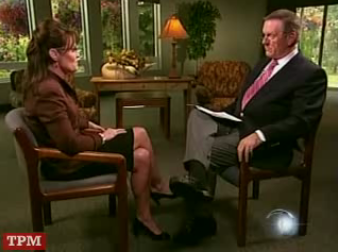
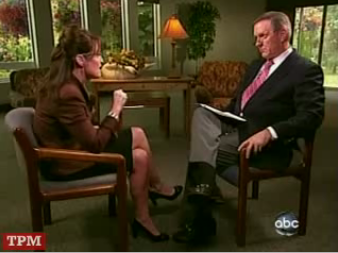
It doesn’t bother me that she didn’t know the term; I think I’ve heard “the Powell Doctrine” more often than I’ve heard “the Bush Doctrine” in the last eight years. What bothers me is her instinctive response to the question. Don’t just listen to what she says; that’s the part that’s prepared. Check out what she does. Note her posture at the beginning of the clip:

And about halfway through:

Her shoulders hunch. Her arm is raised and held in front of her torso. In her answer, you can see her lips purse. These are classic limbic system signals for “I wasn’t ready for this and now I’m afraid of screwing it up.” A confident person would remain physically relaxed during these questions, regardless of what she actually said. You can watch her try to regain her footing, literally; as she answers Gibson’s questions, she waves her foot in time with the key words of her statement, probably the ones she thinks put her back in control of the interview.

But her body language remains crouched against attack. She’s not confident, on a level that goes beyond coaching. You can’t coach for this.

So we have a candidate who wants to project the image of perfect confidence, but can be thrown off by a question she can’t answer. I’m calling her on it because the language of “blink” tries to imply instinctive confidence. That’s pretty much both the image and the shortcomings we have in the White House now, and in my view it was that fear of failure that psychologically helped lead to seven years of political swaggering and military force.

Thankfully, we’re at least two major events from the concern of watching President Palin face that kind of crucible. Even so, I trust this kind of read more than the next two months of airbrushed pablum I’m going to be fed, and I’m quite comfortable saying that I’ll be scared shitless if she finds herself behind the desk of the Oval Office.