- Mexican border fence being built “for national security” mysteriously stops at edges of property owned by golf courses and billionaire Bush donors.
- RIP, Gary Gygax. I spent most of 1985 in your Tomb of Horrors, and I thank you for it.
- David Pogue with a brilliant medley about the music and video industry. Same video embedded below from YouTube; the link is to the TED video feed.
- Google map of presidential primaries. Gotta love a popular vote difference of 0.013%.
- Statistical data from the United Nations now available online.
- Confidential military data repeatedly sent to British tourism site. Solution: British tourism site voluntarily shuts itself down because USAF won’t stop.
- Bruce Schneier brilliantly discusses the flaws in the “transparent society” model with a review of inherent power dynamics:
You’re stopped by a police officer, who demands to see identification. Divulging your identity will give the officer enormous power over you: He or she can search police databases using the information on your ID; he or she can create a police record attached to your name; he or she can put you on this or that secret terrorist watch list. Asking to see the officer’s ID in return gives you no comparable power over him or her.
Seven things
- Can Cheeseburger-in-a-Can possibly be any good? “No. Oh dear sweet shrieking Lord, no.”
- Sigma Phi Epsilon clearly does not give their brothers enough to do. But the big question: what happens when the iPhone hits 10,000 hours? They didn’t check? Wusses.
- Who do you want answering the phone at 3 AM? Brilliant spoof of Clinton ad.
- $31 million stolen from airport baggage while under TSA watch. Can we just give up on the whole “TSA keeps us safe” thing now? If criminals can take things out of the bags, then criminals can put things into the bags.
- Note to thieves: if you must rob a community organization, try to avoid bikers.
- The Billboard Liberation Front today announced a major new advertising improvement campaign executed on behalf of clients AT&T and the National Security Agency. Focusing on billboards in the San Francisco area, this improvement action is designed to promote and celebrate the innovative collaboration of these two global communications giants.

Billboard Liberation Front web site highly recommended for its uncanny spoof of marketing firms.
- I think I’ve neglected to mention the excellent webcomic Basic Instructions. This is excerpted from December 12th, “How to Destroy Society”; collect them all!

This week’s timewasters
Dada, thy name is Jim Davis: Garfield strips without the cat. Humorous if you enjoy laughing at the pathetic.
While I’m thinking about comic strips, A Friend Who Shall Not Be Named pointed me in the direction of the highly disturbing Sexy Losers comic strip. No, really, I mean it. Highly disturbing. But this relatively tame joke about incest is the most amusing thing I’ve read all year.
It’s all over, folks; a Diebold computer error has released the 2008 election results (according to The Onion). “This country is based on the fantasy that the government is the voice of the people.”
919,000 “suspected terrorists” on government watch lists. And growing.
Iraq war causes sub-prime crisis? Can’t say as I understand it, but then again, Joseph Stiglitz has a Nobel in economics, and he said so. But $3 trillion, or about 60 times more that Bush said it would cost when he was (literally) selling the war? That I understand. How many more times will we be forced to ask, “incompetence or malfeasance?”
Experimental 16.4 terabit per second fiber network created over a distance of 1,500 miles. Jesus. That’s my entire 120 gig hard drive in 0.06 seconds. Human eyeblink: 0.3 seconds.
Most of my readers won’t understand this, but those that do will find this hysterical, as I do: “GLTerminal emulates a 1970’s terminal monitor, complete with flaws in brightness, warped display curvature, and flicker. It even simulates baud rate lag. And! for extra verisimilitude, the character colors can be green or amber.”

The Onion: Dangerous idiom shortage strikes. “Citizens in the South and West have been hit by the dearth of idioms like babies bite the bedpost. Unless something is done before long to dry out the cinnamon jars, residents of Texas may soon cease speaking altogether.”
CES wrapup
Last show post wrap-up available at TidBITS, but as a special extra for blog readers, here’s a photoblog with some thoughts that were deemed either too rude or too inconsequential for publication.
|
|
|
|
|
|
|
|
|
|
 Yes, it’s true, I met
  Here’s a tip about adjusting the volume in your car stereo: if your subwoofers can make a man’s scrotum vibrate at 50 paces, it is too fucking loud.
 Microsoft demonstrates that either they continue to have their wooden ear for comedy, or that they’re being crippled by the writer’s strike.
 I, for one, welcome our new robot overlords. (This thing was huge.)
 Finally, a new personal record set for “longest line ever waited in at Starbucks”. And all the time I’m thinking, “if there were just one line for all of those frufru bastards with their lattes and cappuccinos, and another for us venti drip with room people, I’d be outta here by now.”
CES Day 2
My second products article at TidBITS, which ranges from MC Escher to tiny spacemen to motorized rollerskates (13 MPH!).
CES Day 1
My first CES product review, posted at TidBITS.
CES 2008 Day 1: Finding My Bearings
First TidBITS article is available here.
A GTD trade show survival tactic
The CES show floor is immense, and I’m staying at a hotel that’s too far away for convenient drop-off of the many pounds of conference brochures and swag I’m picking up. Therefore, a strategy for schlepping is essential.
More to the point, I’m writing up this show and I need a way to keep track of everything I’m getting, plus a way of organizing it for the various articles I’m planning to write. Ergo, my unofficial GTD system for trade shows:
First, you need inboxes. In this case, I’m using giveaway bags from the show floor. Today I was actually carrying two inboxes; a large paper shopping bag and a shoulder bag. Brand new items went into the paper bag, which I carried in my hand. Every 20 minutes or so, I’d transfer things into the easier-to-carry shoulder bag, and gave each item a quick perusal to see if it should be discarded.
Second, processing. The shoulder bag inbox is reviewed from time to time, when I can sit down with my MacBook. Items worth keeping get noted in an OmniOutliner document, and are transferred to my laptop backpack. Anything which contains information that I can quickly put into OmniOutliner and toss, I do so.
Third, post-processing. When I get back to my hotel room, everything in the bag gets dumped into various piles that act as my on-the-road reference system. I leave in the morning with completely empty bags. Next year, I’d seriously consider bringing a high-speed scanner for this step.
Result: lots of weight gets quickly distributed into the best bags for carrying them without causing too much fatigue, plus each bag represents an entry in an ad hoc filing system. The large quantities of atoms I receive act as automatic “mind like water” reminders for most of the writing I’m doing (especially once I put some categorization effort into them), and they’re shifted from being deadweight to useful objects as quickly as possible.
Bad CEA, no biscuit.
So much for the “all of this very heavy paper might be on this nice digital DVD right here” theory. I just love it when a directory shows up with these contents on my MacBook:
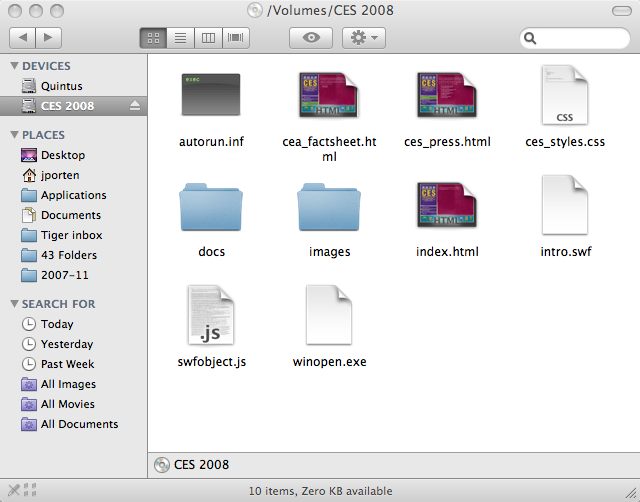
There are a few PDFs in the docs directory which might be useful, but really, I was hoping to leave all that paper at home….
Hello from CES
It’s press day here at the Consumer Electronics Show, and I’m officially a member of the first amendment brigades for the duration, thanks to an article I’m writing for TidBITS.
For those of you who have never been to (or heard of) CES, see below:

Note the phonebook-like directory of the conference; that’s covering up one or two conference addenda magazines below. Frommer’s publishes its own guide to the show, which I’m expecting to be handy. And in the front, the five Triptik style maps you need to navigate the various convention halls. I’m hoping to God that most of this stuff is on that conference DVD.
I’m already starting out the week with a new gadget: picked up a Sprint EVDO Palm Centro yesterday, on the theory that it would be easier than hunting down hotspots, and I could return it at the end of the remorse period. Problem is that I’ve already fallen in love with the speed boost over EDGE, so this might be a permanent addition to my telecom mix.
Which means, that once again I am that guy who carries around two cell phones. I hate being that guy.
My article for TidBITS will be focused on stuff of interest to the Mac community, but I’m actively looking for other things to write about. If any faithful VJW Conspiracy readers have any requests on interesting-looking things I should check out here, let me know.
Day zero conference swag award: Toshiba, who gave me a backpack made of enough ballistic nylon to build a fabric howitzer.
Food for thought
Introducing the bacon cheese baconburger: the “burger” being made of over a pound of ground bacon. I’d cast aspersions at such a meal, but it’s not that long since I had a boarburger with a side of poutine.
If you’re looking for reasons to commit hari-kari by baconburger, try listening to more country music. “[Stack and Gundlach’s] model explains 51% of the variance in urban white suicide rates.”
If you feel like having your mind nicely blown, check out these astronomical photos taken this year. I like the astral comet with the 13 light-year tail, myself. But the pictures of the dark matter really do take the cake.
Insert Rain Man reference here
Take your pick of goofy headline: “YouTube Inspires Schmuck to Risk Own Life”, or “Schmuck Has Entirely the Wrong Name to Work at Dunkin’ Donuts”.
If you ever meet someone claiming to be a “multi-touch engineer”, no, that’s not a euphemism. Although it damn well should be.
Drexel: the ugliest campus in America. But a great source for orange bricks, if you have a sledgehammer handy.
Gambler’s Review: Gold Coast
Rating: perfectly cromulent++.
No one goes to the Gold Coast for the glitz. This hotel is pretty much the working definition of the working man’s casino, with plenty of cheap games and plenty of cheap rooms. Plus they have bowling and bingo, and don’t knock it ’til you’ve tried it.
That said, if you’re looking to stretch a dollar (or stretch your trip as long as possible with as few dollars as necessary), this is an excellent choice. Room rates are frequently low, and go lower with casino or poker time. The restaurants are decent and cheap; the buffet is surprisingly good for the price. The room’s not much to look at, but hey, did I mention it’s pretty cheap?
Point scored: what might not be immediately obvious is that the Gold Coast is in an excellent location, and is a great bargain for that location. In your hotel, cheap eats and gambling. Across the street, the Rio. Across the other street, the Palms. Three very different casinos, very different crowds, and probably more entertainment options than you can fit into the average week.
If you want to go to the Strip, hop the free and frequent shuttle to Bill’s Gambling Saloon (formerly known as Barbary Coast), or grab the Rio shuttles to Ballys, Caesar’s, or Harrahs. Once you’re there, the monorail pretty much takes you everywhere else. I wouldn’t recommend the Gold Coast for anyone who wanted to spend significant time Downtown, but otherwise this place is a lot more central than it first appears.
Point scored: I didn’t realize it at the time, but Gold Coast offered one of the best poker games I found in a week in Vegas. 4-8 with a half kill was spreading two out of three times I stopped by, and the game was usually soft and rather friendly. Might be the high hand jackpots, which topped out at $2,000 for a heart royal at the time–and which I missed by a sole ace in one heartbreaking hand.
Gambler’s Review: Red Rock Casino
Rating: damn decent-.
As I mentioned in an earlier post, the Red Rock is just about the most beautiful hotel/casino I’ve ever laid eyes on. The hotel entrance and lounge bring to mind the sort of New York hotels that I don’t enter because I know I can’t afford them; extremely stylish and easy on the eye. And yet the place feels comfortable to a guy like me, who is not extremely stylish and whose easiness on the eye depends on the beholder. I sometimes feel like I’m underdressed to play poker at the Borgata in Atlantic City; the Red Rock doesn’t have the same pretensions. Like the Suncoast, it’s way out in the middle of nowhere so far as tourists are concerned; likewise, it offers a range of amenities geared to making sure you don’t need to leave the building for months.
The poker room is spacious and had 4-8 with a half kill running on both days I attended; on Sunday there was an 8-16 half kill. The 8-16 was the highest game I’ve played to date, and the first time since 2003 when I felt outmatched at a limit poker game; that said, I’d love to take a crack at this game when I come back for CES next month. Meanwhile, the 4-8 had the highest variability of any game I’ve seen in a single casino; on Sunday, it ranked among the softest games I’ve ever played, but on Monday it was only marginally easier than the 8-16 (possibly because 3 of the 8-16 players joined me there over the course of the evening).
Red Rock had a nice innovation at their tables. Instead of clocking in at the front desk, the dealer swipes your card at the table to track your time. A small LCD screen then tells the dealer the names of all the players, so he can say, “Your turn to act, Jeff.” It’s a small thing that greatly increases the friendliness of the game, since the players can pick up each other’s names over the course of play. Slight downside: the system also allows the dealer to clock you out when you’re out of your seat, so you can’t lock one up and keep the comp clock running while you’re in the bathroom or grabbing a smoke.
The casino itself resembles a theatre in the round: a central bar, followed by an inner circle of table games, a large outer circle of machines, followed by restaurants, shops, and spokes out to the rest of the hotel. It’s an easy place to get lost, but with a clear field of view to landmarks, it’s also an easy place to get reoriented.
Red Rock offered one game of note: a video poker machine that sells blocks of hands rather than the standard one bet per hand. At the quarter machines I played, $40 purchased 200 hands at any of six different games; games with weaker paytables compensated by offering more hands, up to 200 extra at the Jacks or Better. Once you start a round, you can’t change games or reduce your bet from the maximum.
For your forty bucks, you get a countdown from 200 onscreen, and your credit meter starts at zero. This is decremented by five every time you deal, and will go negative if you’re losing. At the end of 200 hands, you cash out whatever is on the credit meter. If you hit quad Aces on the first hand and you’re afraid you’ll put it all back, you can quit and cash out at any time, forfeiting the remaining hands.
Here’s what was fascinating about this structure: it’s not a video poker game, it’s a one-person tournament. You basically have two goals: one, finish with a credit meter above zero to get anything back; two, finish with a credit meter above 160 to win money. Beyond that, it doesn’t matter if your credit meter is zero or the theoretical maximum of negative 1,000; both scores leave you down forty bucks. I played three rounds, and lost them all with final scores of -360, -120, and -60; do the math and you’ll see that I did marginally better than I would have done playing the game straight, provided I played the same number of hands. On the flip side, towards the end of each round, there was absolutely no value in hitting trips or worse; these hands weren’t big enough to get my credit meter back towards positive.
I don’t have the calculus to do a mathematical analysis of the variance involved here, but I think it makes sense to play this like a tournament game rather than a straight video poker game. First, play the highest variance option you can find; with your losses capped at forty bucks, it makes sense to shoot for the bigger payouts. (On the machines I played, that was Double Double Bonus, paying 9-5-4.) It seems to me to be a poor bet to play the lower variance games like Jacks or Better; they give you more hands but a weak paytable, so you’re likely to lose money to the churn.
Second, adjust your play as you near the end of your session, if you’re negative. On the second-to-last hand of my last session, I was down 80 credits and was dealt four to a flush; I kept two to the straight flush for the Hail Mary. My guesstimate is that aggressive play adjustments kick in when the negative credit meter is just over the hands remaining times five; i.e., if you’re down 300 and you’ve got 50 hands left, it’s time to kick it up a notch. I’m not sure the exact inflection point where you keep 44 on a deal of 9944x, but I’m sure it’s in there somewhere.
Point lost: okay, so I know I sound cheap when I say this, but Red Rock is the first casino where I’ve asked about a poker rate and was told no. The impression they give is that the entire place is first class, so I can understand the marketing decision behind not discounting the rooms–that said, that’s the sort of bennie that is likely to get my butt warming one of their chairs in the future.
Gambler’s Review: Suncoast
Rating: damn decent- -.
I booked at the Suncoast primarily because I had two days extra on this trip without a room, on the same day that an offer arrived by email. I had a good experience last year at the Orleans, another Boyd property, so I gave this one a shot sight unseen.
My first impression when I got here: this is likely the best room value to be found anywhere in North America. My deal works out to $25 a night, and for that my room is quite likely larger than my first studio apartment was in DC. There are two separate seating areas, one with a couch, and one with a dinette table; king bed, plasma flatscreen TV, and a bathroom with a walk-in closet-sized anteroom for the sinks. The icing on the cake is the floor-to-ceiling windows with a view of the golf course and the mountains.
The disadvantage is that the Suncoast is pretty much in the middle of nowhere. There’s a shuttle to the strip, but it runs infrequently during the day. Plenty to do here, though, and close by a residential neighborhood, so this would be a good place for visitors with a car looking to do some shopping and eating in regular venues. I don’t fall into that category, but for me the location is balanced by the short cab ride ($13) to the gorgeous Red Rock Casino, where the poker room is hopping and the eye candy is plentiful. As the Red Rock doesn’t offer a poker rate on its rooms, I’d definitely consider staying here if I wanted to do my gambling there.
Not that the Suncoast is a slouch in the casino department; the poker room is large, and offers high-hand jackpots. I’m looking forward to getting back into the 4-8 half kill later this evening, after I catch a movie downstairs. Like the Gold Coast, 100% video poker machines are on offer if you know where to look.
Point lost: the downside of my hotel room is a bizarre hospital disinfectant odor. Not strong enough to get me to change the room, but then again, I’m a smoker and I have no sense of smell. People with normal senses might have hated this room. I don’t know if I’m more bugged by the odor, or by wondering what the hell happened here that required it.
Point lost: when going to the buffet on your 38th birthday, the last thing you want to hear is the cashier asking if you’re eligible for the 50-and-over discount. I know I’m a bit dissipated after a week in Vegas, but sheesh.
Addendum: if I were writing this review today (upon checkout) rather than two days ago, I’d drop the rating a full letter grade to Perfectly Cromulent. The reason: that 4-8 half-kill game that I spotted the day I got here didn’t spread again until an hour before I left, which led to long periods of wandering around the casino deciding what to do. The 2-4 half kill ran pretty much 24-7, but a game that goes to high stakes at 3-6 just doesn’t do it for me. Needless to say, this put the cherry on the “you’re staying a long way from anywhere” sundae that didn’t bug me at first.
Naturally, the 4-8 that fired up immediately before I had to leave was damn near perfect: mostly loose passive, two tight-aggressive players who allowed me to dial in their play in five minutes, and just as I left, my favorite maniac from Sunday who makes every pot go to 100 chips or higher. Somehow, this happens every time I leave Vegas.
Gambler’s review: Sahara Las Vegas buffet
Rating: meh++.
Schlepped across town to the Sahara tonight to catch a show, so I decided to stop in at the dirt cheap Sahara buffet: $6.95 for dinner if you have a player’s card. You’re getting just about what you pay for here; most of the food gives the impression that it might once have been worthwhile, before it spent the last three weeks on the steam table. (Note: I’m here on a very slow Tuesday; it’s likely that the place actually improves when it’s busier and they have to replace the trays.)
I do kind of like the college cafeteria approach here; everything is self-serve. Get your own beverages, pick your own table. The waitstaff seems to be here to bring your napkins and maybe take away your plates (apparently only after you leave). The result is that you don’t have to wait for that cup of coffee you really need right now.
Point scored: the pizza and taco bar is pretty darn good, and in fact is making up the bulk of my meal.
Point scored: seven bucks, and they have lox on the buffet. At dinner time. That sort of blew my mind. Unfortunately, they serve same with minibagels that resemble hockey pucks, so I resorted to inventing the lox and cream cheese burrito. Mmmmmmm.
Red and Blue: Global Harming
Replying to Brian’s post about taking adaptive measures to global warming. This was too long for a comment.
Let’s say that, for some reason, you find the editor of the Colorado Springs Gazette to be a more credible source than ninety-odd percent of climate researchers, and you decide that the best political course of action is to do nothing until the crisis is obvious. I’ll stipulate that at such time, we’ll have much more evidence than we do now, so it’s therefore likely that we will have a better set of possible solutions at that future date than we do today.
That leaves three problems.
1) I hope you’ll agree with me that there is some level of human suffering caused by climate change today. (Such as the inhabited island that is no longer above sea level.) Your argument can be rephrased as, “there is not enough suffering yet to call this problem a crisis, therefore we Americans (who will be among the last to suffer) will wait until the suffering and death has increased.” Do you have benchmark total in mind for how much suffering and death is required before we agree it’s crisis time?
2) You further presume that there is a linear progression into crisis; unfortunately, climate science tends to disagree with you on this point. You have tipping points, chaotic effects, and runaway processes, such that there are potential effects that outstrip our ability to respond, even presuming continued technological progress. How well would America and Europe respond if the impact is a Dust Bowl cutting off the food supply? Or if England gets dropped into a Siberian temperature zone? Or Boston and Seattle?
3) Finally, note that the same country that you expect to become levee-building ubermenschen is the one that built the levees in New Orleans. At what point do you expect our government to be blessed with such wonderful foresight, and how many cities do you expect to lose in the process?
On the bright side, it will probably be much more scenic to take a boat to Manhattan than the subways, and you’ll be able to get off right at the 34th floor, saving much elevator time.
Something old, something new for Christmas
Care for a new retelling of A Christmas Carol? Or, actually, a very old retelling…. I’m definitely in the bah humbug crowd, but I still think you should check out this radio broadcast (MP3 link) from Christmas, 1938, starring Lionel Barrymore as Scrooge and narrated by Orson Welles.
Actually, as I’ve mentioned before, the entire Mercury Theatre archive is well worth your time.
On Google nudity
Ralf raises some interesting points about the nature of privacy while we all live under the satellites, but I’m actually not sure if I agree with his conclusions. I’ll propose a few hypotheticals to explore the premise, and I’ll preface by saying that I’m not talking about legality or morality — both of which have things to say about public nudity — but about our personal sense of privacy.
Ralf links to a woman who was caught sunbathing by the Google Earth Orbiting Gnomes, and points out that although the picture is fuzzy enough to avoid being salacious, you can still determine the woman’s address — and hence a name and identity. So while we don’t quite know what it’s like to see her naked (or rather, we know what it’s like for an extremely nearsighted person to see her naked), we know the fact that she likes airing herself out in flagrante, which in and of itself invades her privacy.
I can agree with this, simply because she’s doing this on her roof, and not her backyard. Unfortunately, her sense of privacy is limited to two dimensions; she was considering whether she’d be visible from the ground, and forgot to think about Low Earth Orbit. I think it’s safe to say that if she lived next door to a high-rise apartment with balconies, the roof would have had the same connotations as her backyard for her sunbathing plans.
So where, then, should we have an expectation of privacy? Inside our houses? Unfortunately, most of us are forced to live amongst technologies that allow strangers to gather information about our private domiciles; generally, these are called “windows”. The other day, I accidentally knocked down the blinds off my window and haven’t yet bothered to stand on a chair to put them back up; therefore, since then, I’ve been turning off my lights before walking around naked at night, thanks to a rudimentary understanding of light refraction.
Presumably, I have the right to walk around naked in my own home, the line being drawn at a certain gray area of what might be considered exhibitionism since I don’t have the blinds up. Doing the can-can naked in front of the window, even in the privacy of my own home, might cross a few lines since the window itself creates a non-private zone.
Which leads me to a story I heard at Penn this year, about two undergraduates who decided to have intimate relations standing up against a large window, with the lights on, at night. Said students were clearly visible to other students living in the high rise next door, many of whom owned digital cameras, and some of these pictures made their way onto the Internet. Lawsuits and much academic debate commenced, which to me largely obscured the obvious point, namely: if you’re gonna get yourself laid in full view of a thousand horny undergraduates, you’re a damn fool if you don’t expect them to watch. The sole difference between a high rise dorm room (with those lighting characteristics) and the middle of College Green is that you’re allowed to have sex there, whereas getting busy in the center of campus would probably inspire one of that thousand to throw a bucket of water on you.
This is one of the areas where I actually do see an inevitable end of certain forms of privacy, as personal video cameras become ubiquitous enough that they’ll be impossible to avoid. I’m predicting an outgrowth of pre-sexual revolution chastity for today’s prepubescents, since they’ll be coming of sexual age at a time when the taboo against starring in an amateur porn video will still be in force, but the risk that any sexual partner might decide to make and publish one will be extremely high. (This is also a risk for us grown-ups, but once sexual habits are established, they’re very difficult to change.) Ultimately, though, it seems inevitable that the taboo will fall away as it becomes so common; when the teenagers of 2040 commonly find out that their mother was a hit on YouTube in 2010, their reaction is likely to be, “What’s the big deal?”
Likewise, I can certainly see why that sunbather would feel that her privacy was invaded, and it’s a shame that she’ll have to curtail her hobbies accordingly. But we should expect to see a resumption of rooftop nudity, as soon as we collectively realize that there’s no particular reason to consider that private.
Amtrak mobit… er, moblogging
Writing from Amtrak on the way to Philly. We left after the usual 15-minute departure delay, during which time the board listed us as on-time, and I overheard one woman complained that she’d have to wait another hour because they told her this train had left. I went to the cafe and asked if I could sit there, since the last time I tried this I proceeded to debate with the Amtrak employees for 20 minutes over whether I was allowed to. (The answer, in hierarchical order of people I spoke to, was no, yes, no, yes, no.) This time, like every other time, the answer was, “Sure. Why’d you ask?”
As I took my seat at the table, I noticed two drops of water on the cushion and a premonition told me to take the other side. Around 10 minutes later during acceleration, a long stream of water poured out of the ceiling onto the spot where I’d have been sitting. I noticed that the opposite corner of the same ceiling panel was directly over me, deduced what might happen when we were braking, and moved to another table.
Mentioned this to the conductor. “Oh, yeah,” he says. “Happens every time it rains, all over the train. No way of knowing where it’s going to come down.”
Does the A in Amtrak stand for Aeroflot?