I was called out today on my past errors, in Brian Greenberg’s eulogy for the Bush administration. Specifically, among Bush’s many other accomplishments which I did not anticipate, he refrained from large-scale invasions of more than two foreign powers, and he did not pardon himself or others for war crimes.
In both cases, not only do I freely admit to being wrong, but I also freely admit that I was hoping to be wrong. Unlike some who find it “disappointing” when they don’t find weapons of mass destruction, I’d rather have a less-than-perfect oracular record when that means that the world is a better place than I expected it to be.
Likewise, I’ll stipulate that I was glued to my news feed for the 72 hours prior to the Obama inauguration, watching for and expecting last minute abuses of presidential power. I can say that I am pleasantly surprised by Mr. Bush’s actions here as well.
I don’t have any good explanations for why Bush declined to be a greater failure in his last two months in office, but if I had to guess, I’d say he was just too damn tired. After the election, you just got the feeling that he was ready to go home, and the following two months were his prolonged Senior Week before graduation.
Brian points out all sorts of specific ways in which the United States currently differs from a 3,000-mile wide smoking nuclear crater, and suggests that each of these specifics are reasons to be grateful to 43 for not screwing up more.
And there, well, I have to agree with him from a philosophical perspective. It is, in fact, possible to envision a Platonic dystopia in which George W. Bush was even more misfeasant than he was in reality—say, by using Syria to stage the Iraqi invasion—which logically implies that he is actually less than perfectly awful. At the same time, it’s hard to figure out what you’d put on that Certificate of Merit.
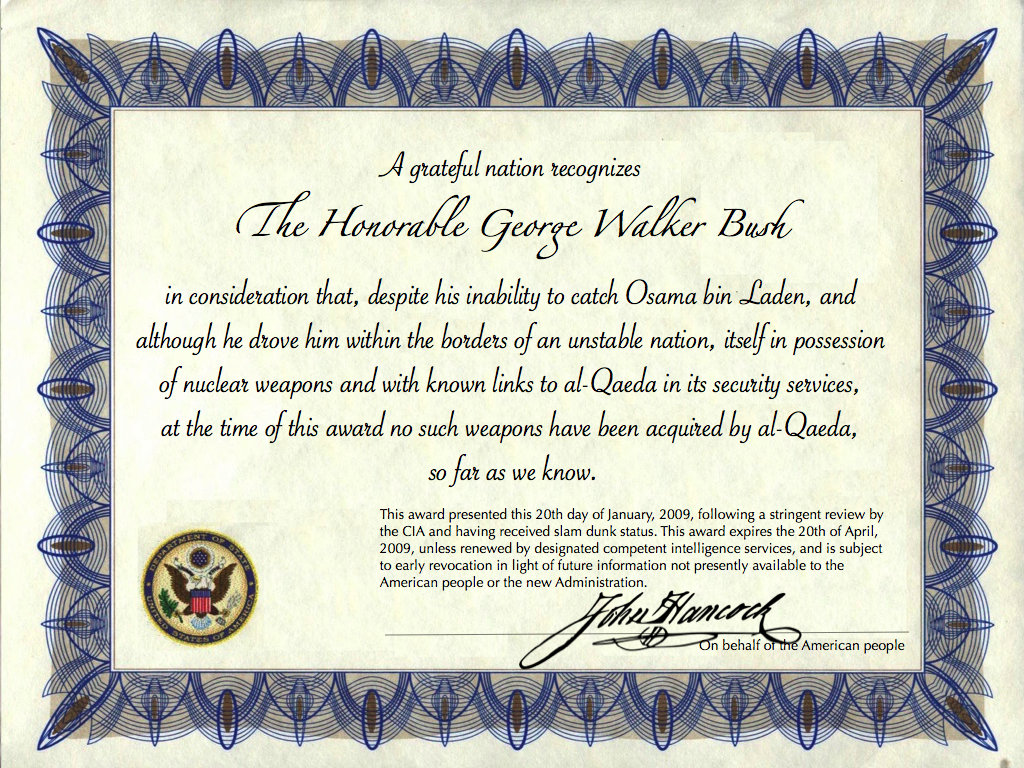
I find it amusing how often Bush defenders (and the man himself) raise the question of how he’ll be viewed by history as a way of deflecting present criticism and debate, as if history doesn’t count until suitably large numbers of decades have passed. Unfortunately, history already has very clear opinions: Of presidents who entered into temporarily popular, but extended and unsuccessful wars. Of presidents who suspended Constitutional rights for some people, especially of a particular racial group. Of presidents who presided over great shocks in the nation’s economy after implementing their own brand of economic policy.
If you know history, it is not difficult to guess how history will view Mr. Bush. And it is not difficult to guess where he will end up—like other failed presidents, he himself will be the answer to the trivia question, remembered rarely, and generally thought of only when the next list is drawn up comparing Tyler to Buchanan to Harding to Bush.
Or perhaps, like Hoover, he’ll be remembered mainly in contrast to the president who succeeded him.