Slightly cross-genre

It has just come to my attention that, over on PaperbackSwap, the “users who want this book also want” suggestion for a particular title are:

Perhaps if I had been shelved in that section, I’d have had a second printing.

In related news, with the discovery that there is a web site which will give you my book for free, we have broken all previous pricing records. The new record is expected to stand until another web site decides to actually pay you to take their copy.

Switching gears for a serious comment:

It occurs to me that it’s been 12 years since my book was published. There were 6,000 copies, total. Of which I just found 61 copies still available for sale on the Internet. Plus 84 copies in libraries, ranging from the Library of Congress to Singapore. I find this amazingly cool.

Any theoretical physicists among my readers?

Okay, here’s a question that’s puzzling me. From Brian Greene’s talk on superstring theory, a frame showing the usual means of picturing the general theory of relativity:

Earth warps 3-dimensional space, creating the gravity pull on the moon

In the center, you’ve got the Earth warping three-dimensional space, depicted here as the two-dimensional plane in which the Moon orbits. (Actually, it’s depicted as the plane one lunar radius below the orbital plane, as the Moon appears to be rolling.) The Moon is pulled by the Earth in the same way that a marble would roll down a similar incline. Simple enough.

Here’s the question: in which direction is space warped? That is, to depict the warping of a 2-dimensional plane, you need three dimensions; we use depth here to show the inclination of the moon to head back into the Pacific basin from whence it came. Therefore, since it’s actually 3-dimensional space that’s being warped, presumably the direction of the warp must be into a fourth spatial dimension.

The obvious answer is that the direction of the warp is an artifact of the depiction: 3-dimensional space doesn’t need a direction to warp, any more than you need three dimensions to stretch out a flat sheet of pizza dough. But if that’s the case, if we’re talking about a warped three-dimensional space, don’t we need an external 3-dimensional frame of reference against which to measure the changes to our own space? And if so, is that a purely mathematical construct, or is there a physical analogue?

I have a gut feeling that this question is either blindingly brilliant or blindingly obvious. Probably the latter.

Spectacular offworld eclipse

I’m two years behind on this image, which was brought to my attention by Carolyn Porco’s TED presentation:

Saturn eclipse of the sun, viewed from Cassini

Not visible in this resized version, but clearly evident in the original, is Saturn’s moon Epimethus, whose gas jet from its south pole is responsible for the thin ring outside the main body. If you’re wondering why a saturnine moon has a gas jet, Porco discusses the theory that it’s caused by internal high temperatures and pressures acting on a subsurface body of water, vented through fissures in the surface. These are ideal conditions for the creation and eventual discovery of life.

Which is perhaps not so surprising, as the only known body in the solar system which has life on it also makes a cameo appearance. In this excerpt, you can see Earth (normally occluded by solar light), waving hello.

Earth viewed from Saturn\'s rings

On American nobility

I’m crossposting a comment I made in the ongoing thread over at Brian Greenberg’s ISBS, mainly because I think it’s a fine bit of writing that I don’t mind showcasing here. Secondly because it’s a bit far afield from our original topic. Thirdly because I’m reasonably sure I still have readers who think I have my head firmly lodged up my ass on matters military and geopolitical, and I’d like to hear them tell me why.

That said, while comments here are welcome, you’re invited first to click over and join us on Brian’s site.

Finally, there are edits made to this excerpt, primarily because what I thought flowed well as part of a comment reply looked too much like an ad hominem phrasing when lifted out of context. Brian and I disagree on a great many things, but fundamentally, if I’ve gotten heated in my debates with him over the years, it’s because I can never understand how a fine mind and great heart like his can see things so differently. It concerned me that my original text would give the opposite impression here, so I took the liberty of making minor changes.

Excerpt follows:

You seem to be saying that, regardless of what the political objectives are of the war, or whether the war can be judged a success on various terms, that there is a value imbued to the effort by the sacrifices made and pride taken by the participants. You call this nobility.

You might be surprised to hear that I agree. I think it is noble to risk dying for one’s country or one’s beliefs. Ideally, an American soldier going into combat would feel the moral force of both behind him or her. What I find exceptionally noble is that, for many soldiers — and I expect the true numbers here are impossible to quantify — they no longer believe that the war was for country or American values, but they continue to fight for their comrades in arms. To have only that remaining, to have lost the notion that there’s a greater meaning behind the sacrifices they’re asked to make, makes what is going on all the more poignant.

Put another way: you and I both know that the way we shape our military, it really doesn’t matter how badly clusterfucked a military operation becomes. Our forces will fight for each other when nothing else remains. I think this makes it exceptionally important that our leadership and our citizens should be exceedingly stringent and miserly before we decide that it’s time to open up the can of American whoop-ass.

I expect you to reply now that for most of our troops, perhaps the majority, perhaps the overwhelming majority, this is not what they are fighting for — that they remain convinced that this effort is for country and American values, and that this justifies their continued sacrifice.

And this brings us to the million-casualty question. If it is inherently noble to die for your country or your beliefs, then are the Iraqi insurgents imbued with nobility? Were the 9/11 hijackers? Palestinian suicide bombers? Timothy McVeigh?

If the answer is no, then you cannot argue that such actions are inherently noble. You have to argue that the specifics of your country or your values are what imbue that nobility to dying for your cause. Which leads to only two possible conclusions regarding the assumption of nobility for American forces dying overseas:

1) The death of American soldiers is inherently noble because America is the Great Exception; alone among all nations, causes, and beliefs in the world, we are touched by God, or have some other similarly irrevocable status by dint of being American.

2) The death of American soldiers is causally noble because Americans fight for what we deem to be decent, honorable, and right, and because America has acted for over two centuries as a beacon disseminating our notions of these values to the world, much to the betterment of humankind.

Personally, I’m a fervent believer in the second formulation, and I equally believe that, in this time and in this case, we have eschewed too much of our own morality to continue to believe this of ourselves. We have invaded nations which did us no harms to justify war, in the manner of our worst historical enemies. We have killed, tortured, and imprisoned the innocent, and we have continually lied to ourselves and to the world about the worst of our excesses and the worst of our actions.

Then, to justify ourselves, we wrap ourselves in the undeserved nobility that we ascribe to the poor bastards we ship overseas to fight and die, in that remaining scrap of the best of ourselves. The more we believe in the indomitable nobility of the American soldier, the more we can believe in the indomitable nobility of America, regardless of how much we shit upon our cherished beliefs.

Yes, the American soldier does maintain this nobility, because they continue to die for their country, or their beliefs, or their friends. But we do not deserve to bask in any dim reflection of their sacrifice.

Which leads me to the last of what you said, which I see as the dying gasp of American triumphalism to which we cling, that Tony Snow and by extension America’s leadership “likely knew more about what it’s like in Iraq than either of us ever will”. Because we desperately want to believe that our leaders are wise, and informed, and will act in the best interests of the nation.

Unfortunately, there is ample evidence and history that this simply has not been true. Our leaders have ignored what they could have known, rejected what they did not want to hear, lied continuously, and have broken faith consistently with both the American people and the American soldier. They could have chosen otherwise; they had the resources and the tools to be informed and act wisely, and they chose instead to act on gut instinct and a near-messianic belief in their own rightness and closeness to God.

This is why I think we all should have been terrified when we heard administration officials refer to their opponents as the “reality-based community.” Those who supported the Bush administration, the neoconservatives, and the warmongers collectively made our horror into a national joke. The price we’re paying now is precisely because if America deserves the mantle of righteousness, it is because we have had for two centuries a partial track record of being right. Of being correct. Of seeing the world for what it is and speaking of what it could be.

You can’t be right if you don’t know of whence you speak. And that is why I can’t mourn the death of the spokesman for those who have been so catastrophically, blindly, blisteringly, painfully wrong, and who spoke in America’s name as they were doing so.

On presidential spokesperson fatalities

Over on I Should Be Sleeping, Brian and I are having an interesting discussion on what’s appropriate following the death of a perhaps-controversial celebrity. By all means, join us if you care to make my opinions sound less inappropriate (or more so).

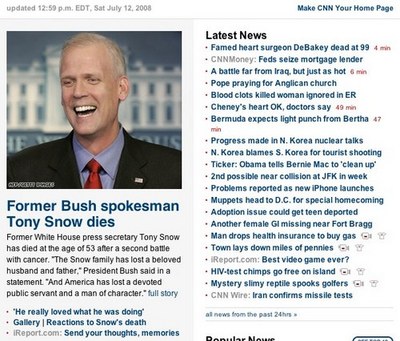
Speaking of inappropriate, I swear to God, when I saw this screenshot on another blog:

Screen shot of Tony Snow obit from CNN.com

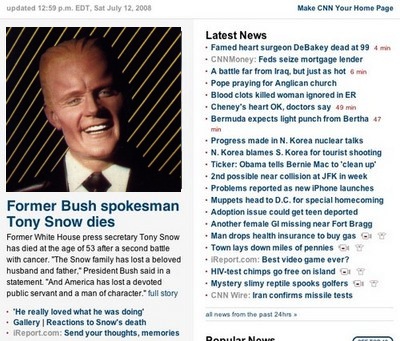
What I thought I saw was this:

CNN.com shot altered to include picture of Max Headroom

According to Wikipedia, Max Headroom [1985] “presents a dystopic look at a run-down near-future dominated by television and large corporations.” Interesting time for that image to pop up, subconsciously or not.

Subconscious blogging

I had a dream last night in which I met Bill Gates in a high school gymnasium (not my own) and he gave me a Masonic handshake.

I completely forgot about this dream until I was reminded of it by Wil Wheaton’s tweet involving masonry, which suggests that my conscious life is not much less weird than my subconscious.

US presidents, collated by first name

No, I have no idea why I suddenly needed to know this. I just did. Herewith, all of the first names of US presidents, followed by a count, sorted both ways:

Abraham: 1
Andrew: 2
Benjamin: 1
Calvin: 1
Chester: 1
Dwight: 1
Franklin: 2
George: 3
Gerald: 1
Grover: 1
Harry: 1
Herbert: 1
James: 6
John: 4
Lyndon: 1
Martin: 1
Millard: 1
Richard: 1
Ronald: 1
Rutherford: 1
Theodore: 1
Thomas: 1
Ulysses: 1
Warren: 1
William: 4
Woodrow: 1
Zachary: 1
James: 6
John: 4
William: 4
George: 3
Andrew: 2
Franklin: 2
Abraham: 1
Benjamin: 1
Calvin: 1
Chester: 1
Dwight: 1
Gerald: 1
Grover: 1
Harry: 1
Herbert: 1
Lyndon: 1
Martin: 1
Millard: 1
Richard: 1
Ronald: 1
Rutherford: 1
Theodore: 1
Thomas: 1
Ulysses: 1
Warren: 1
Woodrow: 1
Zachary: 1

I guess that’s one more way in which the Democrats were historic this year. We’ve never had a Barack or a Hillary, but we’ve had plenty of Johns.

IndyMac failure bodes ill for entire Mac community

LOS ANGELES—Scores of pundits who have invested their credibility in the safety of Macs found themselves scrambling today to defend the collapse of IndyMac Bank, potentially endangering the life savings of many Mac users.

John Reich, director of the Office of Thrift Supervision, said of the massive security failure: “The IndyMac situation is unique. It does not signal a direction for the industry as a whole.”

A former Mac user pledges her eternal fealty to Windows.

These comments were echoed by many tech pundits. Rob Enderle of The Enderle Group said, minutes after the announcement was made: “I’ve long said that people were foolish to rely on Mac for their financial needs. IndyMac — and indeed, the entire Mac community — placed their faith in FDIC, SEC, and ISBN compliance for far too long, disregarding the need to instead join forces with larger organizations that have captured the bulk of the financial computing industry.”

Cory Doctorow, contacted by phone at the Codefürhackersnötdweebsgoddammerung 2008 conference in Berlin, said of the collapse: “As I said on Boing Boing in 2005, Mac’s collapse was clearly inevitable after they refused to open-source their ATM network.”

Security consultants and Mac industry observers were flummoxed by the news. Adam Engst, publisher of the TidBITS Mac online newsletter, said, “Wait. What are you talking about? Are you one of Tristan’s friends?” Andy Ihnatko of the Chicago Sun-Times was unavailable for comment, possibly due to temporary hypoxia from the gales of laughter and the distinguishable sound of milk coming out of his nose.

Individuals who have invested in Mac are insured by the federal government up to $100,000, but any Mac user who has purchased the Photoshop Creative Suite has an investment of several times that amount tied up in their Mac. Mac’s failure is expected to have ancillary impact in numerous similar industries, including Granny Smith apples, Pixar, and the use of the Chicago font in movie titles. (See sidebar: “Sprint bracing for massive Impact sales as millions abandon their iPhone 3G”.)

Jeff’s annotated states

Picking up on a meme from Brian, where Jeff has been, domestic version:

Mainly I’m doing this because I so rarely get to use the skill I picked up at 9 years old, memorizing the states in alphabetical order:

Arizona: business trip to Phoenix consulting for an ISP. I still have their T-shirt, which says “Think Globally, Hack Locally” on the back. I remain amazed by the concept of water misters at outdoor restaurants, and by my client’s warning that during the half mile hike from my hotel to his office, I’d need to stop for bottled water twice. He was right.

California: For some reason, I have been to Disneyland twice as often lifetime as I’ve been to Disney World. No, I can’t explain it either.

Colorado: I am informed that, in 1970, at the age of 1, I roadtripped to Denver. I can probably infer that several states between Indiana and Colorado should be filled in thusly, unless our Chrysler had long-distance high-jump technology. But as I feel I’m stretching to include Colorado in the first place, I’ll leave this stet.

Connecticut: Visiting friends and Weird Al. It was that kind of trip.

Delaware: Home of cousins, fraternal little brothers, and frequent tax-free shopping. I recommend the Chinese buffet.

District of Columbia: my adopted hometown. Brian has been there too. I’ve seen him there.

Florida: I’m Jewish. Of course we drove to Miami Beach regularly.

Georgia: Several student conferences. I distinctly remember hanging up my towel to dry, and at the end of the day, it was damper than when it started. I can’t believe anyone ever lived here before the invention of air conditioning. When Sherman burned Atlanta, you sure couldn’t tell the difference on the basis of ambient heat.

Illinois: Two trips to Chicago, plus numerous opportunities for quality time at O’Hare.

Indiana: ex-girlfriend at Earlham. Cf. Ohio.

Maine: Various trips to hazardous biofacilities as a child. (Why adults think children will be excited about seeing sharks, I’ll never know. I remember thinking, “no thank you, I like all of my fingers equally.”) Most recent excursion was for Steve and Courtney weddingpalooza with Brian.

Maryland: one of two adopted home states.

Massachusetts: various conferences and friends in Boston, which is a city that shares this with Canada: I could see myself living there if it weren’t so frickin’ cold.

Minnesota: I don’t think this counts, but numerous Northwest airlines stopovers. Need to get back sometime. Minneapolis, Ann Arbor, and Madison are three places where I say to myself, “wait, I’ve never actually been there? But I’ve planned on going so many times!”

Nevada: Yeesh, like you couldn’t guess this already.

New Hampshire: Where we went Wal-Mart shopping while in Vermont.

New Jersey: adopted state #2. I’m known to spend far too much time in Atlantic City.

New York: I recall stopping off in Buffalo once on the way to Toronto. Otherwise, not much memorable about this state. You can safely give it a miss.

North Carolina: aside from drive-throughs, I attended a wedding here once just past the Virginia border. Ranks equally with my attendance at the Billy Graham Crusade for Jeff thinking, “these people are not like me.”

Ohio: aside from a memorable and ill-considered trip to Cleveland, responsible for the transmutation of another girlfriend to “ex” status, I once walked to Dayton airport from the middle of I-70 after a consultation with my bus driver proved that I would not otherwise make my plane. Have you seen North by Northwest? It was like that, but without the plane shooting at me.

Pennsylvania: my home state. Roadtrip from Philadelphia to Pittsburgh sometime if you want a true appreciation of how frickin’ large the western states are.

Rhode Island: home of Brown University, where the Store 24 is closed from 11 PM until 7 AM. No, I couldn’t figure it out either.

South Carolina: home of South of the Border and all the priapic plastic crap you could ever want.

Tennessee: roadtrip to Vanderbilt, which means that I think Kentucky should also be included in the marked states, but I can’t remember if that’s where we were faced with the prospect of a grit breakfast. Most memorable moment: the Vanderbilt scoreboard said we were the “Penn State Quakers”. Second most memorable moment: a friend and I, neither of us who would expect such an honor, scored the lowest purity test scores on the Band bus.

Texas: another cheat, as I got stranded in an airport for an hour on the way to Vegas. I can’t say this counts, but I also can’t say that I feel like I’ve missed much.

Vermont: Jeff’s opportunity to warp young minds at a peace camp. Also where I learned three chords on a guitar on another roadtrip.

Virginia: a briefly adopted home state, but not in the places where cigarettes are cheaper.

Washington: An evening layover in Seattle during Jeff’s “Every Time Zone Except the Maritimes” trip. DC-St. Louis-Seattle-Vancouver BC-Calgary. Hmmm, I guess Missouri is also on the states I don’t count.

West Virginia: Harpers Ferry weekend. Will probably head back, now that they have poker.