iPhone musings, 2.0

Current Jeff level of geeklust for an iPhone: 8 out of 10.

Odds that I’m actually going to buy one: about 1 out of 3.

Why? Because right now, it looks like Apple and AT&T are still crippling the single feature that I actually need: Bluetooth tethering, aka DUN. In plain English, this means “your Internet connection can actually go places other than your cell phone.”
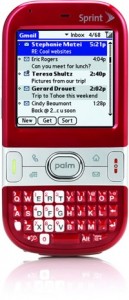
Back in January, I jumped ship on T-Mobile to switch to Sprint EVDO and a shiny new Palm Centro. The Centro is perfectly cromulent as a smartphone; as you can see in the attached photo, the user experience can best be described as “the wet dream of a road warrior… in 1998.” The Palm OS is getting very old and very creaky; it works well (especially in comparison with the Windows Mobile devices I’ve used), but most of the time when it’s doing something particularly cool, it feels like an Atari 2600 that’s been upgraded with a 16K RAM cartridge. Compared to the iPhone 2.0 demoed last week, there’s simply no contest.

But there’s one thing it excels at: dropping that EVDO connection into my MacBook anytime, and mostly anywhere. I’ve found that 50-60 KBps covers most of my Internet needs (exceptions: podcast updates, video streaming, and large software downloads), and I’m unwilling to go without it. At the time of this writing, AT&T is yet to say whether they’re going to offer 3G tethering with the iPhone.

Which is somewhat galling, as they offer tethering for Blackberry phones, and the iPhone 1.0 is perfectly capable of tethering with an unofficial hack. So if tethering is a must-have feature, there’s only one option right now: keep the Sprint phone and get an AT&T plan just for the iPhone.

Geeklust, yes. $200 a month worth of geeklust? Not so much.

Plan B is to go with the iPod Touch, which strips out a few iPhone features (notably GPS, which is on the “want but don’t need” list), but with Wifi-only access, its biggest drawback is that it’s only supercool about 50% of the time. That problem could be easily solved if the Touch could be used to tether to my Sprint phone—which again, is something I can do easily with my Palm TX. (Why would I tether a Palm TX to a Palm Centro? 480×320 screen resolution, versus 320×320 on the Centro, and a faster CPU.) Again, the jury is still out on whether this will be allowed by the corporate masters at Apple and AT&T.

I’ve been a happy uncustomer of AT&T Wireless since around 2000, when they hit me with a $500 charge for “going over” my unlimited minute rate plan. Yes, that still boggles my mind a little bit. My gut tells me that all of the various technology crippling I’m talking about here is based on some bean counter’s analysis at AT&T, not Apple, and I generally avoid companies with policies like these on general principles.

(For that matter, I’m less than impressed with my AT&T experience today, the first weekend that they’re offering the new free Wifi connection at Starbucks. I’ve been to two different hotspots today, and it’s taken over 15 minutes each time to reach the login screen, a sure sign that the servers are completely overloaded. I suspect that the same thing will occur when the 3G hits the shelves for a few weeks.)

I have no doubts whatsoever that these problems will all be solvable with third-party software upgrades; I have many doubts that Apple will allow such applications to be sold in the Application Store. But it’s for this reason that I’m very happy to hear that Apple is no longer sharing in the revenue of AT&T’s service contracts; since Apple keeps 30% of the revenue stream from application sales, that means they’re incented to offer software like this, and less likely to be in a binding contract with AT&T that prevents them from doing so.

Only time will tell whether that means we’ll see applications such as two-way tethering, VOIP, and (dare I dream?) online poker on the iPhone; give me the first and I’ll buy one. Give me the third and I’ll buy two.

Being deaf is even more annoying than it should be

So I’m spending a few months partially (and temporarily) deaf in one ear, thanks to evolution’s apparent inefficiencies in constructing working ear canals in my ancestors. (Or alternately, its inefficiency in preventing them from breeding, which implies I shouldn’t bitch too much about it.)

I’ve written the following extremely simple AppleScript to act as a tester to see how my ear is doing from day to day:

repeat with i from 1 to 7
	set volume i
	say i
end repeat

In my left ear, which is apparently working at full Jeff audio input capacity, I can easily hear “one”. In my right, I’m usually coming in between three and four. Trying to find a reference to translate “set volume i” into decibels so I can figure out exactly how bad my hearing is, but in the meantime relative results have been useful for comparison.

In any case, my hearing is bad enough that I have trouble with dialog at movies, so here’s the checklist for getting decent service with assistive devices, for those of you who also find yourselves temporarily needing them.

  1. Get to the theater early. The listening devices will be in a big box and tangle of wires near the ticket booth, and there will be a delay while they fetch one that might work.
  2. Different theaters use different devices, so you’ll want to spend some time figuring out what dials and switches to use. Ask for a manager if you need help; the box office won’t know diddly about these.
  3. Insist on fresh batteries; I’m currently hanging at Starbucks waiting for the next show because my gizmo fritzed out right after the previews.

Taking a moment to vent: when I stepped out of the theater to get a new unit, the box office took the unit, took old batteries out of another one, and gave it back to me with those. I turned it on and got nothing; handed it back to her and said, “I’m deaf—can you hear anything with this?” “No.” “Then give me a new one like I asked you.” By this time, I’ve missed five minutes of archeological exposition and they’re looking at me with a bovine expression, not quite understanding that when I pay for a movie, I want to see it.

Incidentally, this is reinforcing my general belief that this is why movie theaters—and Hollywood—are in for a very rough time; when you pay ten bucks for a movie, what I believe you’re paying for is the experience of seeing it with theater-level quality. I caught Iron Man the other day, and most of the film was pocked with threading and other signs of wear. Now I’m seeing a movie I can’t hear. In both cases, I’d get a better experience watching the film on my laptop; my headphones are built-in audio assistive devices, thankyouverymuch. Theater number 1 was out of popcorn “butter”, theater number 2 treated me like crap when I complained about the audio; both are generally considered flagship theaters in the DC region. This does not exactly reinforce my desire to go to theaters.

My alternative is to wait twelve weeks and rent the DVD, or wait four to six weeks and download the DVD off the Internet. Oops, strike that—a DVD-quality version is available already, months in advance of the legal DVD release. A good theater can compete with this, and can continue getting their twenty bucks on a regular basis for admission and popcorn—the problem is that the industry seems to care so damned little about providing good theaters.

The true cost of war

Listening to a Diane Rehm podcast about returning Iraq and Afghanistan veterans suffering from post-traumatic stress disorder and depression. The statistics show that the majority of these soldiers are basically screwed. One in five vets have one of these diagnoses; around 40% of them receive treatment.

Quick show of hands in the audience: how many people are surprised by this? Aside, of course, from administration planners.

Putting this into some raw numbers: according to Iraq and Afghanistan Veterans of America, 1.5 million troops have served in those wars. Using the specific percentages from the podcast, that means 240,000 soldiers with PTSD, and 240,000 more with depression; 105,000 have both diagnoses and are counted in each of the above figures, for a total of 300,000 veterans suffering from mental illness as a result of their deployment. 180,000 go undiagnosed or untreated. (No, the numbers don’t add up; I’m extrapolating from percentages in the podcast which have the same discrepancy.)

Personally, this is one of the things that made the $3 trillion cost of the Iraq war plausible to me; the 300,000 with potentially debilitating mental illnesses is only one of many long-term effects of the war that tend to be overlooked by the many Americans who were gung-ho about opening a can of whoop-ass on our enemies. And that’s really the issue here — having built the most powerful military in human history, a cursory reading of the last sixty years shows that Americans are damned comfortable with using it, certainly more comfortable than our self-image as peaceful would imply.

I think it’s well past time that we teach ourselves about the human costs of war. Never mind the 84,000 civilian casualties in Iraq; our tin ear to the suffering of foreigners is probably not going to change in the near future. But we certainly care about American casualties.

So next time, just for a lark, wouldn’t it be interesting if the American people demanded an accounting from an administration about what the statistical results are likely to be from going to war? We have six years of data from these wars; it shouldn’t be much of a leap to be able to say that if we send 100,000 soldiers into combat, we can expect N deaths, lifelong injuries, and mental disorders resulting. The 1.5 million figure above includes combat and noncombat positions; the odds of both injury and mental illness directly correlate, obviously, to combat exposure. We certainly collect specific data on combat casualties, and can use these when considering future deployments. Improvements in medical techniques between wars serve to both reduce the number of combat deaths, and increase the number of lifelong injuries; for these reasons, an accurate estimate should include both predictions based on past statistical results, as well as trendline modifiers for new techniques.

In this war, of course, any such predictions offered by the DoD would have been remarkably rosy, as their original plans were to roundtrip the troops there and back in under a year. But such predictions were never made; no one ever said, “For every 1,000 troops we send, 200 are coming home mentally ill, 21 are coming home wounded, and three come home on their shields.”

If such predictions had been made based on Gulf War I, the numbers would be far lower for killed and wounded in action — although long-term disability numbers are substantively similar. The Vietnam KIA and WIA equivalents are 22/1,000 and 117/1,000 respectively. Perhaps there might have been greater introspection upon the shift from a “shock and awe” war to one of occupation, if the shift from lower towards higher ratios were remembered as possible consequences.

What I do remember about the runup to war was talk of the financial cost we’d bear — numbers that were also laughably low and, to be charitable, optimistic. (To be accurate, lies and malfeasance.) Sure, there was plenty of vague talk about troop casualties, in that sort of “gee, it’s awful” tone we use about such things. I expect that my analysis here is extremely amateurish compared to the casualty estimates that they have at the Pentagon for any given military action, and these numbers should be made public and part of a public debate about any future war we consider. Some wars will still be self-evidently worth their predicted cost, but for others, perhaps it might be worth teaching America just what it takes to open up the can of whoop-ass.